


Table of Contents
- Hoover Awnings vs Delray Awning: A Side-by-Side Comparison
- Awning Installation Cost: What Drives the Price Difference
- Awning Fabric Durability: Sunbrella vs Standard Canvas in South Florida
- Awning Contractor Warranty: What Each Company Actually Covers
- Awning Maintenance: Long-Term Costs and Service Options
- How to Evaluate Customer Reviews and Ratings for Both Companies
- Which Awning Contractor Should You Choose for Your Project?
- Frequently Asked Questions
Last Updated: October 7, 2026
Hoover Awnings vs Delray Awning: A Side-by-Side Comparison
Choosing between Hoover Awnings vs Delray Awning comes down to more than a quote.
An awning is a shade structure made from fabric stretched over a metal frame and mounted to a building or freestanding support.
Here’s why that gap exists, and how to read it before you sign anything.
A lower number usually means a lighter frame, a thinner fabric, or a shorter warranty, and those differences show up fast in South Florida sun and salt air.
Below, we walk through cost drivers, fabric durability, warranty coverage, maintenance, and how to read reviews for both companies. We also explain where a custom manufacturer fits if neither option matches your project.
Awning Installation Cost: What Drives the Price Difference
Awning installation cost depends on five things: size, fabric grade, frame material, mounting method, and whether the job needs a permit. Two quotes for the same patio can differ by thousands because each company weighs those factors differently, and because some quotes quietly leave items out.
Here’s what moves the number most:
- Fabric grade. Entry-level canvas costs less up front but fades and weakens faster under UV exposure. Solution-dyed acrylics like Sunbrella hold color longer and typically run a meaningful step above entry-level canvas per yard.
- Frame material. Aluminum is standard; heavier-gauge or powder-coated frames cost more and resist wind better. Retractable units add arms, a cassette, and often a motor, which is the single largest jump in a quote.
- Mounting type. A fixed awning is cheaper to build than a retractable one with a motor and arms. Freestanding and pergola-style shade sits in a different price tier again.
- Permits. Many jurisdictions require an awning permit, and some storefronts also need a sign permit. Fees and review time vary by city and zoning district, and the contractor’s time to pull the permit is a real line item.
- Site conditions. Stucco, concrete, and wood each need different anchors and prep work. Second-story installs, tight access, and electrical work for a motor all add labor.
What a line-item quote should show
A quote you can actually compare breaks into these buckets. If any bucket is missing, that’s the question to ask before you sign:
- Materials, fabric by name and grade, frame gauge and finish, hardware and fasteners.
- Fabrication, cutting, sewing, thread type, and any custom patterning for odd angles.
- Labor, installation hours, number of installers, and any lift or scaffold rental.
- Permit and engineering, permit fee, plan review, and any wind-load or engineering documentation required by the jurisdiction.
- Electrical, motor, wiring, switch or remote, and whether an electrician is subcontracted.
- Warranty terms, what’s covered, for how long, and who pays labor on a claim.
Why we don’t publish a price list
Pricing depends on fabric selection, frame specifications, and site conditions. Ask every contractor for a line-item quote that separates materials, labor, hardware, and permit fees. A single lump-sum number hides where the savings come from.
A practical way to compare is to request the same scope from each bidder, same dimensions, same fabric family, same mounting type, same permit handling, and then compare the line items side by side. When the scopes match, the price gap tells you something real about materials and labor. When the scopes don’t match, the price gap is mostly noise.
A quote that undercuts the others by a wide margin usually skips something: permit handling, upgraded anchors, or a real warranty. Ask which line item was cut before you celebrate the savings.
The most useful question in a quote review isn’t “what’s the total?”, it’s “what’s not in this total?” Get the exclusions in writing before you compare numbers.
Awning Fabric Durability: Sunbrella vs Standard Canvas in South Florida
Fabric durability separates awnings that last three summers from ones that last fifteen. Solution-dyed acrylic, the category Sunbrella belongs to, holds color and resists mildew far better than standard cotton-canvas blends in coastal humidity.
South Florida weather is the real test. Salt air, afternoon storms, and year-round UV break down cheap fabric fast.
What most guides miss is that the fabric is only half the equation. Stitching, thread type, and how the cover is tensioned matter just as much. A premium fabric sewn with weak thread still fails at the seams.
At A to Z Awnings & Marine Canvas, we build every cover from Sunbrella fabric, and we back both the material and our workmanship with a 10-year warranty.
| Fabric Type | Color Retention | Mildew Resistance | Typical Lifespan |
|---|---|---|---|
| Solution-dyed acrylic | Excellent | High | 10-15 years |
| Standard canvas blend | Fair | Low | 3-5 years |
| Vinyl-laminated | Good | High | 7-10 years |
Awning Contractor Warranty: What Each Company Actually Covers
An awning contractor warranty is only as good as its terms, and the terms are where companies quietly differ. Ask for the written warranty before you compare quotes, not after.
Three things decide whether a warranty is real:
- What’s covered. Fabric, frame, motor, and labor are often separate line items. Some warranties cover the material but not the install.
- How long. A 10-year warranty on both workmanship and material is stronger than a 10-year material warranty with a 1-year labor cap.
- Who honors it. A local manufacturer that services its own installs is easier to hold accountable than a dealer passing along a third-party guarantee.
A warranty comparison framework you can use on any bidder
Rather than guess at terms, put the same questions to every contractor in writing and compare the answers line by line:
| Question | Why it matters |
|---|---|
| What is the workmanship term, separate from the material term? | Workmanship covers the install; material covers the fabric and frame. They expire on different clocks. |
| Is labor included on a claim, or parts only? | Parts-only coverage can still leave you paying for the crew that does the repair. |
| Who performs the repair, the manufacturer, a dealer, or a third party? | The party that built and installed the awning is usually the fastest to service it. |
| What are the exclusions? | “Acts of weather,” improper cleaning, and commercial use are common carve-outs. |
| Is the warranty transferable if you sell the property? | Transferability affects resale value and is often overlooked. |
| What is the response window for a service call? | A stated response time is more useful than a vague promise of support. |
After-sales support and service response
Warranty terms only matter if someone answers the phone. When you evaluate a contractor, ask how service requests are handled: whether there’s a dedicated service line, whether repairs are scheduled on a set cadence, and whether the same crew that installed the awning handles warranty work. A local manufacturer that keeps its own fabrication shop can usually turn a repair faster than a dealer that has to order a replacement cover from an out-of-state supplier.
Call us today for a free estimate →
Homeowners can be impacted by warranties that exclude “acts of weather,” which in this region covers almost everything. Read the exclusions first.
The warranty question to ask is simple: “If the motor fails in year four, who pays for the part and who pays for the labor?” If the answer is vague, the coverage is thin.
Keep your written warranty, your line-item quote, and your permit paperwork together. When a claim comes up years later, the original scope of work is what determines whether the repair is covered.
Awning Maintenance: Long-Term Costs and Service Options
Awning maintenance is cheap when it’s routine and expensive when it’s ignored. A yearly cleaning and inspection keeps fabric, stitching, and hardware in shape and catches small problems before they become replacements.
A practical annual routine looks like this:
- Rinse the fabric with mild soap and water, then let it air dry fully
- Inspect stitching and seams for pulling or rot
- Check mounting hardware and anchors for rust or loosening
- Test retractable arms and motors for smooth operation
- Look for mold or mildew, especially on north-facing and shaded panels
- Re-tension or adjust the cover if it sags
Repair versus replace is the question we hear most. If the frame is sound and only the fabric has faded or torn, recovering the awning usually costs less than a full replacement. If the frame is bent, corroded, or the motor has failed twice, replacement makes more sense.
A local contractor can inspect the frame and give you a straight answer. That inspection is also the moment to confirm your awning still meets current wind-load and permit requirements.
How to Evaluate Customer Reviews and Ratings for Both Companies
Customer reviews and ratings tell you more than a star average, if you read them correctly. Look at the pattern across recent reviews, not the single best or worst one.
Here’s how to weigh what you find:
- Recency matters. A five-star review from six years ago says little about how the company operates now.
- Look for specifics. Reviews that name a fabric, a timeline, or a service call are more useful than “great job.”
- Check business reputation signals. A BBB rating and accredited business status, plus proper state licensing, are worth verifying directly.
- Read the complaints. How a company responds to a bad review often reveals more than the review itself.
For any contractor, confirm the license number on file. Ours is Awning Contractor Rachel Mendes Cramer, license #20-AE-21988-X, serving Broward and Palm Beach under #U-22481.
The Better Business Bureau’s guidance on checking a business is a good starting point for verifying complaints and accreditation before you commit.
Which Awning Contractor Should You Choose for Your Project?
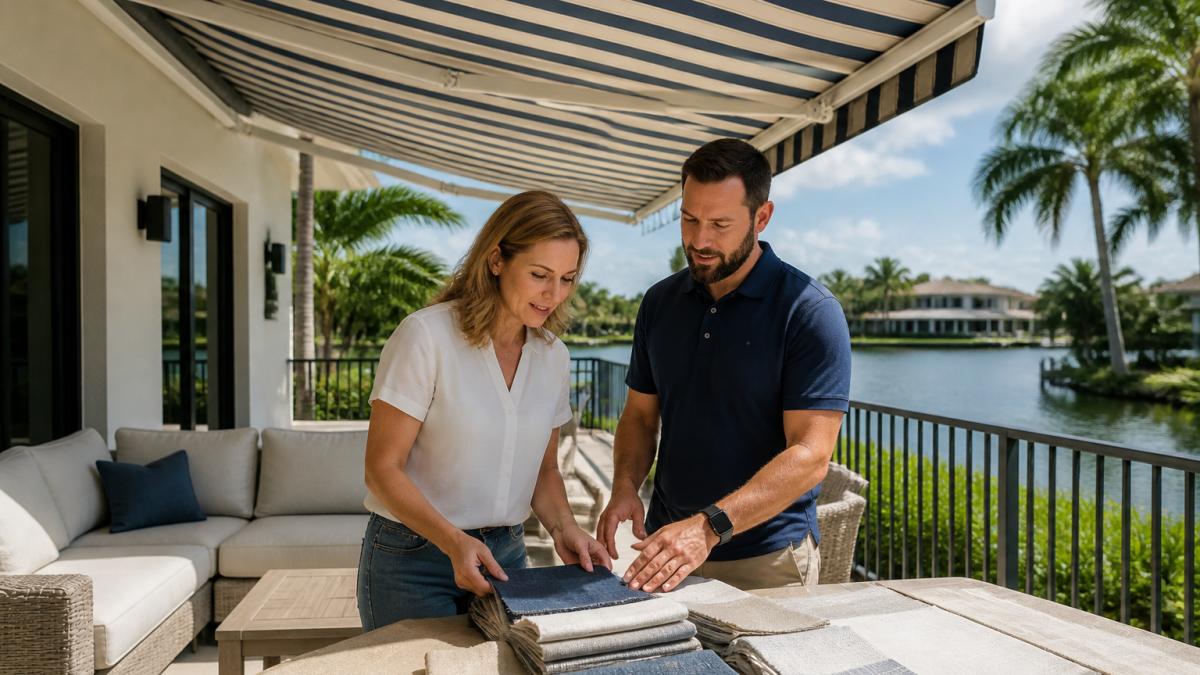
The right choice depends on your project, your timeline, and how much customization you need. For a simple stock-size cover, a general installer may work.
Here’s how to decide:
| Your Situation | Best Fit |
|---|---|
| Standard-size patio cover, tight budget | General installer |
| Custom angles, odd dimensions | Custom manufacturer |
| Restaurant or commercial storefront | Commercial awning specialist |
| Boat enclosure or marine canvas | Marine canvas fabricator |
| Existing awning needs repair | Full-service manufacturer |
A to Z Awnings & Marine Canvas manufactures custom awnings to fit specific dimensions, offers hundreds of Sunbrella fabrics, and covers both workmanship and material with a 10-year warranty.
Before you commit to anyone, confirm licensing, get a line-item quote, and read the warranty exclusions. The Florida Department of Business and Professional Regulation lets you verify a contractor’s license status directly.
Frequently Asked Questions
How should I compare awning installation quotes from Hoover Awnings and Delray Awning?
Request itemized quotes that break down frame material, fabric brand, hardware, labor, and permit fees. Ask whether the price includes removal of your old awning and disposal. Verify each contractor’s license number with the state and confirm they carry liability insurance and workers’ compensation. A lower bottom-line number often means thinner fabric, lighter-gauge aluminum, or a shorter warranty. Compare the full scope, not just the total.
What warranty details should I check before choosing an awning contractor?
Look for two separate warranty periods: one for workmanship and one for materials. Workmanship coverage protects against installation defects like loose brackets or poor stitching, while material coverage protects against fabric fading, cracking, or frame corrosion. Ask whether the warranty is prorated, who handles labor costs on a claim, and whether it transfers if you sell your home. Get all terms in writing before signing.
How long do awning fabrics typically last in South Florida’s sun?
Solution-dyed acrylic fabrics like Sunbrella carry a 10-year limited warranty against fading and loss of strength under normal conditions. In South Florida’s intense UV environment, uncoated or lower-grade canvas may show visible fading within three to five years. Fabric durability depends on UV exposure, salt air, and whether the awning is retracted during storms. Regular cleaning extends fabric life regardless of brand.
What are the common problems with retractable awnings?
The most frequent issues are motor failure, fabric mold from trapped moisture, bent arms from wind damage, and stitching that separates after years of sun exposure. Motor problems often stem from water intrusion or undersized units. Mold develops when awnings stay wet and are rolled up damp. Wind damage occurs when awnings are left extended during gusts. Choosing a contractor with strong warranty coverage and a maintenance plan reduces these risks.
Choosing an awning contractor is a long-term decision, and the cheapest quote rarely delivers the longest life. A to Z Awnings & Marine Canvas builds custom residential, commercial, and marine shading solutions, backed by a 10-year warranty on workmanship and Sunbrella material and a fabric library of hundreds of options. Call us today for a free estimate and get a shade solution built to survive South Florida weather.