


Last Updated: November 4, 2026
Quick Summary
Retractable awnings and adjustable pergola covers are the strongest outdoor shading solutions for most patios and decks, giving you shade on demand. Shade sails and umbrellas are lower-cost options, while permanent gazebos and pavilions suit year-round use but may require permits.
- A retractable awning attaches to the house and shades the zone right against the wall.
- A $150 umbrella lasting two summers costs more per year than a $600 umbrella lasting eight.
- Budget shade usually fails at the hardware and seams, not the fabric face.
- Clean fabric shade twice a year with mild soap, rinse, and dry fully before storing.
- Start with three calls before installing: your building department, HOA, and insurer.
Table of Contents
- Comparing the Best Residential Outdoor Shading Solutions
- Retractable Awnings and Pergola Covers for Patios and Decks
- Inexpensive Patio Shade Ideas That Still Hold Up
- Waterproof Outdoor Shades for Rain and Humidity
- Deck Shade Ideas for Windy Areas and Coastal Properties
- Permanent Outdoor Shade Structures: Gazebos, Pavilions, and Shade Sails
- Permits, HOA Rules, and What to Check Before You Install
- Request a Free Estimate for Custom Outdoor Shading Solutions
- Frequently Asked Questions
Comparing the Best Residential Outdoor Shading Solutions
Outdoor shading solutions are structures and fabrics that block direct sun, cut heat, and protect a patio or deck from rain and glare.
Here is the short answer. Retractable awnings and adjustable pergola covers are a strong fit for many patios. Shade sails and umbrellas can be lower-cost options. Permanent gazebos and pavilions suit year-round use, though they may require permits.
Below, we break down each option by cost, wind performance, rain protection, and upkeep, then show you what to check before anyone drills into your wall.
Shade Type Comparison at a Glance
| Shade Type | Rain Protection | Wind Performance | Upkeep | Best For |
|---|---|---|---|---|
| Retractable awning | Good with quality fabric | Retract before storms | Low to moderate | Most patios and decks |
| Pergola with adjustable cover | Good when louvered | Good if anchored | Moderate | Year-round outdoor living |
| Shade sail | None | Good if tensioned well | Moderate | Budget coverage, open yards |
| Patio or market umbrella | None | Poor in open wind | Low | Flexible seating areas |
| Gazebo or pavilion | Excellent | Excellent | Low | Permanent entertaining space |
| Outdoor roller shade | Good | Good when secured | Moderate | Porches and screened rooms |
| Pop-up canopy | Moderate | Poor unless weighted | Low | Occasional events |
Retractable Awnings and Pergola Covers for Patios and Decks
Retractable awnings and pergola covers give you shade on demand, and that flexibility is why we recommend them first for most homes. Benefits of retractable deck awnings for your home explains what this shade type offers before you decide.
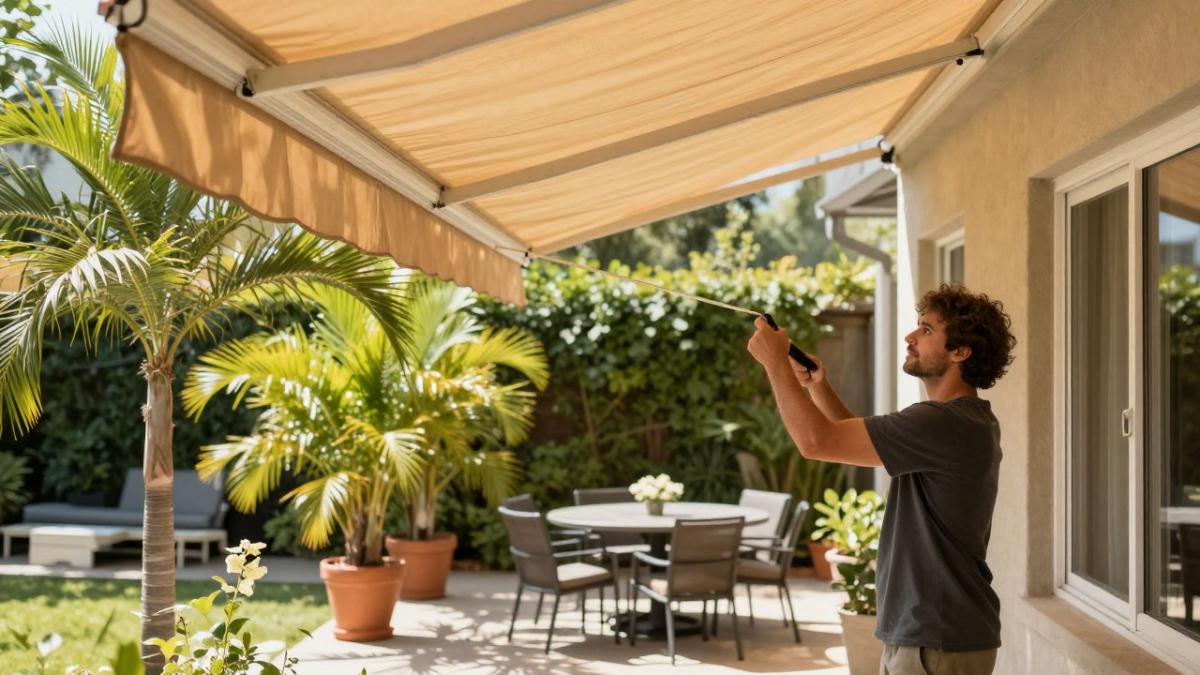
The practical difference comes down to mounting. A retractable awning attaches to the house, so it shades the zone right against the wall, which is usually where people sit.
Custom sizing matters more than most buyers expect. Off-the-shelf widths rarely line up with a real patio edge, and a poor fit means sun sneaking in at the sides all afternoon. A custom-made awning sized to your opening can help solve that.
Inexpensive Patio Shade Ideas That Still Hold Up
Cheap shade is easy to buy and hard to keep. The inexpensive patio shade ideas that actually last share one trait: they use decent fabric and hardware instead of the thinnest option on the shelf. But “inexpensive” is not the same as “low cost of ownership,” and that distinction is where most budget shade purchases go wrong.
Here is a realistic way to think about it. A shade product’s true cost is purchase price plus installation plus maintenance plus replacement, divided by the years it actually serves you. A $150 market umbrella that lasts two summers costs more per year than a $600 umbrella that lasts eight.
What budget shade actually costs
Pricing depends on size, fabric, hardware, and installation requirements. For current pricing or a quote for your project, contact A to Z Awnings & Marine Canvas directly.
Installation is the line item budget shoppers often forget. Shade sails need posts, footings, and tensioning hardware, and that structural work can add significant cost beyond the fabric itself.
Where the cheap option fails first
Watch out: the failure point on budget shade is almost always the hardware and the seams, not the fabric face. Frames bend at the joints, crank mechanisms strip, and stitching gives out at stress points long before the canopy itself wears through. That is why a cheap umbrella with a good canopy still dies early, the frame quits first.
Fabric grade matters just as much. Entry-level polyester with a thin coating sheds water and blocks sun when new, but the coating cracks and peels after a season or two of UV exposure, and the fabric then fades, mildews, and tears.
The budget picks that hold up
Shade sails are the strongest budget pick for open yards. A tensioned triangle or rectangle of UV-stable fabric blocks a surprising amount of sun and needs no power or moving parts. The catch is anchoring.
Market umbrellas come next. They cost little, move wherever you need them, and store away in winter. In open wind they tip, so weight the base and close them when storms roll in.
Pop-up canopies are fine for a party and wrong for permanent use. The frames bend, the tops fade, and one gust can end the whole thing.
A common mistake is buying a cheap umbrella and expecting it to last three summers. It will not. Run the cost-per-year math before you buy, and the “expensive” option often turns out to be the cheaper one.
Waterproof Outdoor Shades for Rain and Humidity
Waterproof outdoor shades need two things: a fabric that sheds water and stitching that resists rot. Most shade fabrics block sun well. Far fewer handle months of humidity without mildew creeping into the seams. This is the section most shade guides skip, and it is the one that determines whether your investment lasts five years or fifteen.
How water actually damages shade fabric
Water damage is rarely about the fabric face. It is about what happens at the seams, the hems, and the attachment points. When water wicks into stitching and sits there, the thread weakens, the seam opens, and the fabric separates.
Solution-dyed acrylics, including the Sunbrella fabrics we work with, are generally known for holding color well. For a closer look at which fabrics hold up to moisture and sun, see the best awning fabrics for Florida.
Watch out: water pools on any fabric stretched flat. Awnings with a proper pitch shed rain; flat canopies sag and collect it until the frame complains.
A maintenance schedule that prevents premature failure
A simple seasonal routine extends the life of any fabric shade product more than any single purchase decision.
Call us today for a free estimate →
- Monthly during use: Brush off debris and check tension. Loose fabric flaps, and flapping wears seams and hardware.
- Before storm season: Retract or remove fabric where the design allows, and inspect stitching at stress points.
- Twice a year: Clean with mild soap and water, rinse thoroughly, and let it dry fully before retracting or storing. Mildew thrives on fabric put away damp.
- Annually: Check frame fasteners, anchor points, and any coating or finish. Touch up rust or corrosion early.
Fabric shade products generally last longest when they are cleaned on a schedule and stored dry rather than left up year-round.
Lifespan expectations by material
Lifespan depends heavily on climate, sun exposure, and care, so treat any general patterns as rough guidance rather than guarantees. Our 10-year warranties on workmanship and Sunbrella material reflect the long-term durability we build into our products.
Deck Shade Ideas for Windy Areas and Coastal Properties
Wind decides more shade projects than sun does.
Retractable awnings work here if you retract them before storms, which is the whole point of the retractable design. Fixed fabric structures need heavy anchoring and reinforced attachment points.
Shade sails can work in wind, but only when tensioned correctly and anchored to posts set for the load. A loose sail is a sail that fails.
Odd-shaped decks make all of this harder, since standard rectangular products leave gaps. Custom shading solutions for odd shaped decks covers options built to fit your specific layout.
Permanent Outdoor Shade Structures: Gazebos, Pavilions, and Shade Sails
Permanent outdoor shade structures trade flexibility for stability. A gazebo or pavilion is a fixed roof over a defined area: excellent rain protection, strong wind resistance when built to code, and low day-to-day upkeep.
Shade sails sit in a middle category. They are permanent in the sense that they stay up, but they are fabric, so they need re-tensioning and eventual replacement.
Which one fits depends on how you use the space. If you entertain year-round and want a structure that feels like a room, a pavilion earns its cost. If you want coverage over an open area without walls, a sail does the job for far less.
Permits, HOA Rules, and What to Check Before You Install
Permits and HOA rules trip up more installations than any technical problem. Many jurisdictions require a permit for attached awnings and freestanding structures above a certain size, and HOAs often restrict color, placement, and visible hardware.
Start with three calls: your local building department, your HOA, and your insurer. Ask what drawings they need and whether wind-load information is required. A professional installer will know the local requirements and can supply the documentation.
Watch out: skipping the HOA step can mean removing a finished installation at your own cost.
Whether to hire out or do it yourself is its own decision.
Request a Free Estimate for Custom Outdoor Shading Solutions
Custom shade is not a shelf product, and that is the point. Every patio, deck, and porch has its own dimensions, sun angles, and wind exposure, and a made-to-measure solution accounts for all three.
At A to Z Awnings & Marine Canvas, we manufacture and service custom residential, commercial, and marine shading.
We also repair and maintain existing systems, so if your current awning has mold or failing stitching, we can tell you whether repair or replacement makes more sense.
Ready to price your project? Our custom patio awnings Fort Lauderdale buying guide covers local options and how to request a custom quote. Call us today for a free estimate.
Frequently Asked Questions
What are the best outdoor shading solutions for a sunny backyard?
The right choice depends on your space and climate. Retractable awnings give adjustable coverage over a patio or deck and retract when not needed. Pergolas with adjustable covers offer a built structure with airflow. Shade sails suit open yards with strong sun, and patio umbrellas work well for flexible seating. For permanent coverage, gazebos and pavilions hold up over time. Compare wind exposure, rain needs, and budget before deciding, then get a custom quote for sizing.
What is the cheapest way to provide shade in my backyard?
Inexpensive patio shade ideas include market umbrellas, pop-up canopies, and shade sails, which cost less upfront than built structures. Natural shade from trees and vines also lowers heat over time. Keep in mind that cheap fabric fades and frames bend in wind, so budget for replacement. If you want shade that lasts a decade, a custom awning with a warranty often costs less per year of use than replacing bargain options every couple of seasons.
Are outdoor shades waterproof or just water-resistant?
Most outdoor fabrics are water-resistant, not fully waterproof. Woven acrylics like Sunbrella shed light rain but let heavy water through seams, while PVC-coated polyester and vinyl laminates block water more completely. For waterproof outdoor shades, look for sealed seams and a fabric rated for rain. In humid coastal climates, breathable water-resistant fabric often performs better because it resists mold. Ask your installer which fabric suits your rain exposure and how to clean it.
Which outdoor shading solutions work best in windy areas?
Deck shade ideas for windy areas should prioritize fixed or tensioned structures over loose fabric. Permanent outdoor shade structures such as pergolas, pavilions, and tensioned shade sails handle gusts better than umbrellas or pop-up canopies, which should be taken down. Retractable awnings with wind sensors retract automatically when gusts pick up. Coastal properties also need corrosion-resistant hardware and fabric with strong UV and salt resistance. Anchor points and professional installation matter as much as the fabric itself.
What is the difference between a pergola and a retractable awning?
A pergola is a freestanding or attached frame with a slatted or louvered roof, often with an adjustable cover, and it stays up year-round. A retractable awning mounts to the house and rolls out fabric when you want shade, then retracts for storage. Pergolas offer more architectural presence and airflow; awnings cost less and give flexible coverage. Both can be motorized. Your choice depends on whether you want a permanent structure or adjustable shade over an existing patio.
The best residential outdoor shading solutions are the ones sized to your actual space and built for your actual weather. That starts with a conversation, not a catalog. Get started with A to Z Awnings & Marine Canvas and get shade you can use every day of the year.