


Table of Contents
- Repair vs Replace Outdoor Awning: Which One Makes Sense?
- The 50% Rule, Explained
- Signs Your Awning Needs Repair or Replacement
- When Repair Beats Replacement
- When Replacement Is the Smarter Choice
- Awning Fabric Replacement Cost vs. Full Unit Replacement
- Retractable Awning Motor Repair: Worth It or Not?
- Awning Maintenance Tips That Delay Replacement
- Warranty, Insurance, and Environmental Factors
- The Bottom Line on Repair vs Replace
- Frequently Asked Questions
Last Updated: September 23, 2026
Repair vs Replace Outdoor Awning: Which One Makes Sense?
The decision to repair vs replace outdoor awning systems usually comes down to one question: is the frame still sound? If the hardware and structure are solid, re-covering the fabric is almost always the smarter move. If rust, bent arms, or a dead motor have compromised the frame, a new unit is the better investment. At A to Z Awnings & Marine Canvas, we walk South Florida homeowners and restaurant owners through this decision every week.
The 50% Rule, Explained
The 50% rule is a simple benchmark: if a repair estimate comes in at more than half the cost of a new awning, replacement usually wins. It gives you a fast way to compare repair vs replace without guessing.
The 50% rule is a starting point, not a verdict. A quote just under the threshold on a 15-year-old frame with rust at the hinges can still be a bad deal, because the next failure is already forming.
Signs Your Awning Needs Repair or Replacement
Most awning problems announce themselves long before total failure. The trick is knowing which signals point to a simple fix and which mean the frame is giving out.
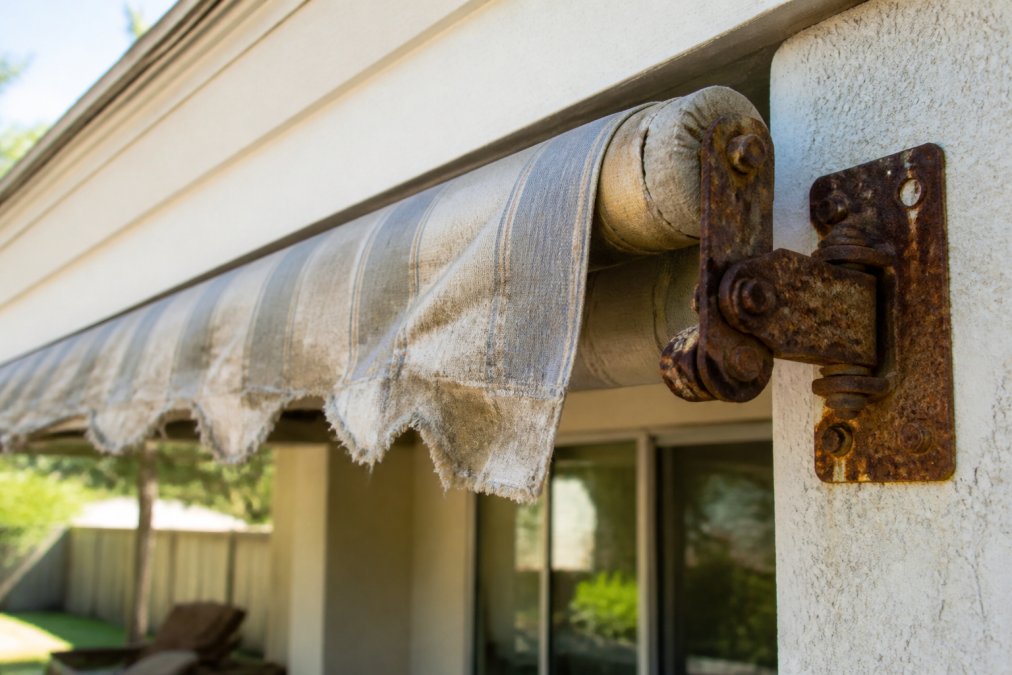
Visual Diagnostic: What to Look For
Run this check twice a year, ideally before and after storm season:
- Fabric: small tears, thinning weave, or mildew that returns after cleaning point to re-covering.
- Stitching: popped seams along the valance or main panel mean the thread has failed from UV degradation.
- Frame: flaking paint, rust at the hinges, or a bent awning arm signal structural trouble.
- Tension: sagging fabric or a cover that flaps in light wind means the fabric tension is gone.
- Motor: grinding, slow retraction, or a unit that won’t move at all points to mechanical failure.
- Mounting: loose brackets or pulled anchors are a safety issue, not a cosmetic one.
When Repair Beats Replacement
Repair wins when the frame, arms, and motor still work and only the cover has aged out, the most common scenario we see, and the one homeowners most often get wrong.
Fabric Re-Covering and Tear Repair
Re-covering means fitting a new cover to your existing frame, preserving the hardware you already paid for at far less than a full unit.
The process is straightforward:
- We inspect the frame and hardware for hidden damage.
- You choose a new fabric from hundreds of Sunbrella options.
- We measure and fabricate the replacement cover to your exact frame.
- The old fabric comes off, the new one goes on, and the frame gets a hardware check.
If your frame is sound but the fabric is faded and the stitching is failing, re-covering is nearly always the right answer. You keep the expensive part and replace the cheap part.
When Replacement Is the Smarter Choice
Replacement makes sense when the structure itself has failed. A new cover on a compromised frame just delays the inevitable.
Structural and Motor Failures That Can’t Be Fixed
Some damage doesn’t have a cost-effective repair:
- Bent or cracked awning arms that no longer retract evenly.
- Rusted-through frame sections where the metal has lost its strength.
- Cracked mounting points that can’t safely hold the unit.
- Motors with burned-out windings where replacement parts are no longer made.
Storm damage often lands here. High winds can twist a frame in ways that aren’t visible until the awning is under load again. If a retractable unit won’t retract straight after a storm, stop using it and get it inspected.
Awning Fabric Replacement Cost vs. Full Unit Replacement
Here are the factors that move the number:
- Square footage of the cover. The single biggest driver. Fabric is priced per square yard, so a 12-foot-wide unit costs meaningfully more to re-cover than an 8-foot unit even though labor is similar.
- Fabric grade and brand. Solution-dyed acrylics like Sunbrella cost more than entry-level acrylics and vinyl, but hold color and resist mildew far longer, lowering cost per year of service.
- Frame condition. If the frame only needs a hardware check, re-covering stays cheap. If arms, brackets, or the roller tube need parts, the re-cover quote climbs toward the replacement threshold.
- Motor status on retractable units. A working motor keeps a re-cover in the low-cost column. A dead or obsolete motor can push the total past the point where a new unit makes more sense.
- Installation access. Second-story, storefront, and marine installations take more labor than a ground-level patio, billed on both paths.
| Factor | Fabric Re-Cover | Full Unit Replacement |
|---|---|---|
| What’s replaced | Cover only | Frame, motor, cover |
| Relative cost | Lower | Higher |
| Cost drivers | Fabric size, grade, frame condition | Everything in re-cover plus frame, motor, install |
| Downtime | Short | Longer |
| Best when | Frame is sound | Frame has failed |
| Warranty coverage | New material | Full unit |
Run the ratio, not just the quote. If a re-cover comes in under roughly half the price of a comparable new unit and the frame passes inspection, the re-cover is almost always the better financial move, and the larger the awning, the stronger that case gets.
For an exact quote, we measure your unit and price the fabric you choose. Call us for a free estimate.
Retractable Awning Motor Repair: Worth It or Not?
Motor repair is worth it when the motor is serviceable and the rest of the unit is healthy. It’s not worth it when the motor is obsolete or the frame is failing.
Call us today for a free estimate →
Here’s the practical split:
- Serviceable: motor runs but struggles, or stops intermittently.
- Replaceable: motor is dead but the same model is still available.
- Not worth it: motor is obsolete and the frame shows other wear.
Awning Maintenance Tips That Delay Replacement
Good maintenance is the cheapest way to push replacement far into the future, most failures we see were preventable.
- Clean the fabric twice a year with mild soap and water, then let it dry fully before retracting.
- Lubricate the hinge points annually to keep the arms moving freely.
- Check fabric tension and adjust the pitch if the cover sags.
- Inspect after every storm for bent arms, loose brackets, or torn fabric.
- Retract the awning during high winds and heavy rain to protect the frame.
- Treat mildew early so it doesn’t eat into the weave.
Warranty, Insurance, and Environmental Factors
Warranty and insurance can flip the repair vs replace decision entirely, and most guides skip both. Check your paperwork before you spend a dollar.
Checking Your Warranty Before You Decide
A warranty can cover part or all of a repair, changing the math completely. Before authorizing any work, run this checklist:
- Find the original documentation. Look for the purchase receipt, warranty card, and installer paperwork. If you bought the home with the awning installed, check the closing documents, warranties sometimes transfer.
- Identify what is covered. Most fabric warranties cover defects like excessive fading, mildew resistance failure, or seam separation, but exclude wear and tear, storm damage, and improper installation. Frame and motor warranties are usually separate and shorter.
- Check the clock. Fabric warranties commonly run several years; frame and motor coverage is often shorter. A unit past its fabric warranty window is a repair-or-replace decision on your dime.
- Confirm transferability. Some manufacturers allow the warranty to pass to a new owner, some do not. This matters if you are weighing a repair on a unit you did not buy new.
- Watch for void triggers. Unauthorized repairs, pressure washing, and improper cleaning products can void remaining coverage. Get written confirmation before any third party touches the unit.
Filing an Insurance Claim for Storm Damage
Storm damage is often claimable, but the process rewards preparation. Work through these steps:
- Document before you touch anything. Photograph the damage from multiple angles, including close-ups of bent arms, torn fabric, and pulled brackets. Note the date and the weather event.
- Keep the damaged parts. Do not discard bent arms or torn fabric until the claim is settled, the adjuster may want to inspect them.
- Get a written repair estimate. An insurer will want a professional assessment of whether the unit can be repaired or must be replaced.
- Separate covered events from wear. Wind, hail, and falling debris are typically covered events (Which disasters are covered by homeowners insurance?). Gradual fading, rust from age, and seam failure from UV exposure are usually classified as wear and tear and excluded.
- File promptly. Most policies have a deadline for reporting storm damage, and delays invite disputes about causation.
The Environmental Case for Re-Covering
There’s also an environmental angle most people ignore. Re-covering keeps a good aluminum frame out of the waste stream and avoids the emissions of manufacturing and shipping a whole new unit. Aluminum is highly recyclable, but the energy saved by not producing new frame stock exceeds what recycling recovers. Fabric is harder to recycle, so the lower-impact move is to keep the frame in service while it’s structurally sound and replace only the cover.
Before you approve any repair, spend fifteen minutes on the warranty checklist above. A covered repair can turn a borderline replacement decision into an easy repair, and a documented storm claim can cover work you would otherwise pay for out of pocket.
The Bottom Line on Repair vs Replace
Repair vs replace outdoor awning decisions get much easier once you separate the fabric from the frame. If the frame, arms, and motor are healthy, re-covering is the smarter financial and environmental move. If the structure has failed, replacement is the honest answer.
Frequently Asked Questions
How much does it cost to repair an awning?
Repair costs vary widely depending on the issue. Minor fabric tears or hardware fixes typically run a few hundred dollars, while motor repairs or re-covering push higher. Repair costs vary widely depending on the issue. For a precise figure on your awning, request a free estimate from a licensed contractor who can inspect the damage in person.
Is repair a better option than replacement?
It depends on the damage and the age of your awning. If the frame is structurally sound, the motor works, and the fabric has limited damage, repair almost always costs less. The 50% rule helps: if the repair estimate exceeds half the price of a new unit, replacement is usually the smarter long-term investment. A professional inspection gives you the clearest answer.
How long does an awning typically last?
A well-maintained awning lasts 10 to 15 years on average, and high-quality retractable models with premium Sunbrella fabric can reach 15 to 20 years. Lifespan depends on sun exposure, salt air, and how consistently you maintain the fabric, frame, and motorized components. Coastal environments like South Florida accelerate UV degradation, so regular cleaning and lubrication extend the awning lifespan significantly.
Can retractable awning fabric be replaced without replacing the frame?
Yes. Fabric re-covering is one of the most cost-effective repairs available. If the awning frame, arms, and motor are in good condition, a new fabric cover restores appearance and weather resistance at a fraction of full replacement cost. This option works especially well when the existing frame is high-quality and the fabric has simply reached the end of its UV lifespan.
What maintenance steps can prevent the need for early awning replacement?
Clean the fabric every few months with mild soap and water, lubricate hinges and moving parts annually, check fabric tension and pitch adjustment seasonally, and retract the awning during high winds or storms. Scheduling a professional awning inspection every year catches small issues like loose hardware or early UV degradation before they become expensive structural problems.