


Table of Contents
- How Awnings Reduce Cooling Costs: The Basics
- Window Awnings for Energy Savings: What the Numbers Show
- Awning Placement for Sun Protection: Orientation, Sizing, and Climate
- Best Awning Fabric for Heat Reduction: Materials and Colors
- Retractable Awnings and Energy Efficiency: Flexible Shade Control
- Installation, Costs, and Payback for Awnings
- Conclusion: Making Awnings Work for Your Cooling Costs
- Frequently Asked Questions
Last Updated: October 12, 2026
How Awnings Reduce Cooling Costs: The Basics
Awnings reduce cooling costs by blocking direct sunlight before it hits window glass, which cuts solar heat gain and lowers the load on your air conditioning. At A to Z Awnings & Marine Canvas, we make custom exterior shading for homes, restaurants, and boats across Broward and Palm Beach counties.
The science is simple. Sunlight hits a window, the glass heats up, and that heat radiates into the room. An awning interrupts that path.
Solar heat gain is the amount of heat a window lets into a building from sunlight. Block the sun, and you block the heat.
That is why a shaded window stays cooler than a bare one, even on the hottest afternoon.
Awnings work on the outside of the glass. Interior blinds and curtains only trap heat that has already entered, so exterior shading always wins.
Window Awnings for Energy Savings: What the Numbers Show
Window awnings for energy savings work best on the windows that catch the most direct sun. South-facing and west-facing windows take the hardest hit in summer, so shading them first gives you the biggest return.
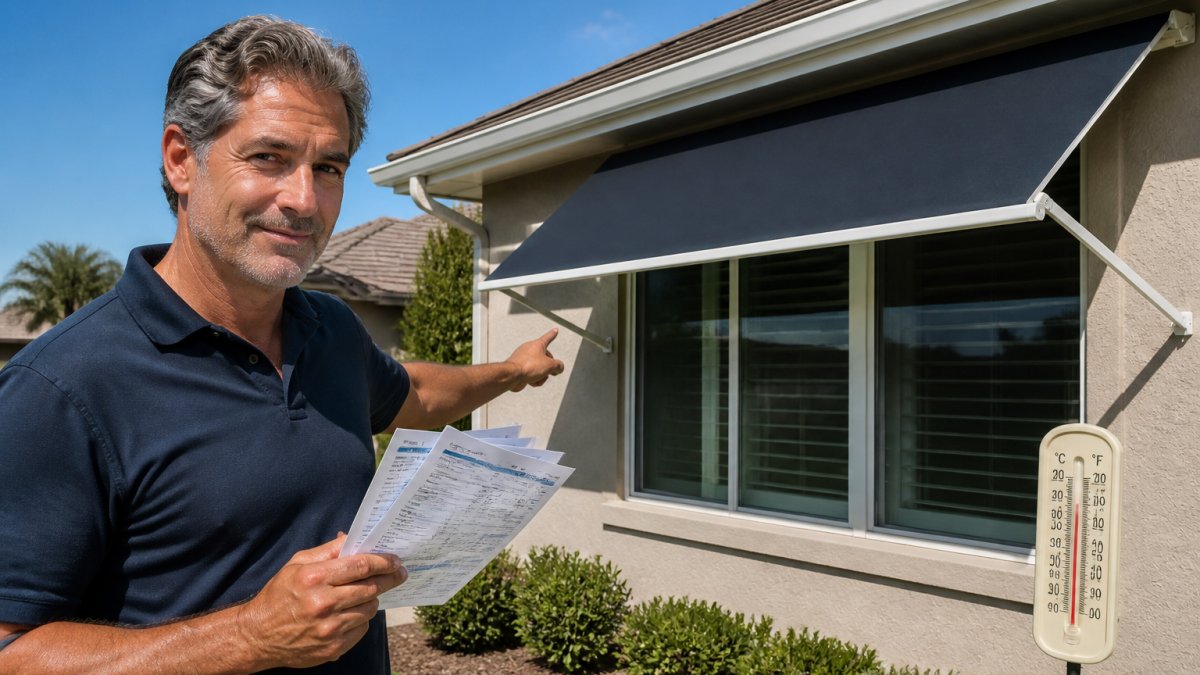
Most articles stop at “awnings save energy” and never show you how to put a number on it. Here is a method you can run yourself, plus the assumptions that make or break the result.
Why the Headline Percentages You See Online Are Unreliable
You will find claims that awnings cut cooling costs by 20%, 25%, or more. Those figures usually come from a single climate, a single window orientation, and a best-case shade condition.
The U.S. Department of Energy notes that awnings can reduce heat gain on south-facing windows, which lowers cooling demand in warm months. You can read the details at U.S. Department of Energy guidance on awnings and shading.
A Simple Way to Estimate Your Own Savings
You do not need an energy audit to get a rough figure. You need four inputs:
- Your summer cooling spend. Pull two or three July and August electric bills and average them. That is your baseline.
- The share of cooling load from your hottest windows. South and west windows typically drive the largest share. If most of your living space faces those directions, your shaded-window share is high.
- How much sun the awning actually blocks. A properly sized awning on a south window can block most of the midday summer sun. A shallow awning on the same window blocks far less.
- How many hours a day it is deployed. A fixed awning shades all day. A retractable one shades only when you extend it.
Multiply your baseline cooling spend by the share of load from shaded windows, then apply a conservative reduction factor. If you shade your two hottest windows and they drive roughly a third of your cooling load, a 15-25% reduction on that portion is a reasonable planning range. On a $200 summer bill, that is a few dollars a month per window, modest, but real, and it compounds across a season.
Run the estimate before and after installation using the same billing cycle. Actual before-and-after bills beat any online calculator, because they capture your home, your habits, and your utility’s rate structure.
What Moves the Number Up or Down
- Window orientation: South and west windows gain the most heat, so they offer the most savings.
- Awning coverage and projection: More shade on the glass means less heat, up to the point where you block light you want.
- Fabric and color: Darker, tighter weaves block more sun; lighter fabrics reflect more but transmit more.
- Deployment habits: A retractable awning used only during peak hours still captures most of the benefit.
- Glazing: Single-pane windows gain more heat than double-pane, so they benefit more from shading.
- Climate and cooling season length: Longer, hotter summers mean more savings; mild summers mean less.
The Heating Trade-Off Nobody Mentions
Shade that helps in July can hurt in January. If you heat your home in winter, a fixed awning that blocks low winter sun on a south window adds to your heating load.
A common approach is to start with your hottest windows, measure your energy bills before and after, and let your own utility data, not a generic percentage, tell you what the awning is worth.
Awning Placement for Sun Protection: Orientation, Sizing, and Climate
Awning placement for sun protection comes down to three things: which way the window faces, how far the awning projects, and how high the sun sits in summer.
Projection is how far the awning reaches out from the wall. A deeper projection casts more shade, but too much can block winter sun you actually want.
Use this quick guide:
| Window Direction | Sun Intensity | Recommended Projection | Best For |
|---|---|---|---|
| South-facing | High | Medium to deep | All-day summer shade |
| West-facing | Very high | Deep | Afternoon heat relief |
| East-facing | Moderate | Shallow to medium | Morning sun block |
| North-facing | Low | Minimal | Light glare only |
For most homes, we recommend shading south and west windows first. Those are the ones that push your indoor temperature up and keep your AC working overtime.
Climate and Seasonal Limitations
Awnings help most in hot, sunny climates with long summers. In cooler months, you may want more sun, not less. That is where a retractable awning earns its keep: extend it in July, roll it back in January.
One honest limitation: a fixed awning cannot adjust. If your climate swings between hot summers and cold winters, a retractable model gives you control.
Skipping a wind check is the most common mistake. A fully extended awning in a sudden storm can tear fabric or bend hardware. Always retract when high winds are forecast.
Best Awning Fabric for Heat Reduction: Materials and Colors
The best awning fabric for heat reduction blocks sunlight before it passes through. Two factors matter most: the weave and the color. But the fabric you choose also decides how long the awning lasts, how often you clean it, and how it handles sun, rain, and salt air. Here is how the common options compare.
Call us today for a free estimate →
Fabric Options and What They Trade Off
- Solution-dyed acrylic. The most common choice for residential and commercial awnings. Color is built into the fiber rather than applied on top, so it resists fading and holds up under strong sun. It breathes, which helps in humid climates, and cleans with mild soap and water. It is also the priciest of the common options. Sunbrella is the best-known brand in this category, and it comes in hundreds of colors and patterns.
- Solution-dyed polyester. Similar fade resistance to acrylic at a lower price point. It is often a bit less breathable and can feel stiffer, but for many homeowners it is a solid middle ground.
- Vinyl-coated or laminated fabrics. Highly water-resistant and easy to wipe down, which suits coastal and commercial use. The trade-off is heat: vinyl does not breathe, so it can trap warmth and feel hotter underneath, and it may not block radiant heat as well as a tight acrylic weave.
- Canvas and cotton blends. Traditional look, but they fade, mildew, and stretch faster than synthetics. Best reserved for covered or low-sun applications.
- Mesh and shade fabrics. Good for patios and glare control, but they block less direct sun than a solid awning fabric, so they are a weaker choice for cooling-focused window shading.
Color and Weave: The Heat Math
Color matters more than most people think:
- Dark colors block more light and cast deeper shade, but they absorb heat and can run hotter to the touch.
- Light colors reflect more heat but let some light through, so the shade underneath is less deep.
- Tight weaves block more sun than loose ones, regardless of color.
For pure heat blocking on a window, a dark, tightly woven fabric usually wins. For a patio where people sit underneath, a lighter fabric that reflects heat can feel more comfortable even if it blocks slightly less sun. Match the fabric to the job.
Maintenance and Durability Trade-Offs
Every fabric has trade-offs. Darker fabrics show dust and pollen more. Light fabrics may need more cleaning to stay bright. Vinyl wipes clean easily but can crack over time in strong sun. Acrylic resists fading but still needs seasonal care. Salt air near the coast can wear on stitching and hardware regardless of fabric, so coastal homes should plan on regular checks.
A simple routine keeps fabric in shape:
- Rinse with mild soap and water each season.
- Brush off pollen and debris.
- Check seams and stitching twice a year.
- Retract during storms.
Do not pressure-wash awning fabric. High pressure drives water into seams and can strip coatings, shortening the life of the awning.
How to Choose
Start with where the awning will live. A window awning in a hot, dry climate points toward a tight, dark acrylic. A coastal patio awning that sees salt spray and rain points toward a solution-dyed fabric with corrosion-resistant hardware. A restaurant that needs a specific look may trade a little heat performance for a color or pattern that fits the brand.
Retractable Awnings and Energy Efficiency: Flexible Shade Control
Retractable awnings and energy efficiency pair well because you control the shade. A fixed awning is always out.
That flexibility matters in a place with strong summer heat and mild winters. You get shade in July and sun in January, from the same awning.
For restaurants and outdoor dining, retractable awnings do double duty. They shade guests during the day and roll away for evening service or events.
Installation, Costs, and Payback for Awnings
Professional installation is the step most guides skip, and it is the one that decides whether your awning lasts.
Here is how the process usually goes:
- Measure and assess. We check window size, wall type, and sun exposure.
- Choose fabric and style. You pick from hundreds of Sunbrella options.
- Fabricate the awning. Each piece is custom-made to your measurements.
- Install the hardware. Mounting must handle wind and weight.
- Test and adjust. We check the retract mechanism and fit.
- Set a care routine. You get simple cleaning and use tips.
Sizing and placement matter as much as the install. A well-placed awning on a south-facing window does more than a bigger awning on a shaded one.
On cost and payback: pricing depends on size, fabric, and whether the awning is fixed or retractable.
Ask about orientation before you pick a fabric. A deep awning on a west window often saves more energy than a fancy fabric on a north one.
Conclusion: Making Awnings Work for Your Cooling Costs
Cutting cooling costs is not about one trick. It is about blocking the sun before it turns into heat inside your home. Awnings do that better than almost any interior fix, and they make your outdoor space more usable at the same time.
At A to Z Awnings & Marine Canvas, we build custom awnings for homes, restaurants, and boats, using hundreds of Sunbrella fabrics and backing every job with a 10-year warranty on workmanship and materials.
Frequently Asked Questions
How do awnings help reduce cooling costs?
Awnings block direct sunlight from hitting windows and walls, which lowers solar heat gain. By stopping that heat before it enters, your air conditioner runs less often and uses less energy. On south-facing windows, exterior shading like awnings can cut heat gain substantially, leading to lower indoor temperatures and reduced cooling demand. This translates into lower energy bills, especially during summer months when AC workload peaks.
How much can awnings reduce air-conditioning use?
Studies on exterior shading show that awnings can reduce cooling energy consumption in some homes, depending on climate, window orientation, and awning type. In hotter regions, the percentage reduction may be higher for west- or south-facing windows. Actual savings vary with your home’s insulation, AC efficiency, and how often the awning is deployed. Retractable awnings allow you to extend shade only when needed, maximizing efficiency.
Where should awnings be installed to block the most heat?
Install awnings on south-facing windows first, as they receive the most direct sunlight throughout the day. West-facing windows are also critical because afternoon sun is intense and can significantly raise indoor temperatures. For doors and outdoor living spaces, awnings on the west and south sides provide the greatest comfort. Proper projection and side flaps can further improve performance by blocking low-angle sun.
Which awning fabric is best for reducing heat?
Acrylic fabrics like Sunbrella are a top choice for heat reduction because they are tightly woven, breathable, and block a high percentage of UV rays. Lighter colors reflect more sunlight and stay cooler, while darker colors absorb heat but may offer better glare control. The fabric’s weave and weight also matter: heavier fabrics provide more insulation. For maximum heat reduction, choose a light-colored, tightly woven acrylic fabric.