


Table of Contents
- Why Awnings Fade in Sun: The Science of UV Degradation
- Signs of Sun Damage: Fading, Cracking, and Brittleness
- How Location and Orientation Affect Awning Fading
- How to Protect Awning Fabric from Sun Damage
- Best Awning Fabric for Sun Resistance
- Awning Maintenance Tips for Color Retention
- Repair or Replace? Making the Call on Sun-Damaged Awnings
- Frequently Asked Questions
Last Updated: September 18, 2026
Why Awnings Fade in Sun: The Science of UV Degradation
Ultraviolet radiation is the main reason awnings fade in sun. This high-energy light breaks the chemical bonds inside fabric dyes and fibers, and the damage builds every day the awning stays exposed. At A to Z Awnings & Marine Canvas, we see this on South Florida patios every week, even on awnings that are only a few seasons old.
Sunlight carries three threats at once:
- UV radiation attacks dye molecules and polymer chains directly
- Solar heat gain bakes the fabric and speeds up oxidization
- Moisture and salt air weaken fibers from the inside
Acrylic canvas and vinyl laminate handle this differently. Acrylic fibers hold color in the fiber itself, so they fade slower. Vinyl laminate relies on a top layer that can crack once it dries out.
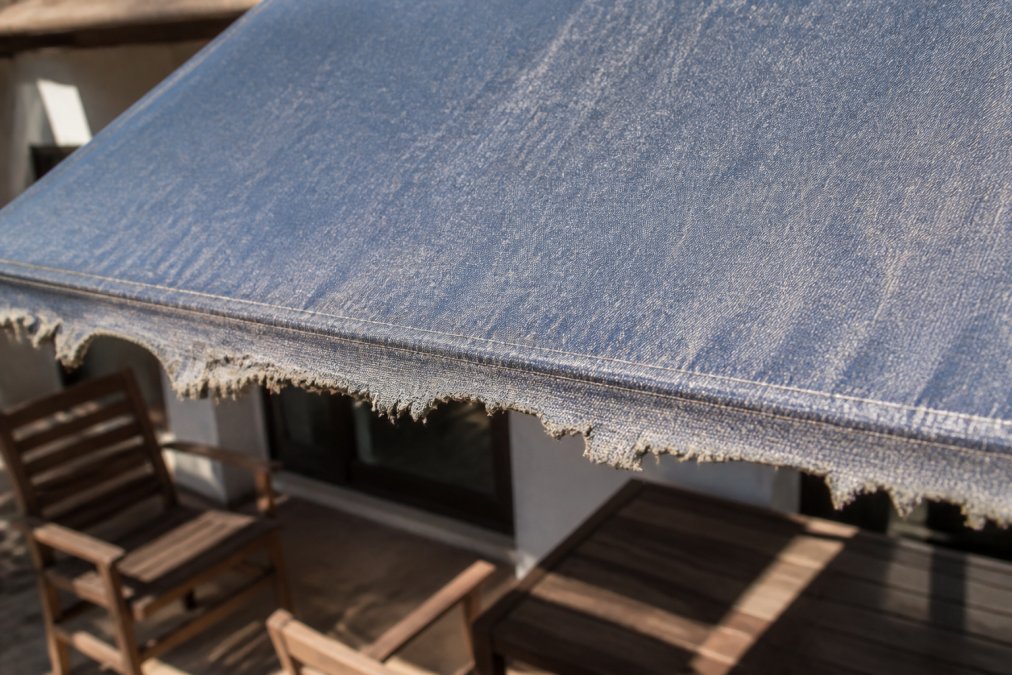
Fading is not just a color problem. Once UV radiation breaks down the polymer structure, the fabric loses tensile strength and seam integrity too.
Signs of Sun Damage: Fading, Cracking, and Brittleness
Discoloration shows up first. A blue awning turns grayish, a red one goes pink, and the change is often uneven because direct sunlight hits some panels harder than others.
Watch for these later-stage signs:
- Chalking, where a powdery residue wipes off on your hand
- Stiff, brittle fabric that cracks instead of flexing
- Frayed edges and pulled stitching along the seams
- Small pinholes that grow into tears
Here’s what most guides miss: fading and structural failure are two different clocks. Fabric can look fine and still be close to tearing. Test it by pressing a thumbnail into a hidden section. If the fabric cracks instead of denting, the fibers are already compromised.
How Location and Orientation Affect Awning Fading
Where an awning sits matters as much as what it’s made of. The UV index climbs the closer you get to the equator, so awnings in the Sun Belt take far more UV load than the same fabric in the Pacific Northwest. Orientation compounds this. A south-facing awning gets direct sunlight most of the day, year-round. North-facing awnings catch reflected light and stay cooler. West-facing awnings take the worst of it in summer afternoons, when UV intensity peaks alongside heat.
But orientation and latitude only tell part of the story. The micro-climate around the awning changes how fast UV damage actually accumulates, and this is where two awnings on the same street can age years apart.
Humidity versus dry heat. UV radiation breaks chemical bonds in dye and polymer chains, but moisture accelerates the follow-on damage. In humid air, water vapor works its way into the weave, and the free radicals created by UV exposure react faster in that wet environment. Dry heat is a different failure mode: it drives plasticizers out of vinyl laminate and embrittles coatings, so the fabric goes stiff and cracks rather than fading evenly. A vinyl awning in arid heat often fails structurally before it fades much at all; an acrylic awning in humid heat tends to lose color and strength together.
Salt air. Coastal exposure adds chloride ions to the mix. Salt deposits hold moisture against the fibers, keep the surface damp longer after rain or dew, and corrode the stitching, grommets, and hardware that hold the fabric in tension. A loose or rusted attachment point lets the fabric flap, and flapping flexes fibers that UV has already weakened. That combination, chemical degradation plus mechanical fatigue, is why coastal awnings often fail at the seams first.
Reflected and radiant load. An awning over a pool deck faces glare off the water plus constant humidity. One mounted near a parking lot soaks up radiant heat from asphalt. A light-colored wall or window can bounce UV back onto the underside of a canopy that would otherwise be shaded. These secondary sources are easy to overlook because they don’t show up in a simple sun-exposure estimate.
Track your awning’s sun exposure for one week. Note the hours of direct sunlight each panel gets, then note whether the fabric stays damp into the afternoon. That combination, sun hours plus drying time, tells you which sections to clean and treat first.
If you want to compare your local UV load against another region, the EPA’s UV radiation overview explains how UV intensity changes by season and region.
How to Protect Awning Fabric from Sun Damage
Protecting awning fabric from sun damage comes down to blocking UV before it reaches the fibers. A few habits do most of the work.
- Retract when not in use. Awning retraction removes hours of exposure every week.
- Apply a UV-resistant treatment. Look for products made for your specific fabric type.
- Clean on a schedule. Dirt holds heat and traps moisture against the weave.
- Fix small damage fast. A loose seam today is a torn panel next season.
- Add a protective coating or sealant. These add a sacrificial layer that UV attacks instead of your fabric.
Chemical compatibility is the gap most owners fall into. A protectant built for acrylic canvas can stain or stiffen vinyl laminate, and vice versa. Check the label against your fabric before you spray anything. The American Cleaning Institute’s fabric care guidance is a good starting point for matching cleaners to materials.
Best Awning Fabric for Sun Resistance
Solution-dyed acrylic is the best awning fabric for sun resistance in most cases. The pigment sits inside the fiber rather than on the surface, so color holds up far longer under UV radiation.
| Fabric Type | UV Resistance | Color Fastness | Best For |
|---|---|---|---|
| Solution-dyed acrylic | High | Excellent | Long-term sun exposure |
| Vinyl laminate | Moderate | Good | Budget shading, low-UV areas |
| Polyester with coating | Low to moderate | Fair | Temporary or seasonal use |
| Cotton canvas | Low | Poor | Shade only, short lifespan |
Sunbrella is the benchmark most of the industry measures against. It’s a solution-dyed acrylic, and it’s the fabric line we build with at A to Z Awnings & Marine Canvas. Hundreds of colorways are available, and the material carries a 10-year warranty against fading and loss of strength. No fabric is fade-proof, but solution-dyed acrylic gives you the longest runway before replacement.
Awning Maintenance Tips for Color Retention
Color retention comes down to consistent, gentle care. Strong chemicals strip the finish that protects your dye, so more scrubbing often means faster fading.
Use these maintenance tips for color retention:
- Rinse fabric monthly with plain water to remove dust and salt
- Wash with mild soap and a soft brush, never a stiff one
- Skip bleach and harsh solvents unless the fabric maker approves them
- Let fabric dry fully before retracting to prevent mildew
- Reapply UV protectant each season, per the product’s directions
- Inspect seams, hardware, and stitching every few months
Preventative maintenance beats restoration every time. A 20-minute rinse costs nothing. Replacing a full panel does not. For a deeper look at how UV exposure affects materials over time, the EPA’s UV radiation overview explains how UV intensity changes by season and region.
Retracting a damp awning traps moisture in the folds. That’s the fastest route to mildew and seam rot, and it can void your fabric warranty.
Repair or Replace? Making the Call on Sun-Damaged Awnings
Repair makes sense when damage is cosmetic or localized.
A decision matrix.
| Condition | Repair | Replace |
|---|---|---|
| Faded color, fabric still flexible | Yes | No |
| Single torn panel or split seam | Yes | No |
| Loose stitching or worn hardware | Yes | No |
| Thumbnail test cracks the fabric | No | Yes |
| Damage spans multiple panels | No | Yes |
| Mildew has eaten into the weave | No | Yes |
| Repairs would cost more than half of a new cover | No | Yes |
Re-coating a fabric that has already failed the thumbnail test wastes money. The coating sits on a surface that’s cracking underneath it, so it peels within a season.
A to Z Awnings & Marine Canvas handles both repairs and full replacements, and every custom cover we build carries a 10-year warranty on workmanship and materials. Pricing depends on fabric choice, size, and hardware, so call us today for a free estimate.
Frequently Asked Questions
What color awning is best for the sun to prevent fading?
Light colors like beige, cream, or light gray reflect more sunlight and absorb less heat, which can slow fading. However, solution-dyed acrylic fabrics in any color resist UV damage better than printed or dyed fabrics. Sunbrella fabrics, for example, have UV-resistant pigments built into the fibers, so even darker colors hold up well. The key is the fabric type, not just the color.
How long should an awning fabric typically last before fading?
With proper care, a high-quality acrylic awning can last 10 to 15 years before noticeable fading. Vinyl laminate may last 5 to 7 years. Factors like sun intensity, orientation, and maintenance affect lifespan. In South Florida, intense UV means fading may start sooner without protective measures. Regular cleaning and UV protectants can extend fabric life.
How can I prevent fabric from fading in the sun?
Retract awnings when not in use, especially during peak UV hours. Clean regularly to remove dirt that can accelerate degradation. Apply a UV protectant designed for your fabric type after cleaning. For fixed awnings, consider a professional UV-resistant treatment. Also, choose solution-dyed acrylic fabric like Sunbrella, which has color built into the fibers rather than applied on top.
Does UV radiation affect all awning materials equally?
No. Solution-dyed acrylic (e.g., Sunbrella) resists UV fading best because pigments are infused into the fibers. Vinyl laminate is less UV-stable and may fade faster. Polyester and cotton canvas degrade more quickly unless treated. Marine-grade fabrics are engineered for high UV exposure. Always check the fabric’s UV resistance rating before buying.
Sun damage is relentless, and no fabric escapes it forever. The right material, a simple care routine, and a fast call on repairs all stretch your awning’s life by years. A to Z Awnings & Marine Canvas builds custom awnings with premium Sunbrella fabrics, backs them with a 10-year warranty on workmanship and materials, and repairs or replaces covers that have already lost the fight. Get started with A to Z Awnings & Marine Canvas and keep your outdoor space shaded, colorful, and built to last.