


Table of Contents
- Marine Fabric Material Comparison: Solution-Dyed Acrylic vs. Vinyl vs. Polyester
- Types of Boat Enclosures: Center Console, Full, and Trailerable Options
- Marine Grade Vinyl vs Canvas: Which Is Right for Your Enclosure?
- Custom Boat Enclosure Cost: What Drives the Price and How to Budget
- UV and Water Resistance Standards: What to Look for in Heavy Duty Fabric
- Hardware and Framing Components: Anodized Aluminum, Stainless Steel, and Zipper Systems
- Marine Canvas Maintenance Tips: Cleaning, Mold Prevention, and Zipper Care
- Repair and Patching Techniques for Heavy Duty Marine Canvas Enclosures
- Frequently Asked Questions
Last Updated: September 30, 2026
Marine Fabric Material Comparison: Solution-Dyed Acrylic vs. Vinyl vs. Polyester
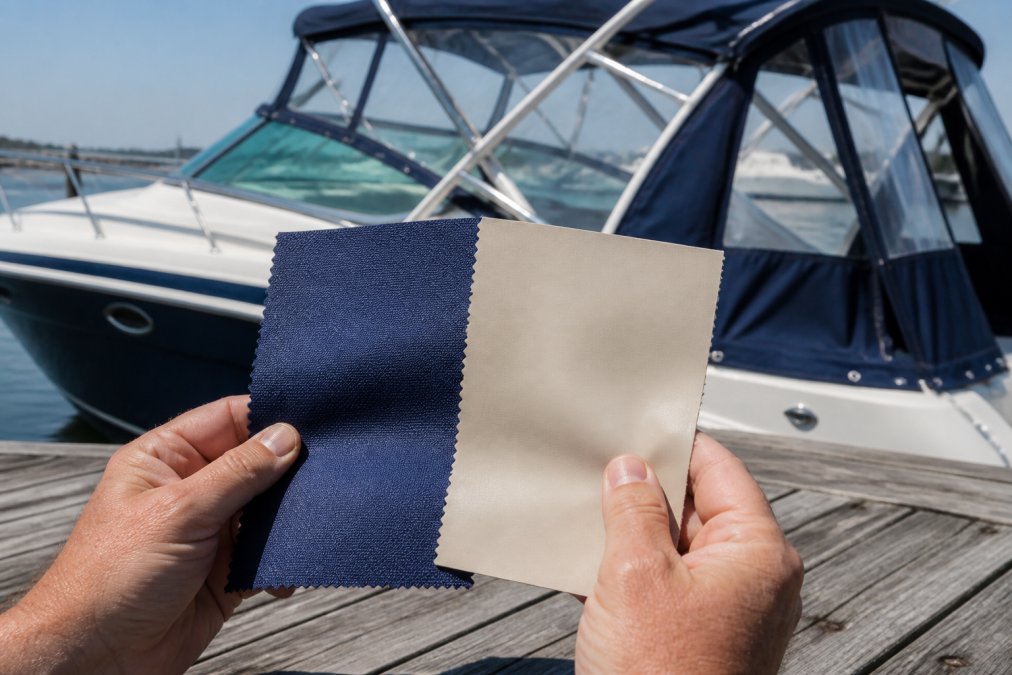
Heavy duty marine canvas enclosures start with the fabric, and three materials dominate: solution-dyed acrylic, marine-grade vinyl, and polyester. Each behaves differently under UV, salt spray, and flexing, so fabric choice drives lifespan and cost.
| Fabric | UV Resistance | Breathability | Best For |
|---|---|---|---|
| Solution-dyed acrylic | Excellent | High | Long-term enclosures |
| Marine-grade vinyl | Moderate | Low | Clear panels, waterproofing |
| Polyester | Fair | Moderate | Budget covers |
Denier, Weight, and Weave: What the Numbers Mean for Durability
Denier measures fiber thickness; higher denier generally means a heavier, more abrasion-resistant fabric. Weight (ounces per square yard) indicates weave density. A tighter weave resists water and seam failure but reduces breathability, which matters for mildew prevention in humid coastal air. For heavy duty use, prioritize tightly woven, higher-denier fabric over weight alone.
Ask for the fabric’s seam strength and tear strength specs, not just its weight. A heavy fabric with a weak weave fails at the seams long before the panels wear out.
Types of Boat Enclosures: Center Console, Full, and Trailerable Options
Boat enclosures fall into three categories. A center console enclosure wraps the helm and seating while leaving the bow open. Full enclosures cover the entire cockpit and often connect to a hardtop. Trailerable enclosures fold down or detach quickly for highway transport.
Marine Grade Vinyl vs Canvas: Which Is Right for Your Enclosure?
Marine grade vinyl and canvas serve different jobs, and most enclosures use both. Canvas provides structural panels and breathability; vinyl, usually clear isinglass or polycarbonate windows, provides visibility and waterproofing.
Isinglass and Polycarbonate: Transparency, Flexibility, and Long-Term Clarity
Isinglass is flexible clear vinyl that rolls and folds with the canvas. It offers good transparency when new but scratches and yellows with UV exposure. Polycarbonate panels are rigid, resist scratching far better, and hold clarity longer, but they don’t roll up and cost more. For a trailerable enclosure that folds often, isinglass is practical; for a permanent full enclosure where clarity matters most, polycarbonate earns its price.
Rolling isinglass panels while they’re cold can crack them. In cooler months, let panels warm in the sun before folding, or store them flat.
Custom Boat Enclosure Cost: What Drives the Price and How to Budget
Custom boat enclosure cost depends on four variables: total square footage, fabric grade, panel type, and hardware complexity. A center console enclosure with standard isinglass costs less than a full enclosure with polycarbonate windows, stainless steel framing, and custom zippers.
UV and Water Resistance Standards: What to Look for in Heavy Duty Fabric
UV resistance and water resistance are separate properties, and heavy duty fabric needs both. Most buyers compare marketing language, “UV-treated,” “marine-grade,” “weatherproof”, instead of test methods. Knowing the standards behind a spec sheet makes comparison easier.
The Test Methods Behind the Claims
UV resistance is expressed through two measurements. The first is colorfastness to light, most often run under AATCC Test Method 16 (commonly the Option E, 20-hour or 40-hour xenon-arc cycle), graded on a 1-5 Gray Scale where 5 means negligible color change. The second is tensile strength retention after accelerated weathering, usually ASTM G154 (fluorescent UV) or ASTM G155 (xenon-arc).
Climate-Specific Performance: What Changes by Region
Generic guides treat “marine environment” as one condition. It is not, and the fabric that wins in one climate can underperform in another.
How to Read a Spec Sheet
When comparing fabrics, ask the supplier for four numbers: AATCC 16 colorfastness rating, tensile strength retention after ASTM G154 or G155 exposure, AATCC 127 hydrostatic resistance, and ASTM E96 moisture vapor transmission. If a supplier cannot produce those, “heavy duty” is a marketing term, not a specification.
Match the fabric to your dominant failure mode, not to the highest number on the spec sheet. A high-hydrostatic, low-MVTR fabric is the wrong choice for a humid climate even though it looks stronger on paper.
Do not assume a fabric rated for years of outdoor exposure is rated for years of marine exposure. Salt, UV dose, and constant flexing at the seams are a harsher combined test than any single accelerated weathering standard replicates.
Hardware and Framing Components: Anodized Aluminum, Stainless Steel, and Zipper Systems
Hardware fails before fabric does in most marine environments. Fabric degrades gradually and visibly; metal degrades in ways you often cannot see until a fitting fails under load. Understanding the corrosion mechanisms separates a frame that lasts a decade from one that needs re-fitting in three seasons.
Anodized Aluminum: Light, Cheap, and Finite
Anodized aluminum tubing is the default frame material for most enclosures because it is roughly a third the weight of steel and costs less. The anodized layer is a controlled aluminum oxide coating that forms a barrier against the atmosphere. In fresh water and mild coastal air, that barrier holds up well.
Stainless Steel: The Alloy Grade Is the Whole Story
“Stainless steel” is not a single material. The grade determines whether hardware survives saltwater or rusts within a season.
Call us today for a free estimate →
- 304 stainless is the common general-purpose grade. It resists fresh water and mild exposure well, but in saltwater it is prone to pitting and crevice corrosion, especially at welds and under fittings where oxygen cannot reach the surface. It is the grade most often sold as “marine” hardware at big-box retailers, and the one most likely to disappoint a saltwater owner.
- 316 stainless adds molybdenum, which substantially improves resistance to chloride pitting and crevice corrosion. It is the standard for saltwater marine hardware, snaps, hinges, fasteners, and frame fittings that live in spray. The cost premium over 304 is modest relative to replacing corroded hardware and the canvas it damages.
- 316L is the low-carbon variant of 316, used where welding is involved because it resists sensitization (the chromium depletion that makes weld zones corrode first). If a frame is welded, 316L at the welds matters.
The Cost-Benefit Trade-Off in Saltwater
The honest comparison is not “which metal is better” but “which failure mode can you tolerate.” Anodized aluminum fails by pitting at stress points, often without visible warning, and cannot be field-repaired structurally. Stainless steel fails by surface staining and, in the wrong grade, crevice corrosion at fittings, both visible during routine inspection and addressable before structural failure.
Zippers, Snaps, and Tensioning Systems
Zippers are the most common point of enclosure failure, and the failure is usually mechanical before chemical. A corroded slider binds, the binding concentrates force on the teeth, and the teeth deform. Once teeth deform, the zipper is done, no field repair restores it.
What to specify:
- Zipper teeth and slider: corrosion-resistant metal (316 stainless where available) or high-quality molded resin. Resin zippers do not corrode, but they tolerate misalignment and grit poorly.
- Zipper tape: UV-stabilized, because the tape fails from sun exposure before the teeth wear out.
- Snaps and fasteners: 316 stainless. A 304 snap in continuous salt spray will stain and seize within a season or two.
- Tensioning: shock cord, turnbuckles, or strap systems that keep panels taut without overstressing seams. Over-tensioning is a common cause of seam failure, the fabric is strong, but the stitch line is the weak link.
Inspection Schedule That Actually Prevents Failures
Hardware inspection is cheap; hardware failure is not. A practical routine:
- Monthly in saltwater use: rinse all metal with fresh water, work every zipper through its full travel, and check snaps for stiffness.
- Seasonally: inspect frame tubing at bends and under fittings for pitting or white aluminum oxide residue. Inspect stainless for rust staining, which signals crevice corrosion starting under a fitting.
- Annually: check every fastener for tightness and every weld for cracking. Re-lubricate zippers with a silicone-based marine lubricant.
Budget hardware as a real cost, not an afterthought, and budget it by exposure, not by total frame length. The fittings, snaps, and zippers that live in spray are where the money should go. Upgrading those to 316 stainless while keeping anodized aluminum frame tubing is usually the highest-return decision in the entire enclosure.
Do not mix stainless fasteners into an aluminum frame without an isolating barrier. Dissimilar metals in a wet, salty environment create a galvanic couple, and the aluminum will corrode preferentially around the fastener, often invisibly, until the fitting pulls out.
Marine Canvas Maintenance Tips: Cleaning, Mold Prevention, and Zipper Care
Marine canvas maintenance tips come down to three habits: regular cleaning, moisture control, and zipper care. Rinse fabric with fresh water to remove salt and dirt, then clean with a mild soap and soft brush. Avoid harsh detergents, which strip protective finishes.
Repair and Patching Techniques for Heavy Duty Marine Canvas Enclosures
Small damage doesn’t require full replacement. For tears, a peel-and-stick canvas patch on a clean, dry surface handles minor repairs. For seam failures, restitching with UV-resistant thread restores strength. Isinglass scratches can sometimes be polished out with a plastic cleaner.
Frequently Asked Questions
What is the most durable material for marine canvas enclosures?
Solution-dyed acrylic canvas is the most durable choice for heavy duty marine canvas enclosures. The color is locked into the fibers before weaving, so it resists fading from UV exposure far better than surface-dyed fabrics. It also breathes, which reduces mildew growth in humid coastal conditions. Marine-grade vinyl offers better waterproofing and transparency for windows, but it does not breathe and can crack over time. For long-term durability in salt air, acrylic canvas with vinyl or polycarbonate panels is the strongest combination.
How long do heavy duty marine canvas enclosures typically last?
With proper care, a quality marine canvas enclosure made from solution-dyed acrylic or marine-grade vinyl can last 7 to 10 years or more. Lifespan depends on sun exposure, salt air, how often the enclosure is used, and whether you clean and treat it regularly. Storing the enclosure during off-season months and addressing small tears before they spread will extend its life. A 10-year warranty on both workmanship and materials gives you a reliable benchmark for expected durability.
Is custom marine canvas worth the investment for older boats?
Yes, if the boat is structurally sound and you plan to keep it. A custom enclosure protects upholstery, electronics, and gelcoat from UV and salt damage, which preserves resale value. It also extends your usable boating season by blocking wind and spray. Ready-made covers rarely fit older hulls with non-standard angles, leaving gaps where water and sun get in. A custom fit ensures full coverage and better performance. The cost is typically recouped through reduced interior wear and a higher selling price.
What is the difference between marine-grade canvas and standard outdoor fabric?
Marine-grade canvas is engineered for constant exposure to salt, UV radiation, and moisture. It uses solution-dyed acrylic or heavy denier polyester with mildew-resistant treatments, corrosion-resistant hardware, and reinforced seam strength. Standard outdoor fabric may look similar but lacks the UV stability, water repellency, and abrasion resistance needed for a marine environment. Using standard fabric on a boat often leads to rapid fading, mold, and seam failure within a season or two. Always verify the fabric is rated for marine use.
How do I maintain and clean heavy duty marine canvas to prevent mold?
Brush off loose dirt, then wash with mild soap and lukewarm water using a soft-bristle brush. Rinse thoroughly and let it air-dry completely before closing the enclosure. Never use harsh detergents, bleach, or abrasive cleaners, as they strip protective coatings. For mold spots, a diluted vinegar solution can help, but test a small area first. Lubricate zippers with a silicone-based product, and check snap fasteners for corrosion. Regular cleaning every few months prevents mildew and keeps the fabric breathable.
What are the benefits of using Sunbrella fabric for boat enclosures?
Sunbrella is a solution-dyed acrylic fabric known for excellent UV resistance, mildew resistance, and colorfastness. It breathes, which reduces condensation and mold growth inside the enclosure. It also resists fading and abrasion, maintaining its appearance after years of sun exposure. Sunbrella offers hundreds of colors and patterns, so you can match your boat’s aesthetic. A 10-year warranty on Sunbrella material backs its long-term performance. It is one of the most trusted fabrics for marine canvas enclosures in saltwater environments.
Heavy duty marine canvas enclosures reward careful material choices, and the wrong fabric or hardware costs you a replacement years sooner than necessary. A to Z Awnings & Marine Canvas builds custom enclosures using premium Sunbrella fabrics, corrosion-resistant hardware, and a full-service repair shop, all backed by a 10-year warranty on workmanship and materials. Call us today for a free estimate and get an enclosure fitted to your boat, your climate, and your budget.