


Last Updated: October 30, 2026
Quick Summary
Marine canvas fabric weight is measured in ounces per square yard or grams per square meter, and that number tells you how dense, heavy, and generally how durable a given fabric will be on your boat. One ounce per square yard equals roughly 33.9 grams per square meter, so a 10-ounce fabric lands near 340 GSM and an 18-ounce fabric lands near 610 GSM.
- Mid-weight marine canvas in the 11-14 ounce range suits most trailered and moored boats.
- Match weight to each enclosure panel rather than using one fabric for the whole job.
- Heavy canvas of 15-22 oz requires an industrial walking-foot machine with a servo motor.
- Use a size 18-20 needle and V-92 thread for mid-weight canvas of 11-14 oz.
- Never patch a coated fabric with an uncoated patch, or vice versa.
Table of Contents
- How Marine Canvas Weight Is Measured in Ounces and GSM
- Marine Canvas GSM Conversion Made Simple
- Choosing the Best Fabric for Boat Covers by Weight
- Marine Canvas for Boat Enclosures: Matching Weight to Panels
- Marine Canvas Durability and UV Resistance: Why Heavier Is Not Always Better
- How Fabric Weight Affects Sewing, Repairs, and Patching
- Get a Custom Marine Canvas Quote for Your Boat
- Frequently Asked Questions
How Marine Canvas Weight Is Measured in Ounces and GSM
Marine canvas fabric weight is measured in ounces per square yard or grams per square meter, and that number tells you how dense, heavy, and generally how durable a given fabric will be on your boat. Choosing the wrong weight means the fabric fails in the wrong place.
Fabric weight is not a marketing label. It is a specification, and it behaves like one.
Ounces per Square Yard vs. Grams per Square Meter
The American marine trade talks in ounces per square yard, usually shortened to “ounce canvas.” A 9-ounce canvas is a different animal from an 18-ounce canvas, and both are different from a 22-ounce top.
Here is the practical translation:
- Ounces per square yard measures how much one square yard of fabric weighs.
- GSM measures how much one square meter weighs.
- Because a square meter is larger than a square yard, GSM numbers are always higher than ounce numbers for the same fabric.
A common mistake is assuming the two numbers track one-to-one. They don’t. That mismatch is where most buyers get confused, and it’s why a fabric that sounds light in ounces can look surprisingly substantial in GSM.
Marine Canvas GSM Conversion Made Simple
Marine canvas GSM conversion is straightforward once you know the multiplier: one ounce per square yard equals roughly 33.9 grams per square meter. So a 10-ounce fabric lands near 340 GSM, and an 18-ounce fabric lands near 610 GSM.
Use this quick reference when you’re comparing a mill spec sheet against a domestic supplier’s label:
| Ounces per Square Yard | Approximate GSM | Typical Marine Use |
|---|---|---|
| 8-10 oz | 270-340 GSM | Light covers, storage, interior cushions |
| 11-13 oz | 370-440 GSM | Bimini tops, cockpit covers |
| 14-16 oz | 475-540 GSM | Dodgers, side curtains |
| 18-22 oz | 610-745 GSM | Enclosure panels, mooring covers |
The conversion is a guide, not a guarantee. Weave density and coating change how a fabric behaves at any given weight.
Choosing the Best Fabric for Boat Covers by Weight
The best fabric for boat covers is a mid-weight marine canvas in the 11-14 ounce range for most trailered and moored boats, because it balances tear resistance against manageable weight and cost.
Boat covers take the most abuse of any canvas on the vessel: sun, rain, wind flutter, and the occasional tow at highway speed. That combination punishes light fabric fast.
- Trailerable boats: mid-weight canvas holds up to wind flutter without becoming a wrestling match to install.
- Moored boats: a heavier cover resists pooling water and UV degradation over long exposure.
- Storage covers: lighter fabric is fine when the cover is seasonal and sheltered.
What most guides miss is that cover weight should follow exposure, not boat size. Readers comparing options can see a marine canvas vs vinyl enclosures comparison before deciding.
Marine Canvas for Boat Enclosures: Matching Weight to Panels
Marine canvas for boat enclosures works best when weight is matched to each panel rather than using one fabric for the whole job. Clear vinyl panels, side curtains, and top panels each carry different loads and different sun exposure.
A dodger top sees direct sun and wind, so it wants a heavier, tighter weave. Side curtains need enough body to hang straight without sagging.
Matching weight to panel matters: a uniform heavyweight enclosure gets stiff and heavy to operate, while a uniform lightweight enclosure wears out at the stress points. For panels that need the heaviest fabric, see the heavy duty marine canvas enclosures guide.
Marine Canvas Durability and UV Resistance: Why Heavier Is Not Always Better
Marine canvas durability and UV resistance depend on fiber type, weave density, coating chemistry, and exposure, not weight alone. A tightly woven solution-dyed acrylic can outlast a heavier, loosely woven fabric because UV degradation attacks exposed fiber surface area, not bulk mass. For specifics, see Sunbrella fabric durability for boats. Weight tells you how much material is there; it does not tell you how well that material is built.
Call us today for a free estimate →
The Four Mechanisms That Actually Kill Marine Canvas
Most failures trace back to one of four mechanisms, and weight only influences the first:
- UV degradation: Ultraviolet light breaks polymer chains at the fiber surface. Solution-dyed acrylics (pigment added before extrusion) resist this far better than surface-dyed fabrics because the color and UV stabilizers run through the fiber, not just on it.
- Abrasion and flex fatigue: Wind flutter and repeated folding wear fibers at the fold lines and seam edges. Heavier fabric resists abrasion better per impact, but a stiff heavyweight fabric that creases sharply can fatigue faster at those creases than a more pliable mid-weight fabric.
- Water intrusion and mildew: Coating quality and seam sealing matter more than weight. Water that wicks through stitch holes or a thin coating creates mildew on the underside, which degrades fabric from within.
Fiber and Coating Trade-Offs by Weight Class
- Solution-dyed acrylic (common benchmark: Sunbrella): Excellent colorfastness and UV resistance, breathable, moderate tensile strength. Best in the 9-13 oz range for tops and covers where breathability and color retention matter.
- Polyester with PVC or polyurethane coating: Higher tensile strength per ounce and excellent water repellency, but heavier coatings reduce breathability and can trap moisture. Common in 14-22 oz enclosure and mooring applications.
- Vinyl-laminated polyester: Maximum water resistance and abrasion resistance, but heaviest and least breathable; best where waterproofing outweighs ventilation.
A common pattern in the trade: the fabric that fails first is rarely the lightest one, it is the one whose coating broke down or whose seams were never sealed.
The Environmental Trade-Off Competitors Skip
Weight is a proxy for durability, not a guarantee of it. Fiber chemistry, weave tightness, coating formulation, and seam construction decide how long canvas lasts. When two fabrics are close in weight, choose the one with solution-dyed fiber, a tight weave, and a coating matched to your exposure, and factor in breathability, which affects both mildew resistance and how the fabric ages.
Colorfastness, water repellency, and abrasion resistance all come from how the fabric is built. Acrylic canvas is known for holding color under sun exposure; polyester blends offer strong tensile strength for their weight.
How Fabric Weight Affects Sewing, Repairs, and Patching
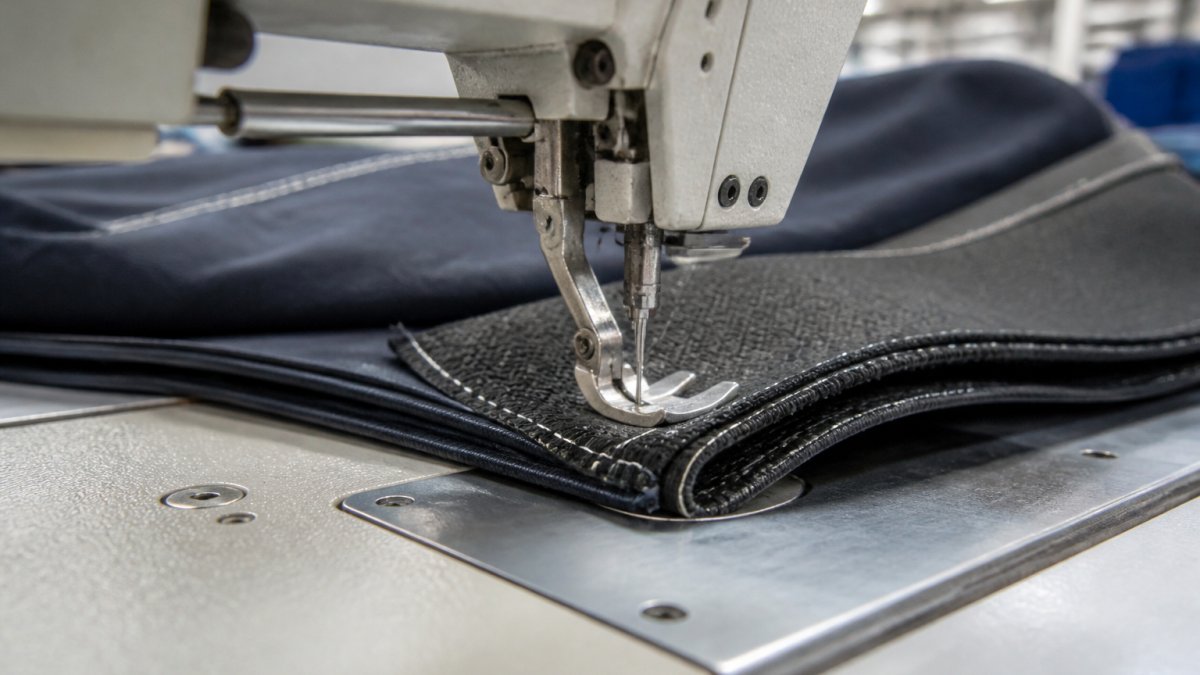
Fabric weight dictates the sewing machine class, needle size, thread weight, and stitch length needed to build or repair marine canvas, and it dictates whether a repair can be done in the field or has to come back to the shop.
Machine Compatibility by Fabric Weight
This is the mechanical limitation most guides skip. A household machine is not a substitute for an industrial walking-foot machine once you get into heavy canvas.
- Light canvas (8-10 oz): A heavy-duty home machine with a walking foot can handle light canvas and interior cushion work. Use a size 16-18 needle and bonded polyester thread (V-69 or equivalent).
- Mid-weight canvas (11-14 oz): A home machine will struggle with multiple layers at seams and hems. A semi-industrial or industrial walking-foot machine is the practical minimum. Size 18-20 needle, V-92 thread.
- Heavy canvas (15-22 oz): Requires an industrial walking-foot machine with a servo motor and sufficient presser-foot lift. Size 20-22 needle, V-92 to V-138 thread. Household machines will skip stitches, bend needles, and burn out motors on multi-layer seams.
A common mistake is repairing heavyweight canvas with a household machine. If you are weighing a fix on heavier fabric, read the marine canvas repair vs replacement guide. The stitch looks fine until the first hard wind load, then the seam pulls.
Needle, Thread, and Stitch Length by Weight
- Needle size: Heavier canvas needs a larger needle to push through dense weave without bending. Too small a needle deflects and creates skipped stitches; too large a needle leaves oversized holes that wick water.
- Thread weight: Thick thread on heavy fabric needs higher tension to seat the stitch. V-69 for light work, V-92 for mid and heavy, V-138 for structural seams on the heaviest fabrics.
- Stitch length: Heavyweight canvas needs longer stitch lengths (roughly 6-8 stitches per inch) and reinforced joins. Short stitches on heavy fabric perforate the weave and create a tear line.
Repairability and Patching by Weight
Weight changes how a repair behaves in the field:
- Light canvas (8-10 oz): Easy to patch with adhesive-backed patches or a quick stitch, but patches wear faster and can peel at the edges under wind flutter. Best for temporary field repairs.
- Mid-weight canvas (11-14 oz): The sweet spot for repairability, heavy enough that a sewn patch holds, light enough to stitch by hand or on a portable machine in the field. Use a patch of the same weight and weave, sew a minimum 1-inch overlap, and seal the stitch line.
- Heavy canvas (15-22 oz): Patches hold very well but are hard to blend and nearly impossible to sew by hand through multiple layers. Field repairs usually mean adhesive patch plus clamps until the panel can come back to the shop for a sewn repair.
Never patch a coated fabric with an uncoated patch, or vice versa, the mismatch creates a water trap and the patch will lift at the edges. Match coating type and weight, and always seal stitch holes on any panel that sheds water.
Get a Custom Marine Canvas Quote for Your Boat
Weight selection is where a canvas job succeeds or fails, and it is not a decision to make from a spec sheet alone.
A to Z Awnings & Marine Canvas uses hundreds of premium Sunbrella fabrics and backs its work with a 10-year warranty on both workmanship and materials.
Tell us your boat’s setup and how you use it, and we will recommend the weight that fits. Get a custom marine canvas quote for your boat.
Choosing fabric weight is a decision most boat owners make once and live with for years.
Frequently Asked Questions
What weight fabric is best for marine canvas?
There is no single best weight for every job. Boat covers usually work well at 8 to 10 ounces per square yard, while bimini tops and enclosures often use 9 to 11 ounces. Cushions and upholstery tend to sit in the 6 to 8 ounce range because they need to stay flexible. The right marine canvas depends on where the fabric sits on the boat, how much wind and sun it faces, and whether it needs to fold or roll.
How is marine fabric weight measured?
Marine fabric weight is measured in ounces per square yard or grams per square meter. A fabric’s weight reflects how much material sits in a given area, which hints at thickness, density, and how much abuse it can take. Weight is not the same as weave density or coating quality, so two fabrics at the same ounce rating can still perform differently in a marine environment.
What is the difference between ounces per square yard and GSM?
Ounces per square yard is the traditional US measure for canvas, while GSM (grams per square meter) is the metric equivalent used by many mills and fabric suppliers. To convert, multiply ounces per square yard by roughly 33.9 to get GSM. For example, a 10 ounce fabric is about 339 GSM. Knowing both helps when comparing spec sheets from different suppliers.
Is heavier marine canvas always more durable?
No. Weight helps with tear resistance and abrasion resistance, but durability also depends on fiber type, weave density, UV coatings, and seam strength. A well-built 9 ounce acrylic canvas with strong UV resistance can outlast a poorly coated 12 ounce fabric. Heavier canvas is also harder to sew, harder to fold, and heavier on the boat, so match weight to the job rather than assuming more is better.
What fabric weight is best for a boat cover?
For most trailered or moored boats, 8 to 10 ounces per square yard is a practical range for a boat cover. That weight resists tearing in wind, sheds water with a good waterproof coating, and still folds without excessive bulk. Boats stored in full sun or high-wind areas may benefit from 10 to 12 ounces, while lightweight day covers can drop to 6 to 8 ounces.
Does fabric weight affect how easy marine canvas is to sew?
Yes, and it matters for both manufacturers and owners doing repairs. Fabric above 10 ounces usually needs an industrial sewing machine with a walking foot, a size 18 to 22 needle, and heavy bonded thread. Lighter canvas in the 6 to 8 ounce range can sometimes be sewn on a heavy-duty home machine. Wrong needle size or thread tension causes skipped stitches and weak seams.