



Table of Contents
- Custom Marine Upholstery Services: What Boat Owners Need to Know
- Marine Grade Vinyl vs Fabric: Choosing the Right Material
- Boat Upholstery Repair Cost: What Drives the Price
- How to Maintain Boat Cushions and Canvas
- DIY vs Professional Marine Upholstery Repair
- Custom Cushion Fabrication and Interior Cabin Refits
- Why Choose A to Z Awnings & Marine Canvas
- Frequently Asked Questions
Last Updated: September 25, 2026
Custom Marine Upholstery Services: What Boat Owners Need to Know
Custom marine upholstery services florida boat owners rely on go far beyond replacing torn vinyl. This guide from A to Z Awnings & Marine Canvas breaks down materials, costs, maintenance, and when to repair versus replace, so you can decide with confidence.
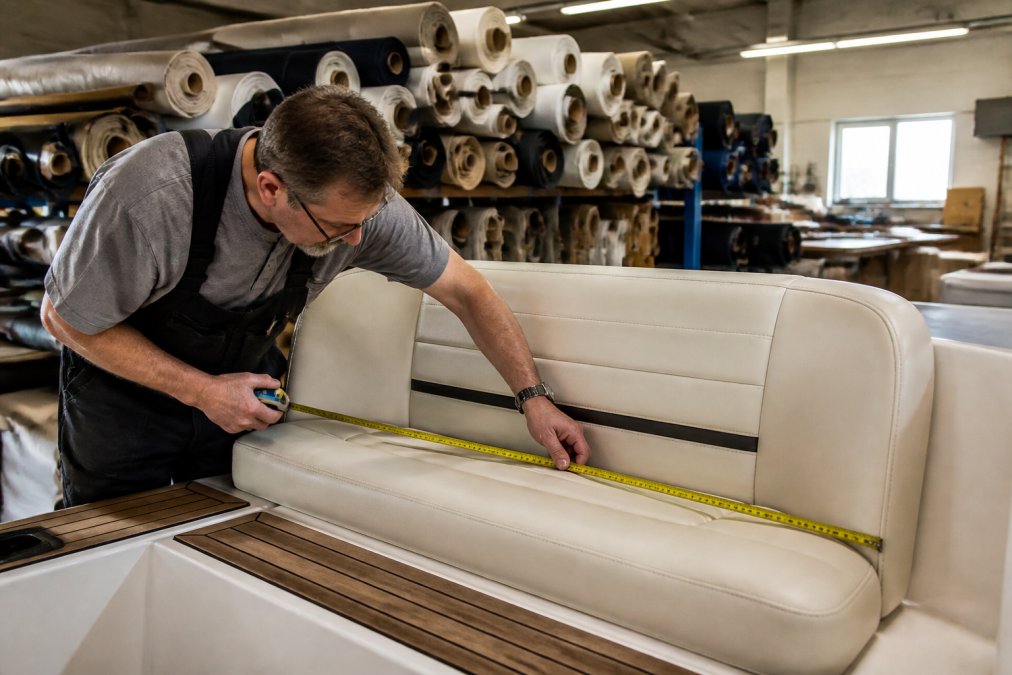
Custom marine upholstery is the design and fabrication of boat seating, cushions, canvas enclosures, and interior soft goods using materials engineered for sun, salt, and constant moisture. Unlike home furniture, every component has to survive an environment that destroys ordinary fabric within a single season.
The scope of a full marine upholstery project typically includes:
- Helm and bench seat rebuilds with new foam and vinyl
- Boat canvas and enclosures, including bimini tops and dodgers
- Custom cushion fabrication for cabins, cockpits, and sun pads
- Interior cabin refits covering headliners, side panels, and berths
- Sail covers, bolsters, and side curtains
What most owners miss is that the material specification, not the stitching pattern, determines how long the finished job lasts. A beautiful seat built from the wrong vinyl fails in two summers. A plain one built from UV-resistant, salt-safe stock can run a decade.
A common mistake is shopping on price alone.
Marine Grade Vinyl vs Fabric: Choosing the Right Material
Marine-grade vinyl is the better choice for high-traffic, high-splash areas like helm seats and cockpit cushions. Solution-dyed acrylic fabric wins for enclosures and shaded cabin interiors where breathability matters more than wipe-clean convenience.
The comparison comes down to four factors:
| Factor | Marine-Grade Vinyl | Solution-Dyed Acrylic Fabric |
|---|---|---|
| Water resistance | Fully waterproof surface | Water-repellent, breathable |
| UV resistance | High with UV inhibitors | High, color locked into fiber |
| Mildew resistance | Strong with antimicrobial backing | Strong when kept dry |
| Best use | Seats, bolsters, cockpit cushions | Bimini tops, dodgers, sail covers |
The durability question most shops skip
Most service pages list “marine-grade vinyl” as if it were one product. It is not. The grade that matters is determined by three things: the vinyl’s topcoat, its backing, and the thread holding it together.
Foam density and why it drives longevity
Foam is not a filler; it is a structural component. Low-density foam compresses permanently within a season, which creates sagging seats and traps moisture against the vinyl backing. Higher-density foam holds its shape, drains faster, and resists the mold that follows trapped water. For cockpit cushions that see rain and spray, a closed-cell or high-density open-cell foam is the practical choice.
A quick decision framework
- Helm and cockpit seating: marine-grade vinyl with a protective topcoat, antimicrobial backing, and PTFE or bonded polyester thread.
- Bimini tops, dodgers, and sail covers: solution-dyed acrylic, which breathes and keeps its color because the pigment is in the fiber, not printed on top.
- Cabin berths and dinette cushions: solution-dyed acrylic or a breathable upholstery fabric over medium-density foam, since these areas are shaded and value comfort over wipe-clean convenience.
- Sun pads and bolsters: marine-grade vinyl, because they take direct sun and body contact and need to be wiped down.
Ask any fabricator to show you the material’s UV and mildew ratings before you commit. Reputable suppliers publish these, and a shop that cannot produce them is guessing.
“Marine-grade” is not a regulated term. Two shops can use the same phrase and mean very different products. Ask for the specific manufacturer and product line, not just the category.
Boat Upholstery Repair Cost: What Drives the Price
Boat upholstery repair cost depends on four variables: square footage, foam replacement, material grade, and labor complexity. Because every hull is different, no honest shop publishes a flat rate card, but you can still build a realistic expectation before you call anyone.
The five cost drivers, in order of impact
1. Surface area. This is the biggest lever. A single helm seat is a small job. A full cockpit set, helm, companion, and bench seating, multiplies the square footage and the cutting, sewing, and fitting time with it. Measure your seating footprint before requesting a quote; it is the number a fabricator will ask for first.
What a realistic estimate looks like
A custom-fit job on a 22-foot center console shares almost nothing with a full refit on a 40-foot cruiser. The practical way to think about it:
- Small jobs, a single cushion cover, a few snaps, minor restitching, are typically the lowest-cost category and are often the ones worth doing yourself.
- Mid-size jobs, a helm seat rebuild or a set of cockpit cushions, involve new foam, new vinyl, and custom patterning, and sit in the middle of the range.
- Large jobs, full cockpit reupholstery, interior cabin refits, or new enclosures, are priced by the project because the patterning and fitting time dominates.
Why phone quotes are unreliable
A price given over the phone without measurements is a guess. The shop cannot see your foam condition, your frame, or the curves it will have to pattern. A low phone number usually grows once the shop sees the actual job, and that is not dishonesty, it is the difference between a guess and an estimate.
Beware of quotes given over the phone without measurements. A price that sounds low up front usually grows once the shop sees the actual foam and frame condition.
Get two or three estimates and compare them line by line, foam, material grade, thread, and canvas as separate items. The lowest total is not the lowest cost if it skips foam replacement or uses standard thread.
How to Maintain Boat Cushions and Canvas
Routine cleaning is the single highest-return habit for extending marine upholstery life. Most premature failures trace back to skipped maintenance, not defective materials.
A practical maintenance routine:
- Rinse vinyl and canvas with fresh water after every saltwater outing
- Clean with mild soap and a soft brush, never harsh solvents
- Dry cushions fully on both sides before storing
- Apply a marine-grade protectant to vinyl twice per season
- Inspect seams and stitching quarterly for early separation
- Store removable cushions indoors or under cover during off-season
- Check canvas for mold and mildew spots monthly
Freshwater rinsing after every trip does more for longevity than any single product you can buy. It removes the salt that degrades both vinyl and thread.
DIY vs Professional Marine Upholstery Repair
DIY marine upholstery repair makes sense for small jobs; professional fabrication wins for anything structural. The dividing line is whether the repair affects fit, safety, or waterproofing.
DIY works well for:
- Replacing a single cushion cover with a pre-made pattern
- Cleaning and re-protecting vinyl
- Replacing snaps, zippers, or bungee cords
- Minor seam restitching on flat panels
Call a professional when the job involves:
- Rebuilding seat frames or replacing foam
- Fabricating curved or custom-fit cushions
- Building or repairing boat enclosures and bimini tops
- Any work where seam integrity affects weather protection
Custom Cushion Fabrication and Interior Cabin Refits
Custom cushion fabrication starts with a pattern taken from your actual boat, not a generic template. This is why custom fit matters so much on older hulls with unusual angles and non-standard seating.
The fabrication process usually runs:
- On-site measurement and templating
- Foam selection based on use and exposure
- Material and thread specification
- Cutting, sewing, and seam sealing
- Fitting and final adjustment
Why Choose A to Z Awnings & Marine Canvas
A to Z Awnings & Marine Canvas manufactures and services custom residential, commercial, and marine shading and upholstery solutions. The team works with hundreds of premium Sunbrella fabrics, so you can match your boat’s existing palette or start fresh.
What sets the shop apart:
- 10-year warranty on workmanship. Backed by a licensed contractor.
- 10-year warranty on Sunbrella material. Coverage that reflects confidence in the stock.
- Full-service manufacturing and repairs. Fabrication and restoration under one roof.
- Custom-made to fit your specific needs. No generic templates.
- Free estimates. Real numbers based on your boat, not a phone guess.
Sunbrella fabric care and cleaning guidance
Frequently Asked Questions
What is the average cost to reupholster a boat seat?
Boat seat reupholstery pricing depends on seat size, foam condition, material choice, and labor. Marine-grade vinyl and UV-resistant thread cost more than standard fabric but last longer in salt and sun. Most shops quote per project after inspecting the frame and foam. Request a free estimate from a custom marine upholstery service for an accurate figure based on your boat.
Is it cheaper to reupholster or buy new boat seats?
Reupholstering is usually cheaper when the seat frame and foam are still solid. A rebuild reuses the existing structure and replaces only the covering and worn foam, which keeps material and labor costs lower than a full replacement. New seats make more sense when the frame is cracked or the foam has collapsed. A marine upholstery professional can tell you which option fits your boat after a quick inspection.
How long does custom marine upholstery typically last?
With marine-grade vinyl, UV-resistant thread, and proper care, custom marine upholstery often lasts 7 to 10 years or more in Florida conditions. Longevity depends on sun exposure, salt air, and how well you clean and protect the material. A 10-year warranty on workmanship and Sunbrella material gives boat owners a clear benchmark for expected durability.
How do I maintain boat cushions to prevent mold and mildew?
Rinse boat cushions with fresh water after every trip, especially after saltwater exposure. Clean vinyl with mild soap and water, then dry thoroughly before storing. Keep cushions out of direct sun when the boat is not in use, and use covers or a full enclosure to block UV rays. Address seam and thread damage early to prevent moisture from reaching the foam, which is where mold and mildew start.
Finding marine upholstery that survives salt, sun, and constant use comes down to materials and workmanship, not luck. A to Z Awnings & Marine Canvas builds custom boat cushions, canvas enclosures, and full interior refits with Sunbrella fabrics, backed by a 10-year warranty on both workmanship and materials. Call today for a free estimate and get a fit built for your boat.