


Table of Contents
- Professional Awning Installation vs DIY: A Quick Comparison
- What the Cost of Retractable Patio Awnings Actually Covers
- DIY Awning Installation Risks That Cost More Than Labor
- Awning Installation Warranty Requirements and Why They Matter
- How Professional Installation Protects Structural Integrity and Property Value
- When the Answer Is Yes: Scenarios Where Professional Installation Pays Off
- Frequently Asked Questions
Last Updated: September 28, 2026
Professional Awning Installation vs DIY: A Quick Comparison
Homeowners searching for shade usually ask the same question first: is professional awning installation worth the extra money? At A to Z Awnings & Marine Canvas, the short answer is yes for most people, because the labor you pay for covers structural anchoring, wind-load planning, and warranty compliance that a boxed kit cannot provide. The real decision is not “kit versus custom.” It is “one afternoon versus the next fifteen years.”
| Factor | Professional Installation | DIY Installation |
|---|---|---|
| Upfront cost | Higher (labor included) | Lower (product only) |
| Anchoring system | Engineered for your wall type | Whatever ships in the box |
| Warranty coverage | Full manufacturer warranty intact | Often voided |
| Wind load rating | Verified against local code | Unknown |
| Expected service life | 10-15 years with care | Varies widely |
| Insurance treatment | Documented, insurable | May be excluded after damage |
What the Cost of Retractable Patio Awnings Actually Covers
The cost of retractable patio awnings is not one number. It bundles the fabric, the awning frame, the motor if you choose a motorized awning, the mounting hardware, and the professional labor to install it correctly.
A low advertised price almost always excludes installation, mounting hardware upgrades, and permit-related work. Budget for the full system, not the box.
Upfront Cost vs Long-Term Value
Think in terms of service life, not sticker price. A properly anchored awning that lasts a decade or more spreads its cost across years of daily shade. A cheaper unit that sags, leaks, or tears in two seasons has to be replaced, and you pay the labor twice.
Ask any installer for the wind-load rating and anchoring spec in writing before you sign. If they cannot produce it, they are guessing.
DIY Awning Installation Risks That Cost More Than Labor
DIY awning installation risks rarely show up on day one. They show up in the first strong wind, the first heavy rain, or the first time you try to file a warranty claim.
Common DIY Failure Points
- Brackets fastened into siding instead of a load-bearing wall or properly reinforced blocking
- Mounting hardware swapped for whatever was in the toolbox instead of rated fasteners
- Missing or incorrect torque on bolts, causing gradual loosening
- No slope or pitch set, so water pools on the fabric
- Fabric tension set wrong, leading to sagging and premature fabric replacement
Each of these is fixable by a professional in an afternoon. Left alone, they shorten the life of the awning frame and can void your warranty coverage entirely.
Awning Installation Warranty Requirements and Why They Matter
Awning installation warranty requirements are the part most buyers ignore until something breaks. Manufacturers typically condition coverage on three things: installation by a qualified professional, use of specified mounting hardware, and adherence to a stated mounting height, pitch, and anchor pattern. Break any one of those conditions and the claim can be denied, even if the defect has nothing to do with the installation itself.
The Clauses That Actually Get Cited in Denials
When a manufacturer denies a claim, it usually points to one of a small set of standard exclusions. Knowing them in advance is the difference between a covered repair and an out-of-pocket one:
- Improper installation. The most common denial. If the awning was not installed by an approved or licensed installer, or was not installed to the published spec, coverage for the frame, fabric, and motor can all fall away at once.
- Non-specified fasteners. Many warranties name the anchor type and minimum embedment depth. Substituting a hardware-store lag bolt for a rated masonry anchor is a documented reason for denial.
- Unauthorized modification. Cutting the frame, re-pitching the arms, or adding aftermarket brackets typically voids coverage on the affected components.
- Failure to maintain. Most warranties require periodic cleaning and inspection. Skipping it can be used to deny a claim even when the root cause is a manufacturing defect.
- Improper storage or retraction. For retractable units, leaving the awning extended during high wind or failing to retract it per the manual is a common exclusion.
Why the Paper Trail Matters as Much as the Install
A professional installer who works with a given manufacturer regularly will typically file the installation paperwork, register the product, and keep the anchor spec and torque values on record. That paper trail is what you hand the manufacturer when you file a claim. A DIY install rarely produces it, which is why so many DIY warranty claims stall at the first request for documentation.
The warranty is only as good as the installation behind it. Professional installation is what keeps your coverage valid, and the installer’s records are what prove it.
The Insurance Angle Most Guides Skip
Homeowners insurance is the second layer of protection, and it behaves differently from a manufacturer warranty. A wind or hail claim on an awning is generally handled under the dwelling or other-structures coverage on your policy. Two things affect whether that claim pays:
Call us today for a free estimate →
- Whether the awning was permitted and inspected. An unpermitted structure can complicate or reduce a claim, and some carriers exclude structures that were not built to local code.
- Whether the installation was documented. A receipt and installation record showing rated anchors and a code-compliant wind-load rating makes the claim straightforward. A DIY install with no documentation invites questions about whether the loss was caused by the storm or by the installation.
How Professional Installation Protects Structural Integrity and Property Value
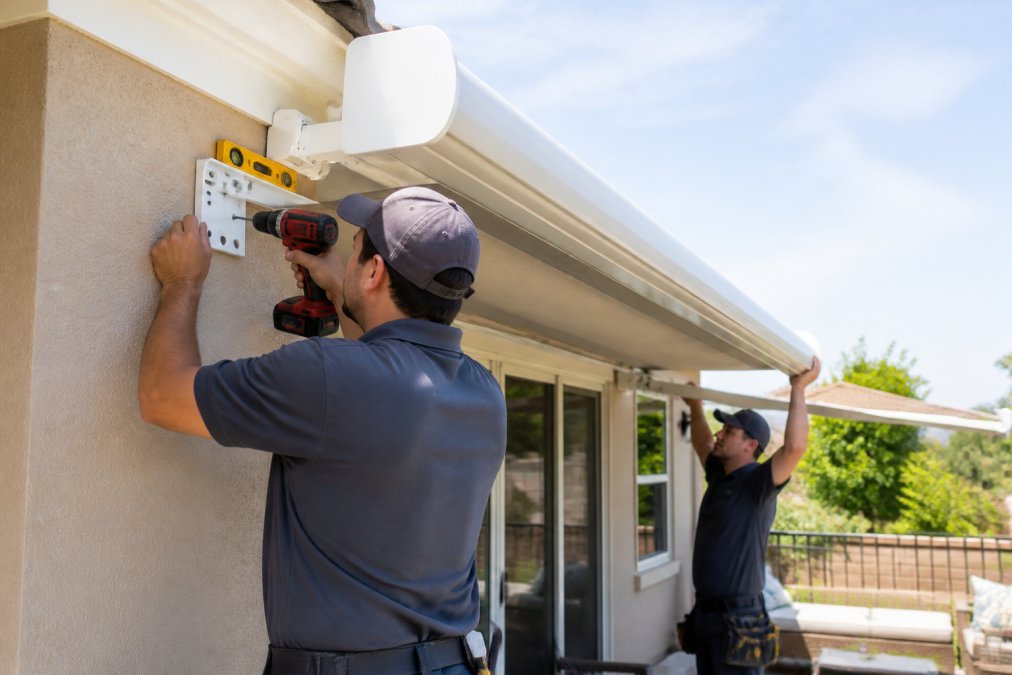
Structural integrity is the reason professional installation pays for itself, but the value is easier to see when you look at how DIY installs actually fail. The failures are not random. They cluster around a handful of predictable points, and each one is preventable in an afternoon by someone who installs awnings weekly.
Where DIY Installations Actually Fail
- Anchoring into the wrong substrate. The single most common failure. Brackets driven into vinyl siding, stucco over foam, or a hollow wall look secure until a gust loads the arm. The fastener pulls through, the frame tears loose, and the awning becomes a projectile. The fix is identifying the load-bearing wall or installing engineered blocking behind the mounting point.
- Undersized or mismatched fasteners. A lag bolt into brick is not the same as a wedge anchor into brick. Using the wrong anchor for the substrate is a documented cause of pull-out, and it is invisible until the first real wind event.
- Missing or incorrect torque. Bolts that are not torqued to spec loosen gradually under the constant load of a retracted arm. By the time the homeowner notices, the bracket holes are elongated and the wall needs repair.
- No pitch or slope set. Water pools on the fabric, stretches it, and eventually finds the seams. A correctly pitched awning sheds water before it can pond.
- Out-of-square frame. A frame that is slightly out of square binds the arms, wears the motor, and stresses the fabric at the seams. It is the failure that shortens service life without ever looking obviously broken.
Wind Load, Snow Load, and Salt Air: Why Climate Changes the Spec
The anchoring spec that works in a sheltered inland yard is not the spec that works on an exposed corner lot or a coastal property. Three regional factors change the engineering:
- Wind load. Local building codes set a design wind speed, and the anchor pattern and embedment depth have to meet it. An awning rated for a mild inland exposure can be under-anchored for a gusty ridge or coastal site.
- Snow load. In snow country, the awning has to either be retractable and stowed for winter or engineered to shed a snow load. A flat-pitched DIY install that holds snow is a collapse waiting to happen.
- Salt-air corrosion. Coastal installations need stainless or hot-dip galvanized hardware. Standard zinc-plated fasteners can corrode through in a few seasons, which is why coastal installs often specify a different anchor and a different maintenance schedule.
The Property Value Side
Curb appeal and property value follow from the same work. A clean, well-fitted awning reads as an intentional upgrade, not an afterthought. For a commercial awning on a restaurant patio, that first impression is the difference between a full outdoor section and an empty one. For a residential install, a properly anchored awning that survives a decade of storms is an asset; a sagging, water-stained one is a repair line item a buyer will price into an offer.
Homeowners and business owners who want the awning to add resale value rather than become a repair line item.
Ask any installer for the wind-load rating, the anchor type, and the embedment depth in writing before you sign. If they cannot produce it, they are guessing.
When the Answer Is Yes: Scenarios Where Professional Installation Pays Off
Professional awning installation pays off fastest in a few specific situations:
- Coastal and high-wind areas. Salt air and gusty storms punish weak anchoring. Rated hardware and correct mounting are not optional.
- Motorized awnings. Wiring, switches, and motor alignment are best handled by someone who does it weekly.
- Commercial setups. Restaurants and retail patios need code-compliant, durable shade that holds up to daily use.
- Older or irregular structures. Odd angles and aging walls need a custom fit, not a one-size kit.
- Anyone who values the warranty. If you want the coverage to mean something, the installation has to qualify.
Frequently Asked Questions
What is the average cost of having an awning professionally installed?
Professional awning installation pricing depends on awning size, fabric choice, motorization, and mounting complexity. The cost of retractable patio awnings typically includes the awning unit, mounting hardware, labor, and any electrical work for motorized models. Because every installation is custom, most companies provide project-based quotes rather than flat rates. For an accurate number, request a free estimate from a licensed awning dealer who can assess your specific wall type, projection needs, and fabric selection.
Does an awning add value to a house?
A professionally installed awning can improve curb appeal and make outdoor spaces more usable, which matters to buyers touring a home. It also reduces sun damage on patios, decks, and furniture, and can lower cooling costs by shading windows and doors. While appraisers do not assign a fixed dollar value to awnings, the combination of extended outdoor living space and reduced energy bills makes the home more attractive in competitive markets.
What are the risks of DIY awning installation?
DIY awning installation risks include improper anchoring into non-load-bearing walls, insufficient torque on mounting hardware, and misaligned frames that stress the fabric. These errors can cause the awning to pull free in wind, void the manufacturer’s warranty, and lead to costly repairs. Structural damage to siding, stucco, or masonry is also common when homeowners lack the tools and expertise to identify proper mounting points.
Is it better to hire a professional for retractable awning installation?
For most homeowners, hiring a professional is the safer choice. Professional awning installation ensures the frame is anchored to load-bearing structures, the fabric is properly tensioned, and the warranty remains valid. It also protects against wind load failures and water intrusion. If you choose DIY, verify that your wall can support the awning, use the manufacturer’s specified mounting hardware, and confirm whether self-installation affects warranty coverage.