


Table of Contents
- What Retractable Awning Motor Repair Cost Actually Covers
- Awning Motor Repair Costs by Failure Type
- Retractable Awning Motor Troubleshooting: Symptoms Before You Call
- Awning Motor Replacement: When Repair No Longer Makes Sense
- Retractable Awning Motor Replacement Cost: What Changes the Number
- DIY Repair vs. Professional Service: What You Can and Should Not Do
- Conclusion: Getting a Real Number for Your Awning
- Frequently Asked Questions
Last Updated: October 14, 2026
What Retractable Awning Motor Repair Cost Actually Covers
A retractable awning motor repair cost is the total you pay to diagnose, remove, fix or replace, and reinstall the motor that drives your awning. At A to Z Awnings & Marine Canvas, we break every quote into four lines: service call, diagnostic time, parts, and labor to reinstall and retest.
Most homeowners assume the motor is the whole bill. It usually isn’t, on some jobs it is the smallest line item.
Here is what typically lands on a motor repair invoice:
- Service call or trip charge: a flat fee to get a technician to your property
- Diagnostic fee: time spent tracing the fault through the motor, wiring, switch, and remote
- Parts: motor, limit switches, capacitor, control board, or a replacement remote
Ask any contractor to quote those five lines separately. A single lump-sum number hides whether you are paying for a $40 part or a full motor assembly, and it makes it impossible to compare two bids fairly.
Two quotes for the same symptom can differ by hundreds of dollars purely because one itemizes the diagnostic fee and the other folds it into labor. Neither is wrong, you just need to see the structure before you decide.
Awning Motor Repair Costs by Failure Type
The failure type drives price more than the awning brand does. A dead remote and a seized motor sit at opposite ends of the range; here is how the categories break down.
Low-Cost Faults: Controls, Power, and Remotes
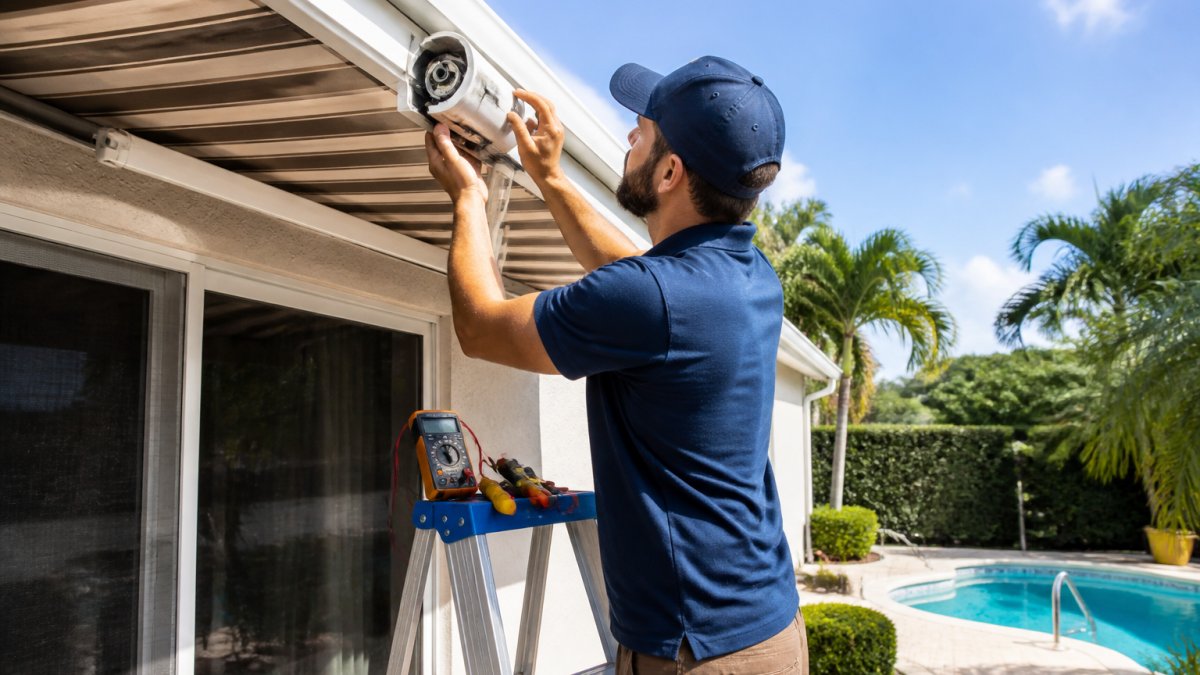
These repairs look like motor failure and aren’t, and they are the most common reason a homeowner calls for a replacement that never happens.
- Dead remote or receiver: a replacement remote or a re-pairing procedure, usually the cheapest line on any invoice
- Tripped GFCI or blown fuse on the dedicated awning circuit: a reset, not a repair
- Loose or corroded wiring at the motor connection or wall switch: a re-termination and a continuity test
A technician with a multimeter can usually isolate these at the motor head in under an hour. The parts are cheap; you are paying for diagnostic time and the trip charge.
Mid-Range Faults: Limit Switches and Control Boards
Limit switches tell the motor where to stop. When they fail, the awning overruns, stops short, or won’t stop. On many tubular motors the assembly is serviceable without replacing the motor, keeping the job mid-range.
Control boards and receivers sit in the same band. A board that no longer responds to the remote or wall switch can often be swapped as a module, but availability varies by brand and age.
High-Cost Faults: Burnt Windings and Stripped Gearboxes
True motor failure is the expensive category. The signs are consistent:
- Burnt or shorted windings: the motor is silent, trips the breaker, or smells hot; it will not run under any control input
- Stripped gearbox: the motor spins and you can hear it, but the tube does not turn, or it turns only under no load
- Seized bearings or a bent output shaft: usually the result of a wind event or a jammed arm that was run anyway
When the motor itself fails, you are paying for a motor assembly, not a component. That line item pushes a repair into the same territory as a new awning, which is why the repair-versus-replace decision matters most here.
How Motor Type and Awning Size Move the Number
Two awnings with the identical symptom can quote differently because the motor inside them is not the same class of part.
| Motor configuration | Where it is used | What it does to the estimate |
|---|---|---|
| Tubular motor | Most residential retractables; motor sits inside the roller tube | Common and widely stocked; replacement is a known procedure |
| Gear motor | Larger residential and light commercial units | Higher torque, heavier housing, longer removal and reinstall |
| Integrated motor-and-tube unit | Some premium and older models | Motor and tube are replaced together, so the part cost is higher |
| Manual crank or gearbox | Non-motorized awnings | No motor to replace; the repair scope is entirely mechanical |
Awning size feeds torque requirements: a wider, heavier awning needs a higher-torque motor, which costs more and is less likely to be on a service van. RV motors are smaller, more specialized, and sourced through RV parts channels, changing both price and lead time.
Ask for the failure category in writing, control, limit switch, control board, or motor, before you approve any work. The category, not the brand, is what determines whether you are looking at a component swap or a motor assembly.
When Fabric and Frame Damage Rides Along
A stalled motor is often a symptom, not the disease. A jammed arm, bent pivot, or shrunken fabric binding in the track will stall a healthy motor and make it look faulty, and if the technician replaces the motor without fixing the bind, the new motor fails the same way.
A competent diagnosis checks the fabric path and arms before condemning the motor. If you have fabric damage and a motor fault, get both assessed in one visit, a second service call for something visible on the first trip is money wasted.
Retractable Awning Motor Troubleshooting: Symptoms Before You Call
Retractable awning motor troubleshooting starts with three questions: does it respond to the remote, does it move in both directions, and does it stop where it should? Your answers narrow the fault before anyone gets on a ladder.
Run this sequence before you book a service call:
- Test the remote. Replace the battery, then try a second remote if you have one. A dead remote mimics a dead motor.
- Check the power. Confirm the breaker and any GFCI outlet on the awning circuit are not tripped.
- Listen at the motor head. A hum with no movement points to a capacitor or a jammed tube. Silence points to power or control.
- Try the wall switch. If the wall switch works but the remote doesn’t, the receiver is the problem, not the motor.
- Watch the retract cycle. An awning that stops short or overruns has a limit switch issue.
- Inspect the fabric and arms. A jammed arm can stall a healthy motor and make it look faulty.
Do not keep pressing the button when the awning is stuck. Holding a stalled motor under load overheats the windings and can turn a cheap limit-switch repair into a full motor replacement.
If steps one through six don’t resolve it, you are looking at a motor or control-board fault, and that is a technician’s job.
Awning Motor Replacement: When Repair No Longer Makes Sense
The decision rule is simple: repair when the fault is a component, replace when the motor itself is the failure. A capacitor, a limit switch, or a remote costs a fraction of a new motor and restores full function.
A common industry guideline is the 50% rule: if the repair quote approaches half the cost of a new motor or a new awning, replacement is usually the better long-term spend. Angi’s retractable awning cost guide outlines this threshold alongside common repair categories, and it holds up in practice.
Age matters too. A motor that has run for a decade or more has already delivered its service life. Repairing it buys time, not reliability, and you may be back on the phone within a season.
Ask the technician to test the motor under load after any repair, not just at the bench. A motor that spins freely off the awning can still stall once it is fighting the weight of the fabric and arms.
Retractable Awning Motor Replacement Cost: What Changes the Number
Awning motor replacement cost varies more than most owners expect, but the variables are predictable. Here is the breakdown that matters, followed by the factors that move each line.
The Four Lines on a Motor Repair Invoice
Every motor repair quote, repair or replacement, resolves into the same four lines. Ask for them separately to compare bids on equal footing.
Call us today for a free estimate →
| Line item | What it covers | What moves it |
|---|---|---|
| Service call / trip charge | Flat fee to get a technician to your property | Distance, market, whether the fee is waived if you approve the work |
| Diagnostic fee | Time tracing the fault through motor, wiring, switch, and remote | Whether it is folded into labor or billed separately |
| Parts | Motor, limit switches, capacitor, control board, or remote | Motor type, torque rating, brand availability, warranty status |
| Labor | Removal, bench repair or swap, reinstall, and a full retract-and-extend test | Access, mounting height, whether the tube must come down |
Two quotes for the same symptom can differ by hundreds of dollars purely because one itemizes the diagnostic and the other folds it into labor. Neither structure is wrong. You just need to see it before you decide.
What Warranty Coverage Actually Pays For
Warranty status is the biggest swing factor on a motor repair bill, and the one owners understand least.
- Parts-only coverage is the most common structure. The manufacturer supplies the motor, and you pay the labor to remove, install, and retest it. On a job where the motor is the expensive line, this is a large saving; on a job where labor dominates, it is a smaller one.
- Parts-and-labor coverage exists on some premium and extended warranties. Read the exclusions: many exclude service-call and diagnostic fees even when they cover the repair itself.
- Voided coverage is the risk to watch. Most manufacturers void the motor and workmanship warranty if the unit has been opened or modified by anyone other than a qualified technician. A DIY attempt to save a service call can cost you the entire warranty.
Before you approve any work, ask two questions: is the motor still under warranty, and does the warranty cover labor or parts only? The answer can change the out-of-pocket number more than the choice of contractor does.
Service-Call Fees, Minimum Labor, and Regional Variation
Three charges catch owners off guard, and none is a markup.
- Service-call fee: charged whether or not the technician can fix the unit on the first visit. Some contractors waive it if you approve the repair; many do not.
- Minimum labor charge: most shops bill a minimum, often one hour, even when the fix takes fifteen minutes. This is standard in the trades and worth confirming up front.
- Regional labor variation: the same job quotes differently across markets because hourly rates and travel distances differ. A dense metro market and a rural service area can produce materially different totals for identical work.
None of these are fake, they reflect travel time, insurance, and local rates. Ask each contractor to state them explicitly so the comparison is honest.
Repair Versus Replace: The Decision Rule
The decision rule is simple: repair when the fault is a component, replace when the motor itself is the failure. A capacitor, a limit switch, or a remote costs a fraction of a new motor and restores full function.
A common industry guideline is the 50% rule: if the repair quote approaches half the cost of a new motor or a new awning, replacement is usually the better long-term spend. Angi’s retractable awning cost guide outlines this threshold alongside common repair categories, and it holds up in practice.
Age matters too. A motor that has run for a decade or more has already delivered its service life. Repairing it buys time, not reliability, and you may be back on the phone within a season.
Long-Term Ownership: What Prevention Saves
Motor repair is often a maintenance failure, not a manufacturing one. The recurring costs are the avoidable ones.
- Weather exposure: motors on awnings left extended in wind and rain take on water and grit. Retracting in weather is the cheapest maintenance there is.
- Debris in the arms and track: leaves and twigs bind the fabric path and force the motor to work harder than it was rated for.
- Skipped lubrication: pivot points and the fabric path need periodic lubrication per the manufacturer’s instructions.
Service life varies by motor class and exposure, but the pattern holds: a motor retracted in weather, kept clear of debris, and never run while stalled reaches the upper end of its range. Prevention is the line item that never appears on an invoice.
DIY Repair vs. Professional Service: What You Can and Should Not Do
DIY repair makes sense for exactly three things: replacing a remote battery, resetting a tripped breaker or GFCI, and clearing debris from the arms and track. Everything past that involves 120-volt wiring, a spring-loaded roller tube, or a motor under tension, none safe to open without training.
What you can safely handle:
- Replacing remote batteries and re-pairing a remote to the receiver
- Resetting the breaker or GFCI on the awning circuit
- Clearing leaves, twigs, and grit from the arms and the fabric path
What you should not attempt:
- Opening the motor housing or the control box
- Working on the 120-volt supply, wiring, or switch
- Releasing or adjusting the roller tube spring
A retractable awning roller tube stores significant spring tension. Releasing it without the proper tools and procedure can cause serious injury and will void most warranties. This is the single most common DIY mistake we see.
There is a warranty angle too. Most manufacturers, including the coverage we provide at A to Z Awnings & Marine Canvas, void the motor and workmanship warranty if the unit is opened or modified by anyone other than a qualified technician. Saving a service call can cost you the entire warranty.
Conclusion: Getting a Real Number for Your Awning
No one can give a firm number without seeing the awning, testing the motor, and identifying the fault. What you can do is insist on a quote that separates the service call, diagnostic, parts, and labor, so you can compare bids on equal footing.
That is how we quote every motor repair at A to Z Awnings & Marine Canvas. We manufacture and service custom residential, commercial, and marine shading systems, we work with hundreds of Sunbrella fabrics, and every custom-made solution we deliver carries a 10-year warranty on both workmanship and materials.
Call us today for a free estimate.
Frequently Asked Questions
How much does it cost to repair a retractable awning motor?
Your actual awning motor repair cost depends on the make, model, awning size, and whether the issue is the motor itself, the wiring, or a remote control. Call A to Z Awnings & Marine Canvas for a free estimate on your specific setup.
Is it cheaper to repair or replace an awning motor?
It depends on the fault. A failed switch, remote, or loose connection is usually a small repair. A burnt-out motor on an older awning is often better replaced. If the repair costs more than half of a new motor or awning, replacement usually makes more sense. Compare the repair estimate against a full awning motor replacement cost before deciding, and factor in the age of the fabric and frame.
How do I know if my retractable awning motor has failed?
Common signs include the awning not retracting at all, moving in one direction only, stopping halfway, or making grinding noises. A non-retracting awning is a frequent sign of motor trouble. Before assuming the motor is dead, check the power supply, the switch, the remote batteries, and any sensor. Retractable awning motor troubleshooting starts with those simple checks, because a tripped breaker or dead remote can look exactly like a failed motor.
Can I manually retract an awning if the motor stops working?
Many motorized awnings have a manual override, often a crank or a strap, that lets you retract the awning when the motor fails. Check your owner’s manual for the override location, since it varies by model. If your awning has no override and the motor is stuck, do not force the arms. Call a technician. Forcing a retracting mechanism can bend the arms or strip the chain, turning a motor repair into a full frame replacement.
Does an awning warranty cover motor repairs?
Coverage varies by brand and by what failed. Many motor warranties cover defects in the motor itself but exclude damage from power surges, storms, or improper installation. A to Z Awnings & Marine Canvas backs its custom work with a 10-year warranty on workmanship and a 10-year warranty on Sunbrella material, so it pays to check what your specific warranty covers before you authorize a repair. Keep your purchase paperwork handy when you call.