


Table of Contents
- Benefits of Retractable Deck Awnings: Why Homeowners Make the Switch
- Cooler Decks and Lower Cooling Costs
- UV Protection for People, Pets, and Furniture
- Retractable Awning Pros and Cons: An Honest Look
- Retractable Awning vs Fixed Awning: Which Fits Your Deck?
- Retractable Awning Rain and Wind Limits: What to Know Before You Buy
- Choosing the Right Retractable Deck Awning for Your Space
- Frequently Asked Questions
Last Updated: October 9, 2026
Benefits of Retractable Deck Awnings: Why Homeowners Make the Switch
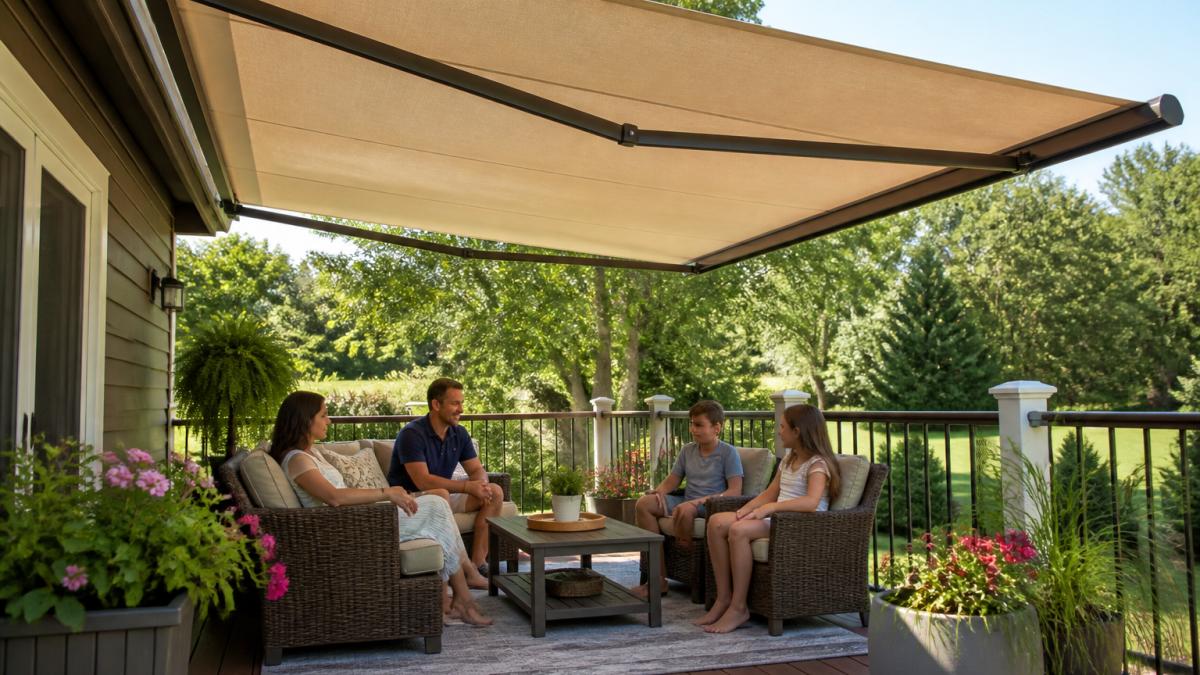
A retractable deck awning is a fabric canopy mounted to your home’s exterior that extends over your deck for shade and rolls back into a protective housing when you don’t need it. At A to Z Awnings & Marine Canvas, we build and service custom retractable deck awnings across Broward and Palm Beach counties, and the reasons homeowners call rarely change: too much sun, too much heat, and a deck they can’t use for half the day.
The benefits of retractable deck awnings come down to control: you decide when shade exists. Fixed structures don’t offer that choice, which is why so many homeowners switch after one season of fighting the sun.
Cooler Decks and Lower Cooling Costs
Shade works on two fronts: it cools the people under it and blocks heat before it reaches your walls. A retractable awning over west- or south-facing glass does both.
How Shade Blocks Heat Before It Reaches Your Home
Direct sunlight hitting a sliding glass door or window transfers heat straight into the room behind it. That’s why a west-facing living room turns into an oven by late afternoon. But the physics of shading exterior glass is well understood, and the U.S. Department of Energy guidance on shade and window heat gain explains how exterior shading reduces solar heat entering a home.
UV Protection for People, Pets, and Furniture
Sun exposure damages more than skin: it fades upholstery, cracks vinyl, and breaks down cushion stitching. A retractable awning creates a physical barrier between your deck and direct sunlight while extended.
For people and pets, that barrier matters. The U.S. Environmental Protection Agency’s UV safety guidance documents how prolonged exposure to UV rays contributes to skin damage and how shade reduces exposure during peak sun hours.
A common mistake is assuming dark awning fabric provides more UV protection than lighter fabric. In practice, construction and weave matter more than color.
Retractable Awning Pros and Cons: An Honest Look
No shade solution fits every deck. The honest trade-off:
Pros:
- Adjustable shade you control by time of day and season
- Rolls away for storage, so it isn’t exposed to storms year-round
- Protects people, pets, and outdoor furniture from direct sun
Cons:
- Costs more upfront than a basic fixed canopy
- Requires a sound mounting surface and proper installation
- Needs periodic cleaning and fabric care
The most common mistake we see is homeowners mounting a retractable unit to a surface that can’t carry the load, like a loose fence post or a rotted fascia board. The awning fails, and so does the deck attachment. Have the mounting surface checked before installation, not after.
Retractable Awning vs Fixed Awning: Which Fits Your Deck?
A fixed awning stays out permanently; a retractable one extends and rolls back on demand. That difference drives every other comparison.
| Factor | Retractable Awning | Fixed Awning |
|---|---|---|
| Adjustability | Extends and retracts on demand | Permanent, no adjustment |
| Weather exposure | Protected when rolled in | Exposed year-round |
| Wind and storm risk | Retracts to reduce damage | Must withstand all weather |
| Upfront cost | Higher | Lower |
| Best for | Decks used across seasons and times of day | Shade needed in one spot, all the time |
For a deck you use morning and evening, a retractable awning wins because the sun angle changes and you can match it. For a spot needing shade every hour, a fixed structure can make sense, though it takes the full brunt of weather with no way to move.
Retractable Awning Rain and Wind Limits: What to Know Before You Buy
A retractable awning is a fair-weather shade structure, not a roof. It handles a passing shower and light breeze but isn’t engineered to stay out through a storm; treating it like a permanent canopy is the fastest way to void a warranty and bend a frame.
What the Numbers Actually Mean
Every retractable awning has a model-specific wind limit. Common residential ratings fall around 15 to 25 mph for a fully extended unit, with heavier commercial frames rated higher.
The practical rule most installers give is simple: if you feel the awning lift, sway, or flutter, it’s already past the point where it should be out. Retract at the first sign of movement.
Why Wind, Not Sun, Kills Awnings
Fabric and frame both degrade over time, but wind causes sudden, expensive failure. When an extended awning catches a gust, load transfers through the arms, torsion bar or spring, and mounting brackets into your home’s framing.
This is why the mounting surface matters as much as the awning. A unit bolted into a solid rim joist or blocked wall stud handles load far better than one lagged into fascia board, a railing post, or a hollow wall.
Rain, Snow, and Ice
Light rain is fine; standing water is not. Awning fabric is water-resistant, not waterproof, and fabric that sags under pooling rain can stretch permanently or tear at the seams. If rain ponds on the fabric, retract the awning.
Call us today for a free estimate →
Snow and ice are a hard stop. An extended awning isn’t designed to carry snow load, and even a few inches of wet snow can exceed what the frame holds.
Retracting Discipline and Automated Help
Most awning damage is a timing problem, not a manufacturing one: the homeowner isn’t home when the afternoon storm rolls in, or wind picks up faster than expected. Two features reduce that risk:
- Wind sensors detect movement and trigger automatic retraction. They are the single most useful add-on for a deck that sits on an open, exposed lot.
- Sun and rain sensors extend the awning when sun is strong and retract it when rain begins, which suits a deck used unpredictably.
Sensors aren’t a substitute for judgment. They reduce forgotten retractions, but a sensor can fail, lose power, or react slower than a fast-moving front. If severe weather is forecast, retract manually and leave it in.
A retractable awning left out through a storm is one of the most common insurance-claim and warranty-void scenarios in the category. Check your homeowner’s policy and the awning warranty language before you assume storm damage is covered.
Matching the Awning to Your Exposure
Before you buy, assess how exposed your deck is. A deck tucked behind a privacy fence, hedge, or neighboring structure sees far less wind than one on an open corner lot or waterfront. If exposed, plan for a heavier frame, a lower wind rating you’ll respect, and a wind sensor. If sheltered, a lighter residential unit may serve you for years.
Manual vs Motorized Operation and Smart Controls
Manual awnings use a hand crank or pull strap. They cost less, have fewer parts to fail, and work fine on a smaller deck. Motorized awnings use a motor and wall switch or remote, and many connect to smart-home controls or wind and sun sensors that retract automatically. Motorized units suit large awnings, hard-to-reach mounts, and anyone who wants the awning to respond to conditions without being home.
If you’re choosing between manual and motorized, think about how you’ll actually use the deck. On a small deck where you extend the awning once a day, manual is the sensible pick. On a large deck or a commercial patio where the awning moves several times a day, motorized pays for itself in convenience and in fewer forgotten retractions before a storm.
Choosing the Right Retractable Deck Awning for Your Space
Most buying guides treat a deck like a patio and skip the details that determine whether an awning works: which way the deck faces, where doors and railings sit, how the sun moves across the space, and how much of the deck you want shaded at the hours you use it. Answer those before picking a size.
Start With Orientation, Not Square Footage
Sun angle drives everything. A south-facing deck gets strong midday sun and needs a shorter projection to shade seating at noon.
Walk your deck at the hours you actually use it and note where the sun hits. A unit sized for noon shade on a west-facing deck will leave your 5 p.m. dinner table in full sun. Match projection to your peak use time, not the deck’s total width.
Projection, Width, and Real Coverage
Awning projection is the distance the fabric extends from the mounting wall; common residential projections run about 8 to 13 feet, with wider units for large openings. Width is the span along the wall.
A useful rule of thumb: a projection of about half the deck’s depth shades the near half at midday, but not the far edge. For shade over a dining table at the far rail, you need a longer projection, a freestanding or pergola-mounted unit, or a second awning on an adjacent wall.
Deck Layout Details That Change the Plan
- Railing height and type. A solid or glass railing can block airflow and trap heat, which makes shade more valuable but also changes how the awning interacts with wind. Open metal railings let breeze through and reduce wind load on the awning.
- Door swing and headroom. A sliding door needs clearance so the awning’s leading edge and valance do not interfere with the track or the door’s travel. A hinged door needs headroom above the swing.
- Mounting wall condition. The wall must have solid framing or blocking behind it. Stucco, siding, and brick all require different fastening approaches, and a hollow or degraded wall needs reinforcement before installation.
Fabric, Frame, and Finish
Fabric choice affects heat, fade resistance, and appearance. Solution-dyed acrylic fabrics such as Sunbrella are engineered for UV resistance and colorfastness and hold color far better than printed or laminated fabrics (Sunbrella Fabric Difference).
Frame choice follows exposure. Standard powder-coated aluminum frames suit sheltered decks; heavier-gauge frames and stainless hardware make sense on exposed or waterfront decks where salt and wind are constant.
Ownership: Maintenance, Lifespan, and Repair
A retractable awning is a long-term purchase, and care determines how long it lasts.
- Cleaning. Brush off debris and rinse the fabric periodically with mild soap and water. Do not scrub with abrasive cleaners or pressure-wash the fabric, which damages the weave and the finish.
- Inspection. Check the arms, brackets, and mounting hardware each season for looseness, rust, or wear. A loose bracket caught early is a cheap fix; a failed bracket is not.
- Seasonal care. Retract and secure the awning before storm season and before winter. Clean and dry the fabric before long storage to prevent mildew.
A Pre-Purchase Checklist
- The mounting surface can carry the awning’s load, verified before installation
- The projection matches the sun angles at your peak use times, not just the deck width
- The frame and hardware suit your wind and salt exposure
A to Z Awnings & Marine Canvas manufactures and services custom residential, commercial, and marine shading solutions, and we repair existing awnings too. If you’re weighing a new retractable deck awning against fixing what you have, we’ll give you a straight answer on which makes more sense.
Frequently Asked Questions
Can you leave a retractable awning out in the rain?
Retractable awnings can handle light rain, but they are not built to stay out in heavy storms. Most manufacturers recommend retracting the awning when rain becomes steady or when wind picks up, because water can pool on the fabric and strain the frame. If you want rain coverage for a deck, look for a model with a steep pitch and water-resistant fabric, and always retract it before severe weather arrives.
Do retractable deck awnings actually keep a deck cooler?
Yes. By blocking direct sunlight before it hits the deck surface, a retractable awning can lower the temperature on your deck by a noticeable margin. The shade also reduces heat that would otherwise radiate through windows and doors, which can ease the load on your air conditioning. Homeowners often find the deck becomes usable earlier in the day and stays comfortable longer into the afternoon.
Are retractable awnings better than fixed awnings?
It depends on how you use your deck. Retractable awnings give you adjustable shade, so you can extend them when the sun is strong and retract them when you want open sky or need to protect the fabric from wind. Fixed awnings offer permanent coverage and fewer moving parts, but they cannot adapt to changing sun angles or weather. For decks that see varied use, retractable models usually offer more flexibility.
What are the main pros and cons of retractable awnings?
Pros include flexible shade control, UV protection for people and furniture, reduced heat on the deck, and the ability to retract the awning during high wind or storms. Cons include a higher upfront cost than fixed awnings, more moving parts that can wear over time, and the need to retract them during severe weather. Regular maintenance and a quality warranty help offset the long-term drawbacks.