


Table of Contents
- Why Florida Patios Need Engineered Shade Systems
- Types of Commercial Patio Shade Systems Compared
- Why Do Outdoor Awnings Fade? Fabric, Sun, and Salt Air
- Wind Load and Building Code Requirements for Shade Structures
- Maintenance Tips for Outdoor Shade Systems in Coastal Climates
- Commercial Retractable Awning Cost: What Drives the Price
- How to Choose a Commercial Patio Shade System
- Conclusion
- Frequently Asked Questions
Last Updated: October 2, 2026
Why Florida Patios Need Engineered Shade Systems
Commercial patio shade systems in Florida are structural equipment built to survive hurricane-season wind loads, salt air, and year-round UV that destroys ordinary fabric. At A to Z Awnings & Marine Canvas, we manufacture and service custom shading for restaurants, commercial properties, and homes across Broward and Palm Beach counties, and the failures we repair almost always trace back to one thing: a system never engineered for this climate.
Types of Commercial Patio Shade Systems Compared
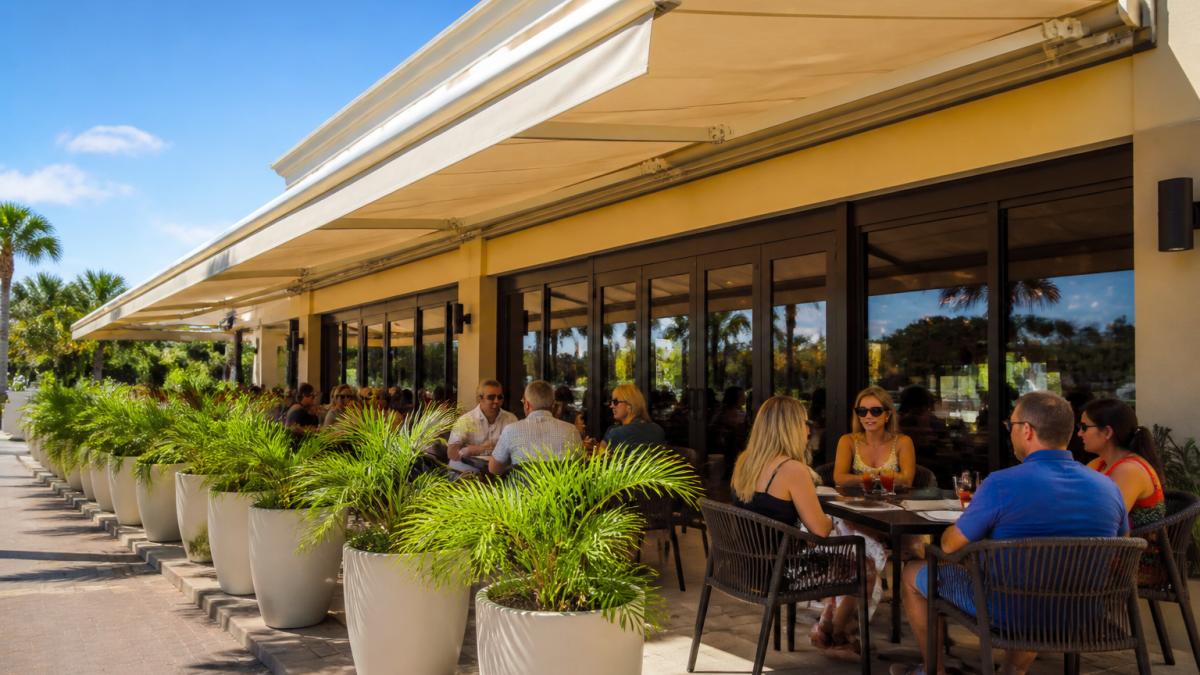
Three families of shade systems dominate commercial patios, each solving a different problem. Retractable awnings give adjustable coverage attached to the building. Shade sails and fabric canopies cover open areas without wall support. Commercial umbrellas and modular structures offer flexibility where nothing can be permanently anchored.
| System | Best For | Coverage Type | Key Tradeoff |
|---|---|---|---|
| Retractable awnings | Restaurants, storefronts | Building-attached, adjustable | Needs sound mounting and wind sensors |
| Shade sails and fabric canopies | Open patios, playgrounds | Freestanding, fixed | No adjustability once installed |
| Commercial umbrellas | Flexible seating, events | Portable, repositionable | Lower wind resistance |
Retractable Awnings
Retractable awnings mount to the building and extend over the patio on demand. The advantage is control: extend for midday sun, retract ahead of a storm. Motorized units with wind sensors retract automatically when gusts pick up. The tradeoff: mounting structure and mechanism both have to be right, a cheap motor on a heavy awning is the most common failure point we see on service calls.
Shade Sails and Fabric Canopies
Shade sails use tensioned, permeable fabric stretched between steel anchor points. Because the fabric is permeable, hot air escapes instead of collecting underneath, keeping the space cooler than a solid cover. High-density polyethylene and tensile fabric sails block UV while letting breezes through, suiting open patios, parks, and playgrounds with no wall to attach to. Once installed, coverage is fixed, so the design has to be right the first time.
Commercial Umbrellas and Modular Structures
Cantilever and center-pole commercial umbrellas move where you need them, useful for patios that reconfigure for events. Modular structures take that flexibility further, letting you add or rearrange shade sections as seating changes. Umbrellas carry the lowest wind rating of the three, so they come in at night or ahead of storms in coastal areas.
Why Do Outdoor Awnings Fade? Fabric, Sun, and Salt Air
The fastest way to extend fabric life is to keep it clean. Salt and pollen bond to the weave and hold moisture against the fibers. A gentle rinse every few weeks during the dry season removes both before they do damage.
Awnings that fail early usually fail for one of four reasons: surface-dyed fabric, standard thread, corroding hardware, or a frame undersized for the wind it faces. Fix any one and the lifespan stretches considerably.
Wind Load and Building Code Requirements for Shade Structures
Shade structures in Florida are regulated as structures, not furniture, which means they must be engineered for wind load and permitted through the local building department before a single anchor is set. Wind load is the lateral and uplift force a structure must resist based on its size, height, attachment method, and site location. Coastal exposure zones carry the highest requirements, and a shade structure not engineered to them can fail inspection, void insurance coverage, or become a projectile in a storm.
- Basic wind speed (Vult): The ultimate design wind speed for the site, read from the wind-speed maps in the code. Coastal Broward and Palm Beach County sit in some of the highest wind-speed zones in the state.
- Exposure category: B, C, or D, based on how open the terrain is. An oceanfront patio is Exposure D; a site surrounded by low-rise buildings may qualify as B. Exposure D produces the highest pressures.
- Risk category: Assigned by occupancy. A restaurant patio, a school playground, and a single-family home can fall into different categories, and higher categories carry stricter factors.
- Height and topography: Taller structures and sites on or near ridges see higher pressures.
- Attachment method: A building-attached awning transfers load into the wall and roof structure; a freestanding sail or canopy resists load through its own footings and anchors. The two are engineered completely differently.
The Permit Process, Step by Step
For commercial patios, the permit path typically runs through the county or municipal building department, in this sequence:
- Confirm zoning and site rules. Some commercial districts restrict projections over sidewalks, setbacks, or easements. Check before you design.
- Commission the engineering. A licensed engineer or the manufacturer’s engineering department produces stamped drawings showing the wind-load calculation, frame sizing, and anchor details.
- Assemble the submittal package. This usually includes the stamped drawings, a product data sheet or Florida Product Approval (or a local product approval) for the shade system, the contractor’s license information, and a site plan.
- Submit and pay fees. Review timelines vary by jurisdiction and design complexity, some run days, others several weeks.
- Pull the permit and install. Installation must match the approved drawings. Substitutions on frame gauge or anchor size can trigger a re-review.
- Pass the inspection. Most jurisdictions require at least a final inspection, and some require a footing or anchor inspection before the structure is closed up.
An awning or shade structure installed without a permit can fail inspection and may void your property insurance. In a storm, an unengineered structure becomes a hazard to people and property, and the liability lands on the owner, not the installer.
What This Means for a Commercial Patio
For a restaurant or commercial property, treat the shade system like any other permitted improvement. Budget for engineering and permit time alongside the hardware, and choose a manufacturer who can supply the stamped drawings and product approvals your jurisdiction will ask for. A system that arrives with engineering documentation attached moves through review far faster than one requiring the contractor to reverse-engineer the numbers afterward.
Maintenance Tips for Outdoor Shade Systems in Coastal Climates
- Rinse fabric and frames with fresh water every few weeks to remove salt and pollen
- Brush off mildew with a soft brush and mild soap, never a stiff brush or bleach
- Lubricate retractable mechanisms and check tension at the start of each season
- Inspect stitching and seams for pulled threads before and after storm season
- Retract or remove umbrellas and free-standing units ahead of named storms
- Check anchors and mounting hardware for corrosion annually
The single highest-return habit is a fresh-water rinse. It takes minutes and removes the salt and pollen that hold moisture against fabric and hardware.
Repair versus replace is the question most owners ask. If the fabric is structurally sound and only the stitching has failed, restitching is often the practical fix. If the fabric has gone brittle, the color has chalked out, or the frame has corroded through, replacement is the better spend. A full-service shop can assess both and tell you which one you are looking at.
Call us today for a free estimate →
Commercial Retractable Awning Cost: What Drives the Price
Commercial retractable awning cost depends on four variables: size, fabric grade, mechanism, and mounting conditions. Any quote that does not account for all four is incomplete. Width and projection set the material volume, fabric grade determines how long the color and weave hold up, the mechanism, manual or motorized, sets the moving-parts cost, and mounting conditions determine how much structural work the installation needs.
The ROI Case: Shade as Revenue, Not Overhead
For a restaurant or hospitality operator, the better question is not what the awning costs but what the covered square footage earns. A patio that bakes in direct afternoon sun sits empty during peak lunch and early-dinner hours. Shade converts that dead space into usable seating, and usable seating is revenue. The math most operators run:
- Covered seats × turns per day × average check. If shade adds even a handful of usable tables during the hottest hours, the added covers can offset a meaningful share of the project cost over a single season.
- Extended season. Shade and the cooling it provides can stretch the comfortable outdoor season at both ends of the year, adding weeks of patio revenue.
- Reduced cooling load. Shading glass doors and windows on a south- or west-facing facade reduces solar heat gain, which lowers the load on the building’s air-conditioning system. The savings show up on the utility bill, not the awning invoice.
- Asset protection. Shade protects tables, chairs, finishes, and flooring from UV degradation, extending the replacement cycle on furniture and finishes.
How to Compare Quotes
Because the variables change so much from one patio to the next, pricing has to be quoted per project. The fastest way to an accurate figure is a site assessment, where the contractor measures the space, checks the mounting surface, and factors in wind exposure. When reviewing bids, ask each contractor to break the quote into these line items so you can compare apples to apples:
- Structure and frame (gauge, finish, and wind rating)
- Fabric (brand, weave, and warranty length)
- Mechanism (manual vs. motorized, wind sensor included?)
- Engineering and stamped drawings
- Permit support and inspection coordination
- Installation labor and any structural reinforcement
- Warranty terms on workmanship and material
Restaurant owners and commercial property managers who need adjustable, building-attached coverage that can be retracted ahead of storms, and who want to weigh the project against the revenue the covered seating generates.
How to Choose a Commercial Patio Shade System
Choosing a commercial patio shade system starts with three questions: how much area needs cover, does the coverage need to adjust, and what wind exposure does the site carry. Answer those and the system type narrows quickly.
- Attachment points: Is there a sound wall for an awning, or does the area need freestanding sails?
- Adjustability: Does the space need shade that moves with the sun, or fixed coverage?
- Wind exposure: What does the site’s wind load requirement demand of the frame and anchors?
- Fabric: Solution-dyed acrylic for colorfastness; marine-grade thread for salt air
- Frame: Powder-coated steel or aluminum sized to the wind load
- Warranty: Ask what is covered and for how long on both workmanship and material
- Service: Confirm the installer also handles repairs and restitching
Conclusion
Getting shade right on a commercial patio means solving for wind, salt, and sun at once, and that is where most off-the-shelf systems fall short. A to Z Awnings & Marine Canvas manufactures custom shade solutions with hundreds of premium Sunbrella fabrics, a 10-year warranty on workmanship, and a 10-year warranty on Sunbrella material, backed by full-service manufacturing and repairs.
Frequently Asked Questions
What are the most durable shade materials for high-heat environments?
Solution-dyed acrylic fabrics such as Sunbrella hold color and resist UV degradation far better than printed or dyed-after-weave fabrics, because the pigment runs through each fiber rather than sitting on the surface. High-density polyethylene works well for shade sails because it breathes and lets heat escape. Frames matter just as much: powder-coated steel or marine-grade aluminum resist rust and corrosion in coastal air. A 10-year warranty on both material and workmanship is a reasonable signal that a manufacturer expects the fabric and frame to hold up under constant sun.
Do commercial shade structures require building permits?
In most cases, yes. Commercial shade systems typically need a permit because they are permanent or semi-permanent structures attached to a building or anchored to the ground, and reviewers want to see wind load calculations for your site. Requirements vary by county and municipality, and coastal areas often apply stricter rules. A contractor who manufactures and installs shade systems locally usually handles the permit paperwork and engineering documentation as part of the project, which saves you from submitting incomplete applications and waiting through repeated review cycles.
How do retractable awnings compare to fixed shade structures?
Retractable awnings give you adjustable coverage: extend them on a bright afternoon, retract them before a storm, and control how much sun reaches your patio throughout the day. They suit restaurants and cafes where flexibility matters. Fixed structures such as shade sails and canopies stay in place year-round and generally handle wind better because there are no moving parts or motors to fail. Many commercial patios combine both, using a fixed canopy over a permanent seating area and a retractable awning over a section that needs seasonal or hourly adjustment.
What is the average lifespan of a commercial patio shade system?
A well-built commercial shade system with solution-dyed acrylic fabric and a powder-coated or aluminum frame commonly lasts 10 to 15 years, and often longer with regular cleaning and prompt repairs. Lifespan depends heavily on sun exposure, salt air, and how quickly you address small problems like loose stitching or a failing motor. Systems that are never cleaned or repaired tend to fail in half that time. A 10-year warranty on workmanship and material gives you a concrete benchmark for what a manufacturer expects from its own product.
Are there specific wind load requirements for shade structures?
Yes. Shade structures must be engineered to resist the wind speeds your area can expect, and coastal counties apply some of the strictest wind load standards in the country. That means the frame, anchors, and fabric attachment points all need to be designed for the load, not just the fabric itself. A shade system that looks solid on a calm day can fail in a storm if its footings or brackets were undersized. Ask any contractor for the engineering documentation behind their wind load rating before you sign.