Tag Archives: why do outdoor awnings fade

Commercial Patio Shade Systems in Florida: 2026 Guide

Table of Contents

Last Updated: October 2, 2026

Why Florida Patios Need Engineered Shade Systems

Commercial patio shade systems in Florida are structural equipment built to survive hurricane-season wind loads, salt air, and year-round UV that destroys ordinary fabric. At A to Z Awnings & Marine Canvas, we manufacture and service custom shading for restaurants, commercial properties, and homes across Broward and Palm Beach counties, and the failures we repair almost always trace back to one thing: a system never engineered for this climate.

Types of Commercial Patio Shade Systems Compared

Three families of shade systems dominate commercial patios, each solving a different problem. Retractable awnings give adjustable coverage attached to the building. Shade sails and fabric canopies cover open areas without wall support. Commercial umbrellas and modular structures offer flexibility where nothing can be permanently anchored.
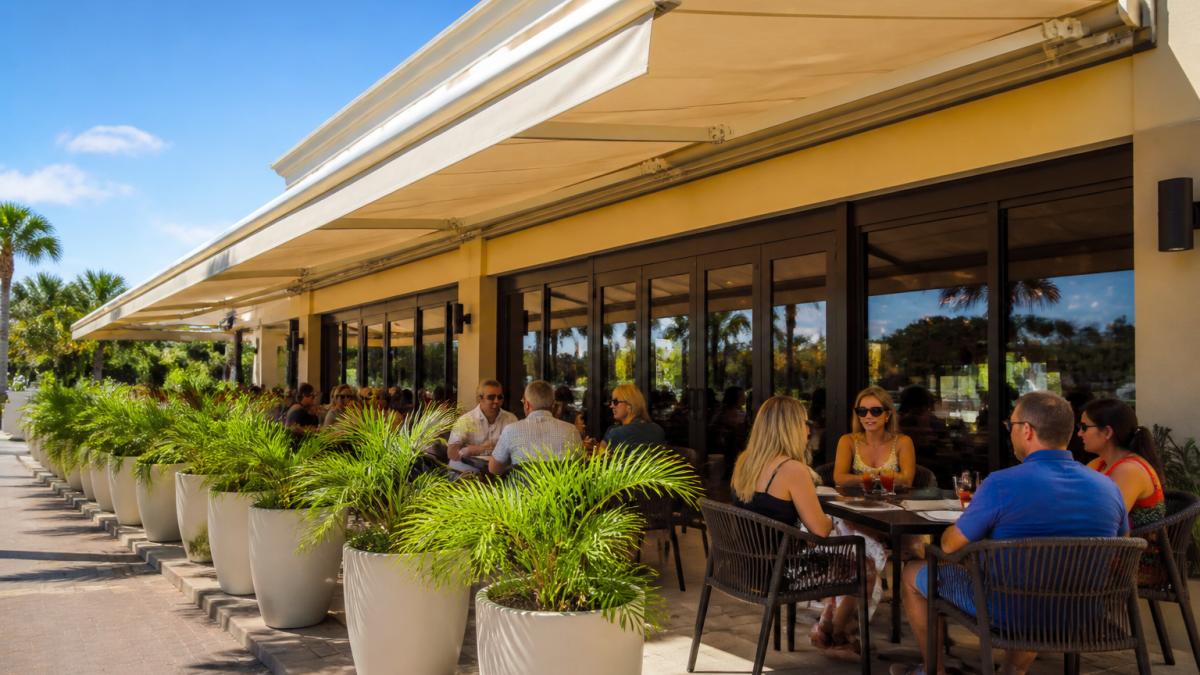
Diners seated under a retractable fabric awning as one of the popular patio shade systems at a sunny restaurant.
System Best For Coverage Type Key Tradeoff
Retractable awnings Restaurants, storefronts Building-attached, adjustable Needs sound mounting and wind sensors
Shade sails and fabric canopies Open patios, playgrounds Freestanding, fixed No adjustability once installed
Commercial umbrellas Flexible seating, events Portable, repositionable Lower wind resistance

Retractable Awnings

Retractable awnings mount to the building and extend over the patio on demand. The advantage is control: extend for midday sun, retract ahead of a storm. Motorized units with wind sensors retract automatically when gusts pick up. The tradeoff: mounting structure and mechanism both have to be right, a cheap motor on a heavy awning is the most common failure point we see on service calls.

Shade Sails and Fabric Canopies

Shade sails use tensioned, permeable fabric stretched between steel anchor points. Because the fabric is permeable, hot air escapes instead of collecting underneath, keeping the space cooler than a solid cover. High-density polyethylene and tensile fabric sails block UV while letting breezes through, suiting open patios, parks, and playgrounds with no wall to attach to. Once installed, coverage is fixed, so the design has to be right the first time.

Commercial Umbrellas and Modular Structures

Cantilever and center-pole commercial umbrellas move where you need them, useful for patios that reconfigure for events. Modular structures take that flexibility further, letting you add or rearrange shade sections as seating changes. Umbrellas carry the lowest wind rating of the three, so they come in at night or ahead of storms in coastal areas.

Why Do Outdoor Awnings Fade? Fabric, Sun, and Salt Air

Pro Tip
The fastest way to extend fabric life is to keep it clean. Salt and pollen bond to the weave and hold moisture against the fibers. A gentle rinse every few weeks during the dry season removes both before they do damage.

Awnings that fail early usually fail for one of four reasons: surface-dyed fabric, standard thread, corroding hardware, or a frame undersized for the wind it faces. Fix any one and the lifespan stretches considerably.

Wind Load and Building Code Requirements for Shade Structures

Shade structures in Florida are regulated as structures, not furniture, which means they must be engineered for wind load and permitted through the local building department before a single anchor is set. Wind load is the lateral and uplift force a structure must resist based on its size, height, attachment method, and site location. Coastal exposure zones carry the highest requirements, and a shade structure not engineered to them can fail inspection, void insurance coverage, or become a projectile in a storm.

  • Basic wind speed (Vult): The ultimate design wind speed for the site, read from the wind-speed maps in the code. Coastal Broward and Palm Beach County sit in some of the highest wind-speed zones in the state.
  • Exposure category: B, C, or D, based on how open the terrain is. An oceanfront patio is Exposure D; a site surrounded by low-rise buildings may qualify as B. Exposure D produces the highest pressures.
  • Risk category: Assigned by occupancy. A restaurant patio, a school playground, and a single-family home can fall into different categories, and higher categories carry stricter factors.
  • Height and topography: Taller structures and sites on or near ridges see higher pressures.
  • Attachment method: A building-attached awning transfers load into the wall and roof structure; a freestanding sail or canopy resists load through its own footings and anchors. The two are engineered completely differently.

The Permit Process, Step by Step

For commercial patios, the permit path typically runs through the county or municipal building department, in this sequence:

  1. Confirm zoning and site rules. Some commercial districts restrict projections over sidewalks, setbacks, or easements. Check before you design.
  2. Commission the engineering. A licensed engineer or the manufacturer’s engineering department produces stamped drawings showing the wind-load calculation, frame sizing, and anchor details.
  3. Assemble the submittal package. This usually includes the stamped drawings, a product data sheet or Florida Product Approval (or a local product approval) for the shade system, the contractor’s license information, and a site plan.
  4. Submit and pay fees. Review timelines vary by jurisdiction and design complexity, some run days, others several weeks.
  5. Pull the permit and install. Installation must match the approved drawings. Substitutions on frame gauge or anchor size can trigger a re-review.
  6. Pass the inspection. Most jurisdictions require at least a final inspection, and some require a footing or anchor inspection before the structure is closed up.
Watch Out
An awning or shade structure installed without a permit can fail inspection and may void your property insurance. In a storm, an unengineered structure becomes a hazard to people and property, and the liability lands on the owner, not the installer.

What This Means for a Commercial Patio

For a restaurant or commercial property, treat the shade system like any other permitted improvement. Budget for engineering and permit time alongside the hardware, and choose a manufacturer who can supply the stamped drawings and product approvals your jurisdiction will ask for. A system that arrives with engineering documentation attached moves through review far faster than one requiring the contractor to reverse-engineer the numbers afterward.

Maintenance Tips for Outdoor Shade Systems in Coastal Climates

  • Rinse fabric and frames with fresh water every few weeks to remove salt and pollen
  • Brush off mildew with a soft brush and mild soap, never a stiff brush or bleach
  • Lubricate retractable mechanisms and check tension at the start of each season
  • Inspect stitching and seams for pulled threads before and after storm season
  • Retract or remove umbrellas and free-standing units ahead of named storms
  • Check anchors and mounting hardware for corrosion annually
Key Takeaway
The single highest-return habit is a fresh-water rinse. It takes minutes and removes the salt and pollen that hold moisture against fabric and hardware.

Repair versus replace is the question most owners ask. If the fabric is structurally sound and only the stitching has failed, restitching is often the practical fix. If the fabric has gone brittle, the color has chalked out, or the frame has corroded through, replacement is the better spend. A full-service shop can assess both and tell you which one you are looking at.

Call us today for a free estimate →

Commercial Retractable Awning Cost: What Drives the Price

Commercial retractable awning cost depends on four variables: size, fabric grade, mechanism, and mounting conditions. Any quote that does not account for all four is incomplete. Width and projection set the material volume, fabric grade determines how long the color and weave hold up, the mechanism, manual or motorized, sets the moving-parts cost, and mounting conditions determine how much structural work the installation needs.

The ROI Case: Shade as Revenue, Not Overhead

For a restaurant or hospitality operator, the better question is not what the awning costs but what the covered square footage earns. A patio that bakes in direct afternoon sun sits empty during peak lunch and early-dinner hours. Shade converts that dead space into usable seating, and usable seating is revenue. The math most operators run:

  • Covered seats × turns per day × average check. If shade adds even a handful of usable tables during the hottest hours, the added covers can offset a meaningful share of the project cost over a single season.
  • Extended season. Shade and the cooling it provides can stretch the comfortable outdoor season at both ends of the year, adding weeks of patio revenue.
  • Reduced cooling load. Shading glass doors and windows on a south- or west-facing facade reduces solar heat gain, which lowers the load on the building’s air-conditioning system. The savings show up on the utility bill, not the awning invoice.
  • Asset protection. Shade protects tables, chairs, finishes, and flooring from UV degradation, extending the replacement cycle on furniture and finishes.

How to Compare Quotes

Because the variables change so much from one patio to the next, pricing has to be quoted per project. The fastest way to an accurate figure is a site assessment, where the contractor measures the space, checks the mounting surface, and factors in wind exposure. When reviewing bids, ask each contractor to break the quote into these line items so you can compare apples to apples:

  • Structure and frame (gauge, finish, and wind rating)
  • Fabric (brand, weave, and warranty length)
  • Mechanism (manual vs. motorized, wind sensor included?)
  • Engineering and stamped drawings
  • Permit support and inspection coordination
  • Installation labor and any structural reinforcement
  • Warranty terms on workmanship and material
Best For
Restaurant owners and commercial property managers who need adjustable, building-attached coverage that can be retracted ahead of storms, and who want to weigh the project against the revenue the covered seating generates.

How to Choose a Commercial Patio Shade System

Choosing a commercial patio shade system starts with three questions: how much area needs cover, does the coverage need to adjust, and what wind exposure does the site carry. Answer those and the system type narrows quickly.

  • Attachment points: Is there a sound wall for an awning, or does the area need freestanding sails?
  • Adjustability: Does the space need shade that moves with the sun, or fixed coverage?
  • Wind exposure: What does the site’s wind load requirement demand of the frame and anchors?
  • Fabric: Solution-dyed acrylic for colorfastness; marine-grade thread for salt air
  • Frame: Powder-coated steel or aluminum sized to the wind load
  • Warranty: Ask what is covered and for how long on both workmanship and material
  • Service: Confirm the installer also handles repairs and restitching

Conclusion

Getting shade right on a commercial patio means solving for wind, salt, and sun at once, and that is where most off-the-shelf systems fall short. A to Z Awnings & Marine Canvas manufactures custom shade solutions with hundreds of premium Sunbrella fabrics, a 10-year warranty on workmanship, and a 10-year warranty on Sunbrella material, backed by full-service manufacturing and repairs.

Frequently Asked Questions

What are the most durable shade materials for high-heat environments?

Solution-dyed acrylic fabrics such as Sunbrella hold color and resist UV degradation far better than printed or dyed-after-weave fabrics, because the pigment runs through each fiber rather than sitting on the surface. High-density polyethylene works well for shade sails because it breathes and lets heat escape. Frames matter just as much: powder-coated steel or marine-grade aluminum resist rust and corrosion in coastal air. A 10-year warranty on both material and workmanship is a reasonable signal that a manufacturer expects the fabric and frame to hold up under constant sun.

Do commercial shade structures require building permits?

In most cases, yes. Commercial shade systems typically need a permit because they are permanent or semi-permanent structures attached to a building or anchored to the ground, and reviewers want to see wind load calculations for your site. Requirements vary by county and municipality, and coastal areas often apply stricter rules. A contractor who manufactures and installs shade systems locally usually handles the permit paperwork and engineering documentation as part of the project, which saves you from submitting incomplete applications and waiting through repeated review cycles.

How do retractable awnings compare to fixed shade structures?

Retractable awnings give you adjustable coverage: extend them on a bright afternoon, retract them before a storm, and control how much sun reaches your patio throughout the day. They suit restaurants and cafes where flexibility matters. Fixed structures such as shade sails and canopies stay in place year-round and generally handle wind better because there are no moving parts or motors to fail. Many commercial patios combine both, using a fixed canopy over a permanent seating area and a retractable awning over a section that needs seasonal or hourly adjustment.

What is the average lifespan of a commercial patio shade system?

A well-built commercial shade system with solution-dyed acrylic fabric and a powder-coated or aluminum frame commonly lasts 10 to 15 years, and often longer with regular cleaning and prompt repairs. Lifespan depends heavily on sun exposure, salt air, and how quickly you address small problems like loose stitching or a failing motor. Systems that are never cleaned or repaired tend to fail in half that time. A 10-year warranty on workmanship and material gives you a concrete benchmark for what a manufacturer expects from its own product.

Are there specific wind load requirements for shade structures?

Yes. Shade structures must be engineered to resist the wind speeds your area can expect, and coastal counties apply some of the strictest wind load standards in the country. That means the frame, anchors, and fabric attachment points all need to be designed for the load, not just the fabric itself. A shade system that looks solid on a calm day can fail in a storm if its footings or brackets were undersized. Ask any contractor for the engineering documentation behind their wind load rating before you sign.
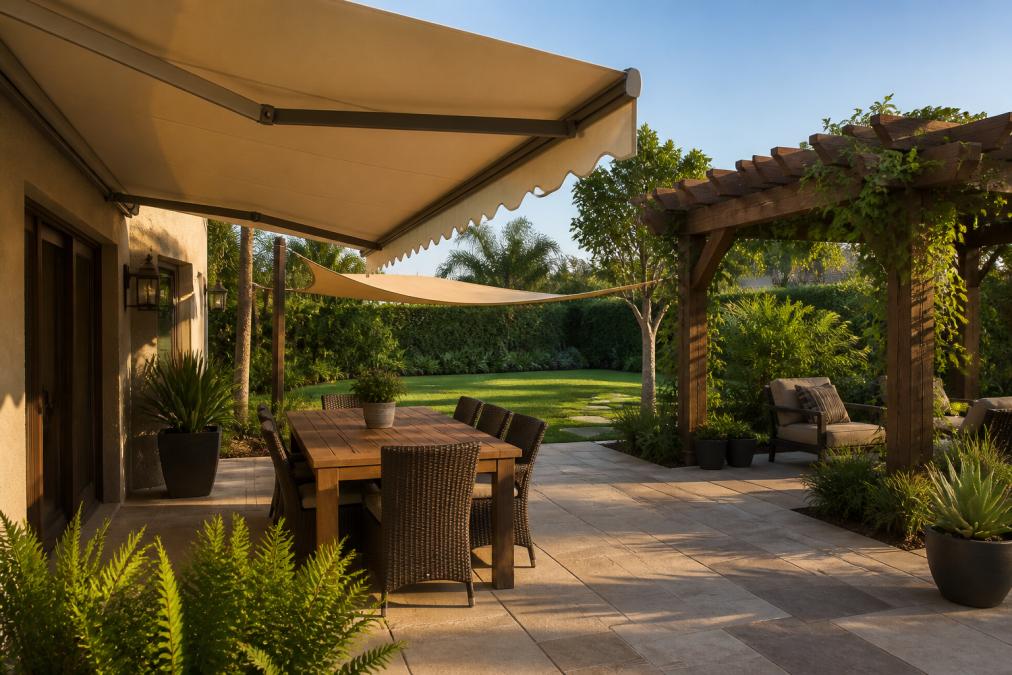
Delray Awning Alternative for Residential Shade

Table of Contents

Last Updated: September 27, 2026

Why Homeowners Look for a Delray Awning Alternative

Homeowners searching for a Delray awning alternative for residential shade usually share the same frustrations: fabric that faded within a few seasons, motors that quit, and frames that rattled loose in the first strong storm. At A to Z Awnings & Marine Canvas, we hear these complaints from homeowners across Broward and Palm Beach counties, and the pattern is always the same. The original awning was chosen on price, not on how it would hold up to salt air, humidity, and summer UV.

That’s the real problem. A residential awning is not a seasonal accessory in this climate; it’s exterior equipment that has to survive year-round sun and hurricane-season wind.

Top Residential Shading Solutions Compared

Residential shading solutions fall into three main categories: retractable awnings, pergolas, and custom marine canvas systems. Each handles sun and rain differently, and each carries a different long-term cost profile. The table below summarizes how they compare before we dig into the details.

Infographic comparing residential shading options like a Delray awning, pergola, and custom canvas sail for patio areas.
Solution Best For Weather Resistance Maintenance Level
Retractable awnings Flexible sun control on patios and decks Good with proper wind sensors Low to moderate
Pergolas Permanent outdoor living structures Structural, but open roofs offer limited rain cover Moderate to high
Custom marine canvas Shade sails, full enclosures, coastal exposure High when built with marine-grade materials Low

Retractable Awnings

Retractable awnings mount to the house and extend or retract on demand, so you control shade hour by hour. Motorized models with wind sensors retract automatically when gusts pick up, which protects both fabric and frame. The trade-off is mechanical: motors and arms are the parts that fail first, so warranty coverage on both matters more than the fabric warranty most brands advertise.

Pergolas

Pergolas are permanent structures that add architectural value and define an outdoor room. A traditional open-roof pergola gives partial shade that shifts through the day, which suits plants and evening gatherings but leaves you exposed at midday. Louvered and fabric-topped versions close that gap at a higher cost. Where pergolas fall short is permitting and wind engineering: attached structures typically need wind-load documentation, and in coastal zones that paperwork is not optional.

Custom Marine Canvas Shading

Custom marine canvas shading uses the same materials trusted on boats: solution-dyed acrylic fabric, marine-grade thread, and hardware built for salt and sun. For coastal homes, this is often the most durable option available. Full enclosures, shade sails, and custom cushions can all be fabricated to fit odd angles, columns, and railings that off-the-shelf products can’t handle. The result is a tailored look rather than a bolted-on afterthought.

Retractable Awning vs Pergola: Which Suits Your Home?

The retractable awning vs pergola decision comes down to one question: do you need adjustable shade or permanent structure? Retractable awnings win on flexibility and cost control, since you shade only the hours you need and can retract everything ahead of a storm. Pergolas win on permanence and resale appeal, but they cost more upfront and require more planning.

Here’s a simple way to decide:

  • Choose a retractable awning if you want shade over an existing patio or deck, you rent or may move, or you want protection you can retract during storms.
  • Choose a pergola if you’re building an outdoor room, you want a fixed structure for entertaining, and you’re prepared for permitting and engineering.
  • Choose custom marine canvas if you live near the water, your space has irregular geometry, or you want the longest service life per dollar.

Why Do Outdoor Awnings Fade? And How to Choose Fade-Resistant Options

  • Dye method. Solution-dyed fibers resist UV fading; printed or surface-dyed fabrics don’t.
  • Stitching and thread. Standard thread rots in humid coastal air. Marine-grade thread is treated to resist UV and mildew.
  • Sealing and hardware. Stainless steel and sealed fasteners prevent the rust streaks and staining that ruin an otherwise good fabric.
Pro Tip
When comparing quotes, ask what thread and hardware are specified, not just the fabric brand. The fabric usually outlives the stitching and fasteners by years, and those are the parts that fail first in coastal humidity.

Replacement is sometimes the smarter call. If the frame and motor are sound but the fabric is faded and the stitching is failing, re-covering costs less than a full new system. If the arms are bent or the motor has already been replaced once, replacement usually wins.

Hurricane and Wind Resistance for Coastal Homes

Hurricane and wind resistance starts with honest engineering, not marketing labels. Any awning or shading structure should be rated for the wind loads expected at your specific location, and retractable systems should have a wind sensor that retracts them automatically before gusts reach damaging speeds. Stationary structures need documented wind-load calculations, especially for attached pergolas and shade sails.

Watch Out
Never leave a retractable awning extended when a storm is forecast, even if the motor is rated for high winds. Wind sensors fail, power goes out, and a deployed awning in a hurricane can damage the frame, the fascia, and the wall it’s mounted to.

Energy Efficiency ROI and Smart Home Integration

  • Orientation. West- and south-facing glass carries the heaviest cooling load in most homes, so shading there returns the most.

  • Window area and glazing. Large single-pane or older double-pane windows benefit more than small, well-insulated units.

  • Shade coverage and angle. A system sized to block midday and late-afternoon sun at your latitude does more than one that only covers morning hours.

    Call us today for a free estimate →

  • Climate and equipment. Savings scale with how hard your system already works during cooling season.

  • Sun tracking. The awning extends and retracts based on solar position rather than a fixed clock, so coverage follows the sun through the season.

  • Wind and rain sensors. Anemometer and rain-sensor inputs retract the awning automatically when conditions turn, protecting fabric and arms without you being home.

  • Schedules and scenes. Shading can join a morning or evening scene alongside lights and climate, so the patio is ready when you are.

  • Voice and app control. Manual override from a phone or voice assistant handles the days the automation guesses wrong.

Pro Tip
Ask your installer to document the awning’s wind-sensor threshold and retract speed in writing. That single number tells you more about storm protection than any marketing label on the box.

Permitting, HOA Compliance, and Installation: DIY vs Professional

  • A site plan showing the structure’s location and setbacks
  • Wind-load calculations for your exposure category
  • Product specifications and engineering drawings
  • Contractor licensing information for the installer
Factor DIY Professional
Best for Small fixed awnings, simple walls, single windows Motorized, retractable, and large systems; irregular geometry
Structural engineering You may need to hire an engineer separately Typically included in the quote
Permits and HOA paperwork You handle it Usually handled for you
Warranty Often voided Preserved
Risk Mount failure, water intrusion, voided coverage Minimal when licensed and insured
Key Takeaway
Check HOA rules and permit requirements before you order. It’s the single most common reason a shading project gets delayed or redone, and it costs nothing to verify first.

At A to Z Awnings & Marine Canvas, custom fabrication is measured to your actual space, so the fit, mounting points, and fabric selection are resolved before installation day. That’s also where the 10-year warranty on workmanship and Sunbrella material comes from: it’s a custom-built system, not a one-size box.

Conclusion: Choosing Your Delray Awning Alternative

The right alternative depends on your exposure, your HOA, and how much maintenance you’re willing to take on. Retractables give you flexibility, pergolas give you permanence, and custom marine canvas gives you the longest service life in coastal conditions. What none of them tolerate is guesswork on wind ratings, materials, or permits.


Frequently Asked Questions

What can I use instead of an awning for residential shade?

Alternatives include retractable awnings, pergolas, shade sails, and custom marine canvas systems. Retractable awnings offer flexibility and UV protection, while pergolas provide permanent structure. Custom marine canvas shading, like that from A to Z Awnings & Marine Canvas, uses Sunbrella fabric for fade resistance and a 10-year warranty. Each option varies in cost, durability, and wind resistance, so consider your climate and HOA rules.

Are retractable awnings better than pergolas for long-term investment?

It depends on your needs. Retractable awnings offer adjustable shade and can be retracted during storms, making them ideal for windy coastal areas. Pergolas are permanent structures that add architectural value but require more maintenance and may not provide full UV protection without added covers. For hurricane-prone regions, retractable awnings with wind sensors and a 10-year warranty can be a smarter investment.

Why do outdoor awnings fade, and how can I prevent it?

Fading occurs from UV exposure, moisture, and poor-quality dyes. Solution-dyed acrylic fabrics like Sunbrella resist fading significantly better than standard polyester. To prevent fading, choose fade-resistant fabrics, clean regularly, and consider retractable awnings that can be retracted when not in use. A to Z Awnings & Marine Canvas offers hundreds of Sunbrella fabrics with a 10-year warranty against material failure.

Can custom marine canvas shading work for my patio or deck?

Yes, custom marine canvas shading is not just for boats. It can be tailored for residential patios, decks, and pergolas. These systems use durable, weather-resistant fabrics and hardware designed for harsh coastal conditions, including salt air and high winds. A to Z Awnings & Marine Canvas specializes in custom fabrication, ensuring a precise fit and long-lasting performance with a 10-year workmanship warranty.

How do I handle permits and HOA approvals for a new awning or shade structure?

Check with your local building department and HOA before installing any exterior shading. Many Florida municipalities require permits for permanent structures like pergolas, and HOAs often have design guidelines. A to Z Awnings & Marine Canvas can provide documentation and specifications to help with the approval process. Professional installation ensures compliance with wind load and safety codes.

Best Awning Fabrics for Florida: 2026 Buyer’s Guide

Table of Contents

Last Updated: September 21, 2026

What Makes Awning Fabric Perform in Florida’s Climate

Choosing the best awning fabrics for Florida comes down to one question: can these awning fabrics survive intense sun, salty air, and year-round humidity without fading, rotting, or tearing? At A to Z Awnings & Marine Canvas, material selection matters more here than almost anywhere else in the country.

The Four Stressors: UV, Salt, Humidity, and Heat

UV radiation breaks down the dyes and fibers in low-grade fabric, causing fade and weakening the weave over time. Salt air accelerates corrosion on hardware and can degrade stitching. Humidity feeds mold growth and mildew if moisture gets trapped. Heat adds constant thermal stress that shortens the life of any material that can’t handle it.

Fabric Comparison: Acrylic, Polyester, and Vinyl

Three fabric families dominate the market, and each handles the four stressors differently. Solution-dyed acrylic leads for color retention and breathability. Polyester composites cost less but fade faster. Vinyl-coated fabrics resist water well but trap heat and moisture.

Solution-Dyed Acrylic vs. Polyester Composite vs. Vinyl-Coated

Solution-dyed acrylic has pigment added to the fiber before it’s spun, so color runs all the way through. That’s why it resists fade so well. It also breathes, which helps prevent mildew.

Fabric Type Fade Resistance Breathability Mildew Risk Best For
Solution-dyed acrylic High High Low Sun-facing patios, coastal homes
Polyester composite Medium Medium Medium Budget residential projects
Vinyl-coated Medium Low Higher Marine covers, waterproof needs

Why Do Outdoor Awnings Fade? The Science of UV Degradation

Outdoor awnings fade because UV radiation breaks the chemical bonds in fabric dyes and fibers, a process called UV degradation. Surface-dyed fabrics lose color first; solution-dyed fabrics resist it because the pigment is locked inside each fiber rather than sitting on top.

How Solution-Dyed Pigments Resist Color Loss

When pigment is added during fiber production, there’s no surface layer to wash or wear away. Color fastness stays high even after years of sun exposure. That’s the core reason solution-dyed acrylic holds up so well in direct sun.

Pro Tip
A common mistake is judging fabric by feel alone. A soft, thick-feeling fabric can still be surface-dyed and fade within a season. Ask specifically whether the fabric is solution-dyed before you buy.

Sunbrella vs Tempotest vs Sattler: Which Brand Holds Up Best

All three are respected solution-dyed acrylic brands, and each has loyal users. The useful comparison is not the logo, it is the specific fabric line, the weave weight, and how that construction behaves under salt air, humidity, and sustained UV.

Brand Typical Construction Standout Strength Trade-off to Know
Sunbrella Solution-dyed acrylic, fluoropolymer finish Widest color/pattern range, published care guidance Finish needs re-treatment over time in salt air
Tempotest Solution-dyed acrylic Consistent color matching across large runs Different drape affects retractable tension
Sattler Solution-dyed acrylic, often heavier weight Wind resistance, shape retention Heavier fabric can strain some retractable frames

What Actually Matters More Than the Brand

Three variables outweigh brand choice in this climate:

  1. Weave weight and construction. A heavier, tighter weave resists wind load and holds shape longer. Lighter fabric is easier to retract but stretches and flaps sooner.
  2. Thread and stitching. UV and salt break down thread faster than fabric. Bonded or UV-stabilized thread on seams is the single most overlooked durability factor on any awning.
  3. Installation and tension. A well-installed solution-dyed acrylic from any of these makers will outperform a poorly installed bargain fabric every time. Correct tension prevents flapping, which is what tears fabric and pulls seams.
Key Takeaway
Brand loyalty matters less than fabric construction and installation quality. Ask for the specific fabric line, the weave weight, and the thread type before you compare prices.

Florida-Specific Trade-offs

Salt air attacks the water-repellent finish and the stitching before it attacks the color. That means the maintenance cycle, rinsing salt residue and re-treating the finish, extends fabric life more than upgrading from one premium brand to another. For fixed awnings in exposed coastal locations, the heavier Sattler-style construction often wins on wind resistance; for retractable awnings where weight and drape matter, Sunbrella and Tempotest lines are usually easier to live with.

manufacturer fabric care and warranty documentation

How to Clean Outdoor Awning Fabric Without Damaging It

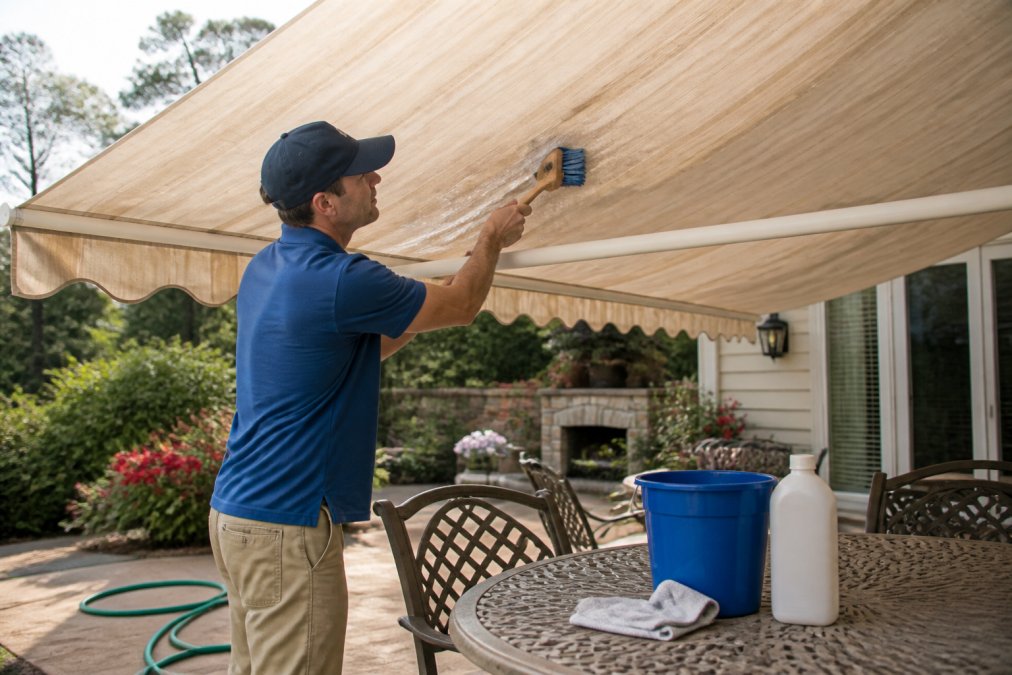
Cleaning outdoor awning fabric is straightforward if you use mild soap, a soft-bristle brush, and plain water, then let it air dry fully. Harsh cleaners and pressure washers are the fastest way to strip water repellency and damage stitching.

Homeowner using a soft-bristle brush to gently clean outdoor awning fabrics with a mild soapy solution

Here’s a simple cleaning routine:

  • Brush off loose dirt and debris with a soft brush
  • Mix mild soap with lukewarm water in a bucket
  • Scrub gently in the direction of the weave
  • Rinse thoroughly with a garden hose
  • Let the fabric dry completely before retracting
  • Repeat two to three times per year, more in salt-air zones

Mildew, Salt Air, and Stitching: What to Watch

Mildew shows up as dark spots that won’t rinse away. Salt air leaves a residue that attracts moisture and can corrode hardware. Stitching is the weak point on any awning: UV and salt break down thread faster than fabric, so inspect seams each season.

Water Repellency, Breathability, and Fire Ratings Explained

Water repellency and waterproofing are not the same thing. Water-repellent fabric sheds rain but still lets air move through. Waterproof fabric blocks water completely but traps moisture and heat underneath.

Watch Out
Never assume a fabric is fire-rated. Commercial awnings and some residential installations require documented fire retardant classification. Skipping this step can fail inspection and force a costly re-do.

Energy Savings and HOA Compliance for Florida Awnings

This is the section most generic awning guides skip entirely, and it is where local homeowners get burned, literally on cooling costs and figuratively on HOA fines.

How Awnings Cut Cooling Load

An awning works by intercepting solar radiation before it reaches the glass or the patio surface. When direct sun hits a window, that energy enters as heat gain and your air conditioner has to remove it. Shade the window from the outside and the heat never enters.

  • Orientation. West- and south-facing windows gain the most heat in the afternoon. Awnings on those exposures deliver the largest cooling benefit.
  • Coverage. A deeper projection shades more glass and more wall. A shallow awning that only covers the top third of a window does far less.
  • Fabric and color. A light-colored, tightly woven fabric reflects more solar energy and stays cooler to the touch than a dark, open weave. Breathable fabric also lets hot air escape from underneath rather than trapping it against the wall.
Pro Tip
For the biggest cooling benefit, prioritize awnings over west- and south-facing glass, and choose a light-colored, tightly woven solution-dyed acrylic. Dark fabric absorbs heat and radiates it back toward the wall.

HOA Rules: What to Check Before You Order Fabric

Many communities restrict awning color, style, and even whether retractable or fixed designs are allowed. Because fabric color is the hardest thing to change after installation, confirm HOA approval before you commit to a color or pattern.

A practical checklist:

  • Request the HOA’s architectural guidelines in writing
  • Confirm approved colors and patterns, not just “earth tones”
  • Confirm whether retractable and fixed awnings are treated differently
  • Confirm whether a permit is required from your local building department
  • Get written approval before ordering custom fabric

Fire Ratings and Code Compliance

Commercial awnings and some residential installations require documented fire retardant classification. Always confirm the fabric’s fire retardant classification meets local building code before ordering. Skipping this step can fail inspection and force a costly re-do, and because fabric is custom-cut, a failed inspection often means buying the material twice.

The Sustainability Angle Most Guides Ignore

Solution-dyed acrylic is a long-life material, and that is its main environmental advantage: a fabric that lasts 10-plus years replaces several short-life alternatives. When it does reach end of life, disposal options are limited, most awning fabric is not widely recyclable through curbside programs, and acrylic does not biodegrade quickly in landfill. The practical takeaway is to buy for longevity, choose a color and pattern you will not want to change, and ask your fabricator whether offcuts and retired fabric can be diverted from the waste stream.

Best For
Best for coastal and waterfront properties where salt air corrosion and humidity control are the top concerns.

Conclusion: Choosing the Right Fabric for Your Project

The best awning fabric for your project balances fade resistance, breathability, mildew inhibition, and code compliance. Solution-dyed acrylic remains the strongest all-around choice for Florida’s climate, especially when paired with proper installation and a real maintenance cycle.

Frequently Asked Questions

What is the best fabric for outdoor awnings in high-UV climates?

Solution-dyed acrylic is the top choice for high-UV areas. The pigment is added to the fiber before it’s spun, so color holds up far longer than surface-dyed alternatives. Brands like Sunbrella, Tempotest, and Sattler all offer solution-dyed acrylic lines with strong fade resistance and UV protection. Look for fabric weight around 9 to 11 ounces per square yard for a good balance of durability and flexibility.

Is there a better outdoor fabric than Sunbrella for humidity resistance?

Sunbrella performs well in humidity, but some buyers prefer vinyl-coated polyester for extreme moisture exposure because it resists mold and mildew without needing applied treatments. The trade-off is breathability: vinyl-coated fabrics trap heat and condensation more than acrylic. For most Florida patios, solution-dyed acrylic with proper tension and airflow works well. For marine enclosures or constantly wet areas, vinyl-coated polyester is worth considering.

How do acrylic fabrics compare to vinyl for residential awnings?

Acrylic fabrics breathe, resist fading, and feel like traditional canvas, which suits residential patios and decks. Vinyl-coated fabrics are waterproof, easy to wipe clean, and resist mildew, but they don’t breathe as well and can feel stiff. Acrylic is usually the better pick for residential shade where appearance and airflow matter. Vinyl makes more sense for commercial kitchens, boat covers, or areas exposed to constant moisture.

What maintenance is required for high-performance awning fabrics?

Brush off loose dirt, then wash with mild soap and lukewarm water using a soft brush. Rinse thoroughly and let it air-dry fully before retracting. For mildew, use a diluted bleach solution (no more than one cup per gallon of water), let it soak briefly, then rinse. Avoid harsh detergents, pressure washers, and machine drying. Inspect stitching and hardware twice a year, and re-tension the fabric if it sags. Consistent cleaning extends fabric life significantly.


Picking the right fabric is only half the battle; installation and ongoing care decide whether your awning lasts five years or fifteen. A to Z Awnings & Marine Canvas builds custom awnings with hundreds of Sunbrella fabric options, a 10-year workmanship warranty, and a 10-year material warranty on Sunbrella. Call us today for a free estimate and get a shading solution made for your space.

Custom Patio Awnings Fort Lauderdale: 2026 Buying Guide

Table of Contents

Last Updated: September 16, 2026

Custom Patio Awnings in Fort Lauderdale: What Actually Matters in 2026

Custom patio awnings are built-to-order shading systems designed to fit a specific roofline, patio dimension, and sun exposure rather than a standard size pulled off a shelf. In coastal Broward County, that distinction decides whether a shade structure survives five summers or fails in three. This guide from A to Z Awnings & Marine Canvas breaks down fabric, hardware, permits, and real cost drivers so you can compare quotes on equal terms.

Most buyers start with the wrong question. They ask “how much per square foot?” when the honest answer depends on fabric grade, frame material, and whether the unit retracts.

The five factors below drive almost every quote you’ll receive. Below, we’ll show you exactly how to read each one.

Why Do Outdoor Awnings Fade? Fabric, Salt Air, and UV Exposure

Outdoor awnings fade because ultraviolet radiation breaks down the dye molecules in the fabric while salt-laden air corrodes the thread and hardware holding it together. Coastal Broward County combines both stressors at higher intensity, and the failure sequence is predictable once you understand the materials.

Four mechanisms do the damage, and each one points to a specific spec you should demand in a quote:

  • UV degradation of the fabric. Sustained sun exposure bleaches pigment and weakens fibers. Solution-dyed acrylic resists this far better than surface-dyed or printed fabric because the pigment is extruded into the fiber itself rather than applied on top. When the surface wears, the color underneath is the same color.
  • Salt-air corrosion of metal. Airborne chloride attacks unprotected steel and even low-grade aluminum. The parts that fail first are the ones you never see: mounting brackets, lag bolts, pivot pins, and the fasteners inside the folding arms. Marine-grade 316 stainless steel fasteners and powder-coated or anodized aluminum frames are the coastal standard; plain galvanized hardware is a three-to-five-year part in this environment.
  • Thread degradation at the seams. The stitching often fails before the fabric does. Standard polyester thread breaks down under UV and salt exposure, which is why coastal fabricators specify PTFE (Teflon) or solution-dyed acrylic thread. If a quote doesn’t name the thread, ask, it’s the cheapest place to cut corners and the most common seam-failure point.
  • Moisture and mildew in folded fabric. Humidity trapped in a rolled-up awning feeds mildew along seams and hems, and mildew damage is almost never covered by a fabric warranty.

Solution-dyed acrylic fabric resists fading far better than surface-dyed alternatives because the pigment runs through the fiber rather than sitting on top of it. That’s the single biggest reason fabric choice matters more than frame choice in this climate, but only if the hardware and thread are specified to match.

Pro Tip
When you compare quotes, ask each fabricator to list four things in writing: fabric construction (solution-dyed acrylic vs. surface-dyed), frame alloy and finish, fastener grade, and thread type. Two quotes that look identical on price can differ significantly in service life based on those four lines alone.

Sunbrella Fabric Durability: What the Warranty Really Covers

Sunbrella fabric durability comes down to its construction: solution-dyed acrylic fibers that hold color through the entire yarn. The manufacturer’s warranty covers fading and loss of strength for a defined period, but it does not cover damage from mildew, improper cleaning, or physical abuse.

Read the fine print before you sign anything.

Pro Tip
Ask your installer to show you both warranty documents separately: one for the fabric, one for the installation. A strong fabric warranty paired with a weak workmanship warranty leaves you exposed on the seams.

A to Z Awnings & Marine Canvas backs its custom work with a 10-year warranty on workmanship and a 10-year warranty on Sunbrella material, which closes that gap rather than leaving it open.

Retractable Awning Cost vs Fixed Canopy: How to Compare Quotes

Retractable awning cost runs higher than a fixed canopy because you’re paying for a folding arm mechanism, a torsion system, and often a motor. A fixed canopy uses simpler structure, so the material and labor bill is lower. Whether that savings is worth it depends entirely on how you use the space.

What Drives the Price of a Retractable Awning

Four variables move the number more than anything else:

Cost Driver What It Changes Why It Matters
Fabric grade Acrylic vs. solution-dyed acrylic Determines fade resistance and lifespan
Frame material Aluminum vs. powder-coated steel Corrosion resistance in salt air
Operation Manual crank vs. motorized Adds mechanism and wiring cost
Size and projection Width and reach of the unit Drives material volume and arm strength

Pricing depends on your specific dimensions, fabric selection, and mounting conditions, so a credible quote requires an on-site measurement. Be cautious with any provider that quotes a firm number over the phone without seeing the space.

When a Fixed Canopy Is the Smarter Buy

A fixed canopy wins when the shaded area never changes. Restaurant patios with permanent seating, storefront entries, and walkway covers rarely need to retract, so paying for folding arms adds cost without adding function. In those cases, a well-engineered fixed structure delivers more shade per dollar and fewer moving parts to service.

Call us today for a free estimate →

Permits, HOA Rules, and Wind Load Ratings in Broward County

Most awning installations in Broward County require a building permit, and nearly all of them require compliance with the Florida Building Code’s wind load provisions. Skipping the permit is a significant shortcut a homeowner can take, because unpermitted structures surface during resale and can force removal at your cost.

Three approval layers typically apply:

  • Municipal building department: Structural and wind load review.
  • HOA architectural committee: Color, style, and placement approval.
  • Coastal or historic overlays: Additional restrictions in some neighborhoods.
Watch Out
Installing an awning without a permit can void your homeowner’s insurance coverage for wind damage and create a title problem when you sell. The cost of retroactive permitting and possible removal can exceed the permit fee you tried to avoid.

Custom Design, Fabrication, and Installation: What the Process Looks Like

Custom design starts with a site measurement, not a catalog. The installer records the mounting surface, projection depth, sun angle, and any obstructions, then builds a unit to those dimensions. Fabrication happens off-site, and installation typically follows once the frame and fabric are complete.

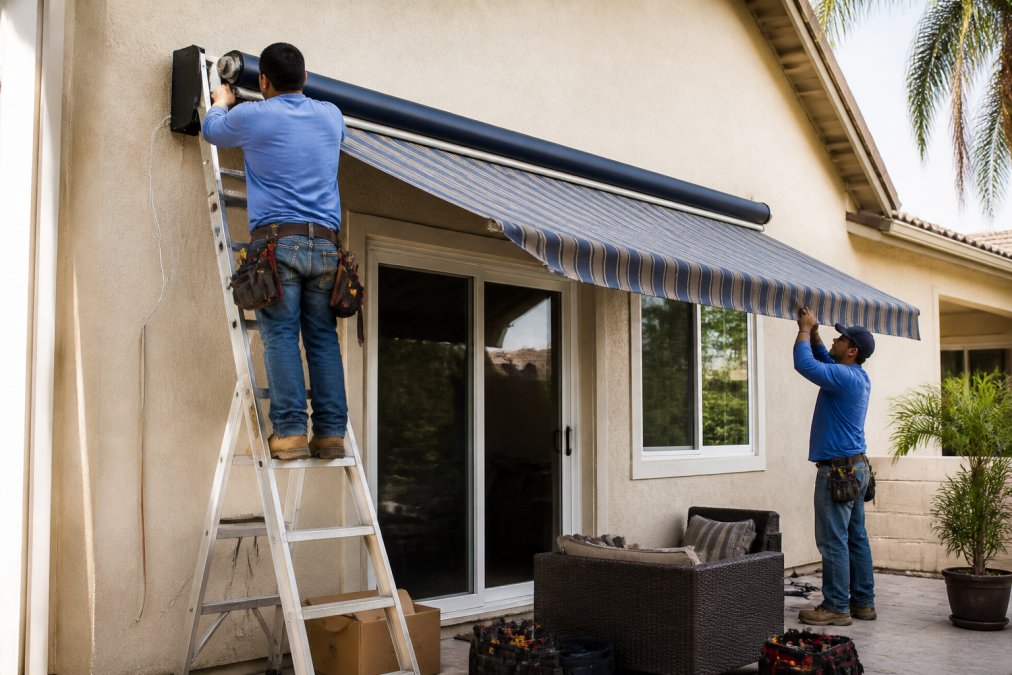
Workers installing retractable patio awnings on a residential home exterior.

Residential vs Commercial Projects

Residential installation prioritizes appearance and how the awning integrates with the home’s exterior design. Commercial storefront work adds different demands: larger spans, higher wind exposure, ADA clearance considerations, and durability under daily use. A restaurant patio, for example, needs fabric that resists grease and frequent cleaning in addition to sun and salt.

Motorized vs Manual Operation

Motorized operation adds convenience and is worth it for large or hard-to-reach units. Manual crank systems cost less, have fewer failure points, and remain a sensible choice for smaller awnings you can reach easily. Remote control operation also lets you retract the awning quickly when weather turns, which protects the fabric.

Maintenance, Repairs, and When to Replace Your Patio Awnings

Key Takeaway
Retracting fabric while it’s still wet can lead to premature awning failure in coastal climates. Letting it dry completely helps prevent mildew and seam rot.

Repair or replace? Fix it when the frame is sound and the damage is isolated to stitching, a single panel, or hardware. Replace it when the fabric has lost strength across the span, when corrosion has reached structural members, or when repairs approach the cost of new fabrication. A to Z Awnings & Marine Canvas handles both repairs and full replacements, so an honest assessment comes before a sales pitch.

ROI and Property Value: Do Custom Patio Awnings Pay Off?

1. Usable square footage. An uncovered patio in this climate can be functionally unusable for much of the day during the hottest months. Shade can convert that slab into space a family uses, dining, entertaining, working. Appraisers don’t add line-item value for an awning the way they do for a screened enclosure, but buyers touring homes in summer may notice which patios are comfortable and which are not.

Key Takeaway
The honest framing: a custom awning is a lifestyle and operating-cost investment first, a resale-value play second. Buyers who expect a dollar-for-dollar bump at sale are usually disappointed; buyers who value the shaded space every weekend for a decade rarely are.

If you’re weighing a residential upgrade against a commercial buildout, the decision criteria are different enough that it’s worth getting a site-specific assessment rather than comparing headline prices.

Frequently Asked Questions

How much does a custom patio awning cost?

Pricing depends on width, fabric choice, retractable or fixed frame, and motorization, so there is no single number. A small manual window awning costs far less than a full motorized patio system with custom fabrication. Sunbrella fabric and corrosion-resistant hardware add to the total but extend service life. Request a free estimate with your patio dimensions and shade goals for an accurate quote.

Are there specific building codes for residential awnings?

Yes. In Broward County, residential awnings typically require a permit and must meet the Florida Building Code wind load requirements for the property’s wind zone. Homeowner association rules may also govern color, projection, and placement. A licensed contractor handles the permit paperwork and provides engineering documentation. Skipping this step can mean fines, failed inspections, or an awning that will not survive a storm.

How do I maintain custom patio awnings in coastal climates?

Rinse the fabric monthly with fresh water to remove salt and pollen, and scrub mild mildew with a soft brush and diluted soap. Keep the frame and hardware free of salt buildup, and lubricate moving parts on retractable units once a year. Retract awnings during high winds and storms. Annual professional inspection catches stitching wear and hardware corrosion before they become expensive repairs.

What is the difference between an awning and a patio cover?

An awning is a fabric or metal shade attached to the exterior wall, often retractable, and typically projects over a door, window, or patio. A patio cover is a permanent roofed structure, such as a pergola or solid roof, supported by posts. Awnings cost less, install faster, and can be retracted. Patio covers offer more permanent weather protection but usually require a larger structural and permitting commitment.