


Table of Contents
- Why Homeowners Look for a Delray Awning Alternative
- Top Residential Shading Solutions Compared
- Retractable Awning vs Pergola: Which Suits Your Home?
- Why Do Outdoor Awnings Fade? And How to Choose Fade-Resistant Options
- Hurricane and Wind Resistance for Coastal Homes
- Energy Efficiency ROI and Smart Home Integration
- Permitting, HOA Compliance, and Installation: DIY vs Professional
- Conclusion: Choosing Your Delray Awning Alternative
- Frequently Asked Questions
Last Updated: September 27, 2026
Why Homeowners Look for a Delray Awning Alternative
Homeowners searching for a Delray awning alternative for residential shade usually share the same frustrations: fabric that faded within a few seasons, motors that quit, and frames that rattled loose in the first strong storm. At A to Z Awnings & Marine Canvas, we hear these complaints from homeowners across Broward and Palm Beach counties, and the pattern is always the same. The original awning was chosen on price, not on how it would hold up to salt air, humidity, and summer UV.
That’s the real problem. A residential awning is not a seasonal accessory in this climate; it’s exterior equipment that has to survive year-round sun and hurricane-season wind.
Top Residential Shading Solutions Compared
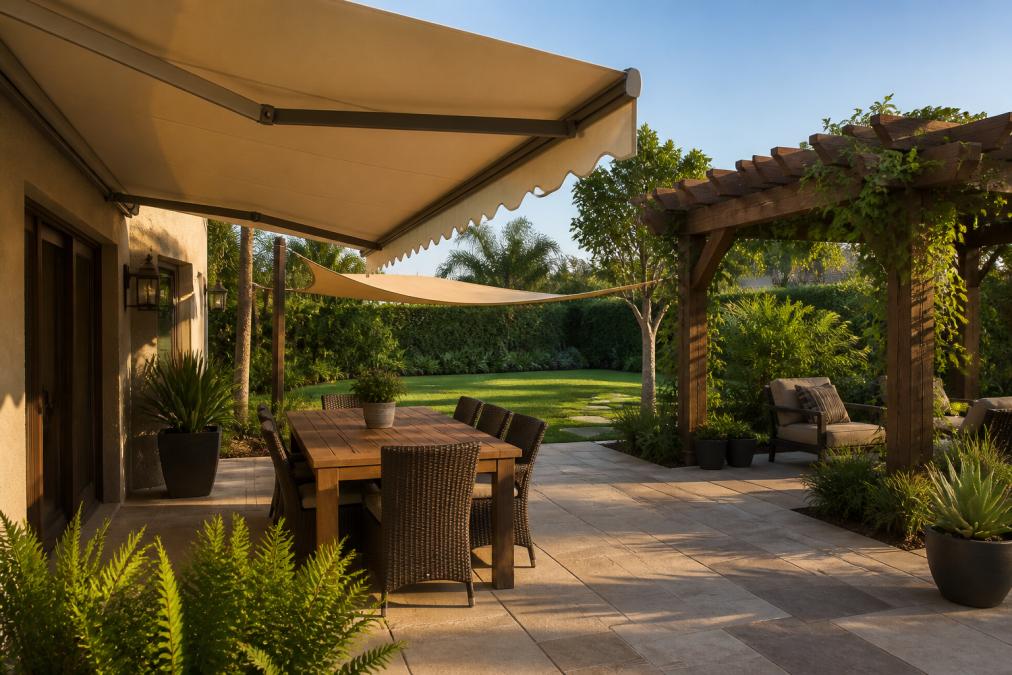
Residential shading solutions fall into three main categories: retractable awnings, pergolas, and custom marine canvas systems. Each handles sun and rain differently, and each carries a different long-term cost profile. The table below summarizes how they compare before we dig into the details.
| Solution | Best For | Weather Resistance | Maintenance Level |
|---|---|---|---|
| Retractable awnings | Flexible sun control on patios and decks | Good with proper wind sensors | Low to moderate |
| Pergolas | Permanent outdoor living structures | Structural, but open roofs offer limited rain cover | Moderate to high |
| Custom marine canvas | Shade sails, full enclosures, coastal exposure | High when built with marine-grade materials | Low |
Retractable Awnings
Retractable awnings mount to the house and extend or retract on demand, so you control shade hour by hour. Motorized models with wind sensors retract automatically when gusts pick up, which protects both fabric and frame. The trade-off is mechanical: motors and arms are the parts that fail first, so warranty coverage on both matters more than the fabric warranty most brands advertise.
Pergolas
Pergolas are permanent structures that add architectural value and define an outdoor room. A traditional open-roof pergola gives partial shade that shifts through the day, which suits plants and evening gatherings but leaves you exposed at midday. Louvered and fabric-topped versions close that gap at a higher cost. Where pergolas fall short is permitting and wind engineering: attached structures typically need wind-load documentation, and in coastal zones that paperwork is not optional.
Custom Marine Canvas Shading
Custom marine canvas shading uses the same materials trusted on boats: solution-dyed acrylic fabric, marine-grade thread, and hardware built for salt and sun. For coastal homes, this is often the most durable option available. Full enclosures, shade sails, and custom cushions can all be fabricated to fit odd angles, columns, and railings that off-the-shelf products can’t handle. The result is a tailored look rather than a bolted-on afterthought.
Retractable Awning vs Pergola: Which Suits Your Home?
The retractable awning vs pergola decision comes down to one question: do you need adjustable shade or permanent structure? Retractable awnings win on flexibility and cost control, since you shade only the hours you need and can retract everything ahead of a storm. Pergolas win on permanence and resale appeal, but they cost more upfront and require more planning.
Here’s a simple way to decide:
- Choose a retractable awning if you want shade over an existing patio or deck, you rent or may move, or you want protection you can retract during storms.
- Choose a pergola if you’re building an outdoor room, you want a fixed structure for entertaining, and you’re prepared for permitting and engineering.
- Choose custom marine canvas if you live near the water, your space has irregular geometry, or you want the longest service life per dollar.
Why Do Outdoor Awnings Fade? And How to Choose Fade-Resistant Options
- Dye method. Solution-dyed fibers resist UV fading; printed or surface-dyed fabrics don’t.
- Stitching and thread. Standard thread rots in humid coastal air. Marine-grade thread is treated to resist UV and mildew.
- Sealing and hardware. Stainless steel and sealed fasteners prevent the rust streaks and staining that ruin an otherwise good fabric.
When comparing quotes, ask what thread and hardware are specified, not just the fabric brand. The fabric usually outlives the stitching and fasteners by years, and those are the parts that fail first in coastal humidity.
Replacement is sometimes the smarter call. If the frame and motor are sound but the fabric is faded and the stitching is failing, re-covering costs less than a full new system. If the arms are bent or the motor has already been replaced once, replacement usually wins.
Hurricane and Wind Resistance for Coastal Homes
Hurricane and wind resistance starts with honest engineering, not marketing labels. Any awning or shading structure should be rated for the wind loads expected at your specific location, and retractable systems should have a wind sensor that retracts them automatically before gusts reach damaging speeds. Stationary structures need documented wind-load calculations, especially for attached pergolas and shade sails.
Never leave a retractable awning extended when a storm is forecast, even if the motor is rated for high winds. Wind sensors fail, power goes out, and a deployed awning in a hurricane can damage the frame, the fascia, and the wall it’s mounted to.
Energy Efficiency ROI and Smart Home Integration
-
Orientation. West- and south-facing glass carries the heaviest cooling load in most homes, so shading there returns the most.
-
Window area and glazing. Large single-pane or older double-pane windows benefit more than small, well-insulated units.
-
Shade coverage and angle. A system sized to block midday and late-afternoon sun at your latitude does more than one that only covers morning hours.
-
Climate and equipment. Savings scale with how hard your system already works during cooling season.
-
Sun tracking. The awning extends and retracts based on solar position rather than a fixed clock, so coverage follows the sun through the season.
-
Wind and rain sensors. Anemometer and rain-sensor inputs retract the awning automatically when conditions turn, protecting fabric and arms without you being home.
-
Schedules and scenes. Shading can join a morning or evening scene alongside lights and climate, so the patio is ready when you are.
-
Voice and app control. Manual override from a phone or voice assistant handles the days the automation guesses wrong.
Ask your installer to document the awning’s wind-sensor threshold and retract speed in writing. That single number tells you more about storm protection than any marketing label on the box.
Permitting, HOA Compliance, and Installation: DIY vs Professional
- A site plan showing the structure’s location and setbacks
- Wind-load calculations for your exposure category
- Product specifications and engineering drawings
- Contractor licensing information for the installer
| Factor | DIY | Professional |
|---|---|---|
| Best for | Small fixed awnings, simple walls, single windows | Motorized, retractable, and large systems; irregular geometry |
| Structural engineering | You may need to hire an engineer separately | Typically included in the quote |
| Permits and HOA paperwork | You handle it | Usually handled for you |
| Warranty | Often voided | Preserved |
| Risk | Mount failure, water intrusion, voided coverage | Minimal when licensed and insured |
Check HOA rules and permit requirements before you order. It’s the single most common reason a shading project gets delayed or redone, and it costs nothing to verify first.
At A to Z Awnings & Marine Canvas, custom fabrication is measured to your actual space, so the fit, mounting points, and fabric selection are resolved before installation day. That’s also where the 10-year warranty on workmanship and Sunbrella material comes from: it’s a custom-built system, not a one-size box.
Conclusion: Choosing Your Delray Awning Alternative
The right alternative depends on your exposure, your HOA, and how much maintenance you’re willing to take on. Retractables give you flexibility, pergolas give you permanence, and custom marine canvas gives you the longest service life in coastal conditions. What none of them tolerate is guesswork on wind ratings, materials, or permits.
Frequently Asked Questions
What can I use instead of an awning for residential shade?
Alternatives include retractable awnings, pergolas, shade sails, and custom marine canvas systems. Retractable awnings offer flexibility and UV protection, while pergolas provide permanent structure. Custom marine canvas shading, like that from A to Z Awnings & Marine Canvas, uses Sunbrella fabric for fade resistance and a 10-year warranty. Each option varies in cost, durability, and wind resistance, so consider your climate and HOA rules.
Are retractable awnings better than pergolas for long-term investment?
It depends on your needs. Retractable awnings offer adjustable shade and can be retracted during storms, making them ideal for windy coastal areas. Pergolas are permanent structures that add architectural value but require more maintenance and may not provide full UV protection without added covers. For hurricane-prone regions, retractable awnings with wind sensors and a 10-year warranty can be a smarter investment.
Why do outdoor awnings fade, and how can I prevent it?
Fading occurs from UV exposure, moisture, and poor-quality dyes. Solution-dyed acrylic fabrics like Sunbrella resist fading significantly better than standard polyester. To prevent fading, choose fade-resistant fabrics, clean regularly, and consider retractable awnings that can be retracted when not in use. A to Z Awnings & Marine Canvas offers hundreds of Sunbrella fabrics with a 10-year warranty against material failure.
Can custom marine canvas shading work for my patio or deck?
Yes, custom marine canvas shading is not just for boats. It can be tailored for residential patios, decks, and pergolas. These systems use durable, weather-resistant fabrics and hardware designed for harsh coastal conditions, including salt air and high winds. A to Z Awnings & Marine Canvas specializes in custom fabrication, ensuring a precise fit and long-lasting performance with a 10-year workmanship warranty.
How do I handle permits and HOA approvals for a new awning or shade structure?
Check with your local building department and HOA before installing any exterior shading. Many Florida municipalities require permits for permanent structures like pergolas, and HOAs often have design guidelines. A to Z Awnings & Marine Canvas can provide documentation and specifications to help with the approval process. Professional installation ensures compliance with wind load and safety codes.