


Table of Contents
- Custom Patio Awnings in Fort Lauderdale: What Actually Matters in 2026
- Why Do Outdoor Awnings Fade? Fabric, Salt Air, and UV Exposure
- Sunbrella Fabric Durability: What the Warranty Really Covers
- Retractable Awning Cost vs Fixed Canopy: How to Compare Quotes
- Permits, HOA Rules, and Wind Load Ratings in Broward County
- Custom Design, Fabrication, and Installation: What the Process Looks Like
- Maintenance, Repairs, and When to Replace Your Patio Awnings
- ROI and Property Value: Do Custom Patio Awnings Pay Off?
- Frequently Asked Questions
Last Updated: September 16, 2026
Custom Patio Awnings in Fort Lauderdale: What Actually Matters in 2026
Custom patio awnings are built-to-order shading systems designed to fit a specific roofline, patio dimension, and sun exposure rather than a standard size pulled off a shelf. In coastal Broward County, that distinction decides whether a shade structure survives five summers or fails in three. This guide from A to Z Awnings & Marine Canvas breaks down fabric, hardware, permits, and real cost drivers so you can compare quotes on equal terms.
Most buyers start with the wrong question. They ask “how much per square foot?” when the honest answer depends on fabric grade, frame material, and whether the unit retracts.
The five factors below drive almost every quote you’ll receive. Below, we’ll show you exactly how to read each one.
Why Do Outdoor Awnings Fade? Fabric, Salt Air, and UV Exposure
Outdoor awnings fade because ultraviolet radiation breaks down the dye molecules in the fabric while salt-laden air corrodes the thread and hardware holding it together. Coastal Broward County combines both stressors at higher intensity, and the failure sequence is predictable once you understand the materials.
Four mechanisms do the damage, and each one points to a specific spec you should demand in a quote:
- UV degradation of the fabric. Sustained sun exposure bleaches pigment and weakens fibers. Solution-dyed acrylic resists this far better than surface-dyed or printed fabric because the pigment is extruded into the fiber itself rather than applied on top. When the surface wears, the color underneath is the same color.
- Salt-air corrosion of metal. Airborne chloride attacks unprotected steel and even low-grade aluminum. The parts that fail first are the ones you never see: mounting brackets, lag bolts, pivot pins, and the fasteners inside the folding arms. Marine-grade 316 stainless steel fasteners and powder-coated or anodized aluminum frames are the coastal standard; plain galvanized hardware is a three-to-five-year part in this environment.
- Thread degradation at the seams. The stitching often fails before the fabric does. Standard polyester thread breaks down under UV and salt exposure, which is why coastal fabricators specify PTFE (Teflon) or solution-dyed acrylic thread. If a quote doesn’t name the thread, ask, it’s the cheapest place to cut corners and the most common seam-failure point.
- Moisture and mildew in folded fabric. Humidity trapped in a rolled-up awning feeds mildew along seams and hems, and mildew damage is almost never covered by a fabric warranty.
Solution-dyed acrylic fabric resists fading far better than surface-dyed alternatives because the pigment runs through the fiber rather than sitting on top of it. That’s the single biggest reason fabric choice matters more than frame choice in this climate, but only if the hardware and thread are specified to match.
When you compare quotes, ask each fabricator to list four things in writing: fabric construction (solution-dyed acrylic vs. surface-dyed), frame alloy and finish, fastener grade, and thread type. Two quotes that look identical on price can differ significantly in service life based on those four lines alone.
Sunbrella Fabric Durability: What the Warranty Really Covers
Sunbrella fabric durability comes down to its construction: solution-dyed acrylic fibers that hold color through the entire yarn. The manufacturer’s warranty covers fading and loss of strength for a defined period, but it does not cover damage from mildew, improper cleaning, or physical abuse.
Read the fine print before you sign anything.
Ask your installer to show you both warranty documents separately: one for the fabric, one for the installation. A strong fabric warranty paired with a weak workmanship warranty leaves you exposed on the seams.
A to Z Awnings & Marine Canvas backs its custom work with a 10-year warranty on workmanship and a 10-year warranty on Sunbrella material, which closes that gap rather than leaving it open.
Retractable Awning Cost vs Fixed Canopy: How to Compare Quotes
Retractable awning cost runs higher than a fixed canopy because you’re paying for a folding arm mechanism, a torsion system, and often a motor. A fixed canopy uses simpler structure, so the material and labor bill is lower. Whether that savings is worth it depends entirely on how you use the space.
What Drives the Price of a Retractable Awning
Four variables move the number more than anything else:
| Cost Driver | What It Changes | Why It Matters |
|---|---|---|
| Fabric grade | Acrylic vs. solution-dyed acrylic | Determines fade resistance and lifespan |
| Frame material | Aluminum vs. powder-coated steel | Corrosion resistance in salt air |
| Operation | Manual crank vs. motorized | Adds mechanism and wiring cost |
| Size and projection | Width and reach of the unit | Drives material volume and arm strength |
Pricing depends on your specific dimensions, fabric selection, and mounting conditions, so a credible quote requires an on-site measurement. Be cautious with any provider that quotes a firm number over the phone without seeing the space.
When a Fixed Canopy Is the Smarter Buy
A fixed canopy wins when the shaded area never changes. Restaurant patios with permanent seating, storefront entries, and walkway covers rarely need to retract, so paying for folding arms adds cost without adding function. In those cases, a well-engineered fixed structure delivers more shade per dollar and fewer moving parts to service.
Call us today for a free estimate →
Permits, HOA Rules, and Wind Load Ratings in Broward County
Most awning installations in Broward County require a building permit, and nearly all of them require compliance with the Florida Building Code’s wind load provisions. Skipping the permit is a significant shortcut a homeowner can take, because unpermitted structures surface during resale and can force removal at your cost.
Three approval layers typically apply:
- Municipal building department: Structural and wind load review.
- HOA architectural committee: Color, style, and placement approval.
- Coastal or historic overlays: Additional restrictions in some neighborhoods.
Installing an awning without a permit can void your homeowner’s insurance coverage for wind damage and create a title problem when you sell. The cost of retroactive permitting and possible removal can exceed the permit fee you tried to avoid.
Custom Design, Fabrication, and Installation: What the Process Looks Like
Custom design starts with a site measurement, not a catalog. The installer records the mounting surface, projection depth, sun angle, and any obstructions, then builds a unit to those dimensions. Fabrication happens off-site, and installation typically follows once the frame and fabric are complete.
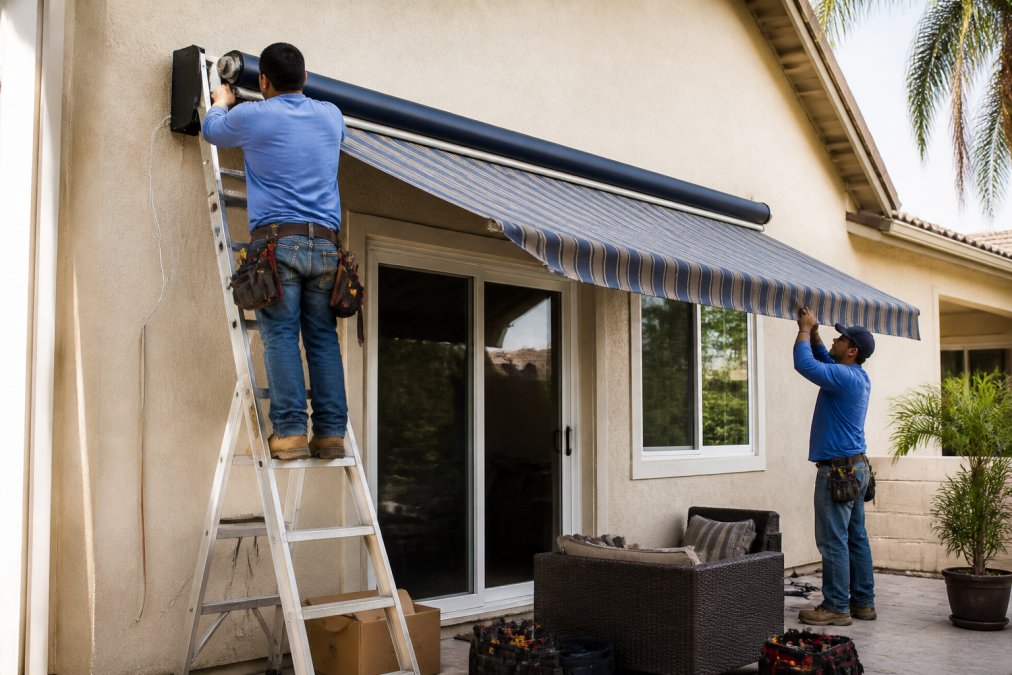
Residential vs Commercial Projects
Residential installation prioritizes appearance and how the awning integrates with the home’s exterior design. Commercial storefront work adds different demands: larger spans, higher wind exposure, ADA clearance considerations, and durability under daily use. A restaurant patio, for example, needs fabric that resists grease and frequent cleaning in addition to sun and salt.
Motorized vs Manual Operation
Motorized operation adds convenience and is worth it for large or hard-to-reach units. Manual crank systems cost less, have fewer failure points, and remain a sensible choice for smaller awnings you can reach easily. Remote control operation also lets you retract the awning quickly when weather turns, which protects the fabric.
Maintenance, Repairs, and When to Replace Your Patio Awnings
Retracting fabric while it’s still wet can lead to premature awning failure in coastal climates. Letting it dry completely helps prevent mildew and seam rot.
Repair or replace? Fix it when the frame is sound and the damage is isolated to stitching, a single panel, or hardware. Replace it when the fabric has lost strength across the span, when corrosion has reached structural members, or when repairs approach the cost of new fabrication. A to Z Awnings & Marine Canvas handles both repairs and full replacements, so an honest assessment comes before a sales pitch.
ROI and Property Value: Do Custom Patio Awnings Pay Off?
1. Usable square footage. An uncovered patio in this climate can be functionally unusable for much of the day during the hottest months. Shade can convert that slab into space a family uses, dining, entertaining, working. Appraisers don’t add line-item value for an awning the way they do for a screened enclosure, but buyers touring homes in summer may notice which patios are comfortable and which are not.
The honest framing: a custom awning is a lifestyle and operating-cost investment first, a resale-value play second. Buyers who expect a dollar-for-dollar bump at sale are usually disappointed; buyers who value the shaded space every weekend for a decade rarely are.
If you’re weighing a residential upgrade against a commercial buildout, the decision criteria are different enough that it’s worth getting a site-specific assessment rather than comparing headline prices.
Frequently Asked Questions
How much does a custom patio awning cost?
Pricing depends on width, fabric choice, retractable or fixed frame, and motorization, so there is no single number. A small manual window awning costs far less than a full motorized patio system with custom fabrication. Sunbrella fabric and corrosion-resistant hardware add to the total but extend service life. Request a free estimate with your patio dimensions and shade goals for an accurate quote.
Are there specific building codes for residential awnings?
Yes. In Broward County, residential awnings typically require a permit and must meet the Florida Building Code wind load requirements for the property’s wind zone. Homeowner association rules may also govern color, projection, and placement. A licensed contractor handles the permit paperwork and provides engineering documentation. Skipping this step can mean fines, failed inspections, or an awning that will not survive a storm.
How do I maintain custom patio awnings in coastal climates?
Rinse the fabric monthly with fresh water to remove salt and pollen, and scrub mild mildew with a soft brush and diluted soap. Keep the frame and hardware free of salt buildup, and lubricate moving parts on retractable units once a year. Retract awnings during high winds and storms. Annual professional inspection catches stitching wear and hardware corrosion before they become expensive repairs.
What is the difference between an awning and a patio cover?
An awning is a fabric or metal shade attached to the exterior wall, often retractable, and typically projects over a door, window, or patio. A patio cover is a permanent roofed structure, such as a pergola or solid roof, supported by posts. Awnings cost less, install faster, and can be retracted. Patio covers offer more permanent weather protection but usually require a larger structural and permitting commitment.