



Table of Contents
- Marine Canvas Repair vs Replacement: The Quick Comparison
- How to Inspect Marine Canvas and Test Whether Fabric Is Still Sound
- Boat Canvas Lifespan: How Age, Fading, and Sagging Change the Math
- When to Repair: Rips, Tears, Holes, and a Marine Canvas Patch
- When to Replace: Zippers, Snaps, Hardware, and Panel Replacement
- Boat Canvas Replacement Cost and Repair Cost: What Changes the Estimate
- Repairability by Material and Damage Type
- DIY Repair vs Professional Work: What You Can Do Yourself
- Frequently Asked Questions
Last Updated: October 5, 2026
Marine Canvas Repair vs Replacement: The Quick Comparison
Marine canvas faces salt, UV, rain, and constant flexing, so the marine canvas repair vs replacement decision comes down to one question: is the fabric still strong, or have only the stitching and hardware failed?
At A to Z Awnings & Marine Canvas, we build and service custom boat canvas, enclosures, and covers. Below, we break down how to inspect your canvas, what each type of damage means, and how to decide.
The single rule that settles most cases: repair when the fabric is still strong and the damage is localized; replace when the fabric itself is weak, shrunken, or failing across multiple panels.
| Situation | Fabric Condition | Best Move | Why |
|---|---|---|---|
| Torn seam, sound fabric | Strong, flexible | Restitch or patch | Cheap fix, keeps original fit |
| One failed zipper or snap | Strong, flexible | Replace hardware | Panel and fabric stay in service |
| Small rip or puncture | Strong, flexible | Patch | Localized damage, low cost |
| Brittle, faded, shrunken canvas | Weak, aged | Replace | Repairs will not hold |
| Multiple panels failing at once | Worn throughout | Replace | Repair cost approaches replacement |
How to Inspect Marine Canvas and Test Whether Fabric Is Still Sound
Start with your hands, not your eyes. A faded fabric can still be structurally fine, and one that looks intact can be dangerously weak. Pull and flex a section: if it feels supple and springs back, it is likely sound.
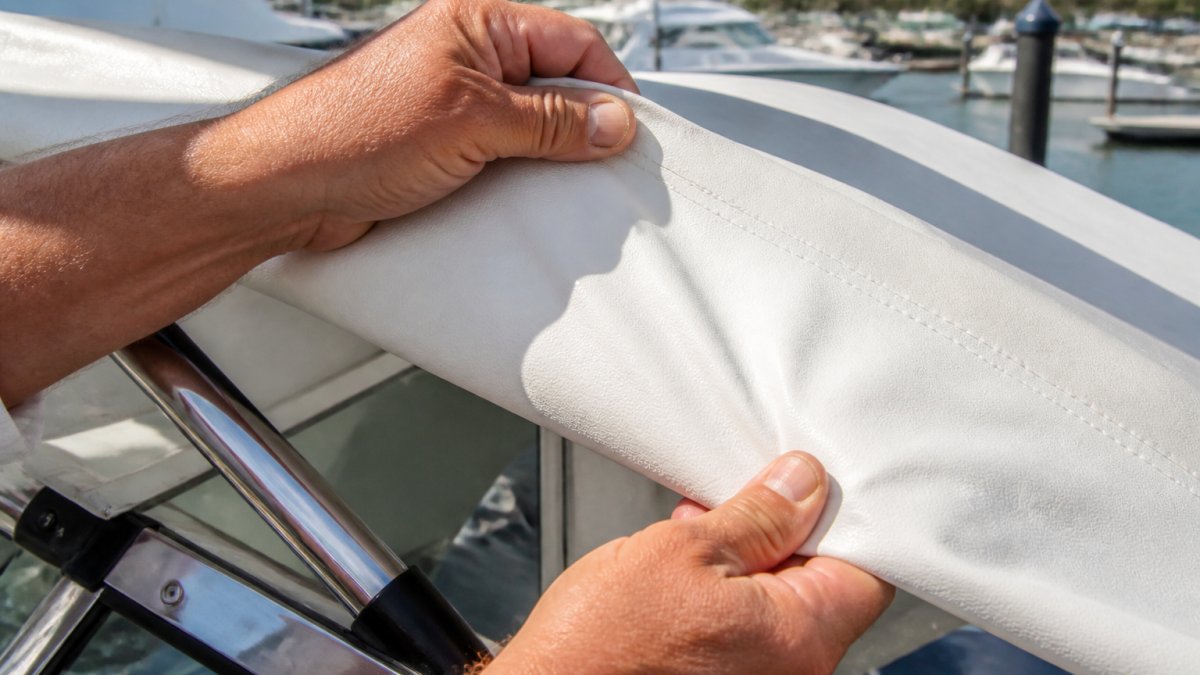
A few checks before you call anyone:
- The pull test: Gently tug at a seam edge. Sound fabric holds; brittle fabric rips.
- The underside check: Mildew, dark staining, and delamination often show underneath first.
- The water test: Spray a small area. If water beads, the finish is intact. If it soaks straight through, water resistance is gone.
The American Boat & Yacht Council standards for canvas and topside equipment are the reference point many marine fabricators work from when judging whether canvas and its fasteners are still fit for service.
Boat Canvas Lifespan: How Age, Fading, and Sagging Change the Math
The decision is not really repair versus replacement. It is how many more seasons you get for the money. A repair that buys one summer is expensive at any price; a replacement that buys a decade is cheap even at a high sticker.
What determines how long marine canvas lasts
Four factors matter most:
- Fabric type. Solution-dyed acrylics are the benchmark for colorfastness and UV resistance because the pigment runs through the fiber. Lighter, uncoated fabrics break down faster.
- Sun exposure. A cover stored under a roof will outlast an identical cover left in open sun. UV is the biggest driver of fabric degradation.
- Thread and stitching. UV degrades thread faster than fabric, so seams typically fail first. A cover can look fine and still be coming apart at every stitch line.
Expected service life after a repair
A repair does not reset the clock on the fabric. It buys time on the specific failure you fixed, while the surrounding material keeps aging. In practice:
- A restitched seam on sound fabric can hold for several seasons.
- A patch on a clean tear in supple material typically holds until the surrounding fabric reaches the end of its life.
- A patch on brittle or sun-degraded canvas often fails within a season, because the patch edge cannot bond to breaking-down material.
Watch for this pattern: each repair on the same cover tends to last less time than the one before it, because the fabric underneath is progressively weaker.
Expected service life after replacement
A full replacement resets everything: new fabric, thread, hardware, and patterning. That is why replacement wins on long-term value once the fabric has aged out, even though the up-front cost is higher.
How to compare the two honestly
Do the math in seasons, not dollars. Estimate how many seasons the repair will realistically buy, then divide the repair cost by that number. Do the same for replacement. The lower cost per season is the better value.
Repair wins when the fabric is sound and the fix is localized. Replacement wins when the fabric has aged out, because a repair on weak canvas buys one or two seasons while a new cover buys many. Compare cost per season, not cost per job.
The signs that the clock has run out
Sagging, leaking, and shrinkage are the three signals that fabric condition has crossed the line. A sagging cover no longer sheds water, so water pools, adds weight, and stretches the fabric further. Leaking usually starts at seams and stitch holes. Shrinkage is the quiet one: canvas that has pulled tight may no longer reach its fasteners or line up with the frame, and no amount of restitching will bring it back.
When to Repair: Rips, Tears, Holes, and a Marine Canvas Patch
Repair is the right call when damage is localized and the surrounding fabric is still strong. A marine canvas patch is the standard fix for small rips, tears, and holes, restoring water resistance and appearance when matched to the original fabric. The patch must bond to sound material; patching brittle canvas fails at the patch edge.
How to Repair a Torn Boat Cover: Steps for Small Damage
Small damage is genuinely DIY-friendly. Here is the sequence we would follow:
- Clean and dry the area fully. Adhesive will not bond to a damp or dirty surface.
- Trim loose threads so the tear lies flat.
- Cut a patch that overlaps the damage by at least an inch on every side.
- Round the patch corners so they are less likely to lift.
- Apply marine-grade adhesive or patch cement per the manufacturer’s instructions.
- Press the patch down firmly and let it cure fully before the cover goes back on.
- Check the repair after the next rain or wash-down.
The most common DIY mistake is patching over a seam or a stress point. Patches placed there peel within weeks because the fabric is still moving under load. Move the patch or reinforce the area instead.
When to Replace: Zippers, Snaps, Hardware, and Panel Replacement
Hardware failure does not mean the canvas is finished. Zippers, snaps, and fasteners wear out faster than fabric, and replacing them is routine service that keeps a good cover in use.
Call us today for a free estimate →
Panel replacement is the middle path. You can see how different shops frame this trade-off in the National Canvas guide to boat canvas repair versus replacement, which makes the same point: repeated repairs eventually cost more than a new cover.
Boat Canvas Replacement Cost and Repair Cost: What Changes the Estimate
Most articles say repair is cheaper than replacement and stop there. That is true, but not useful when you are staring at a quote. The real question is what drives the number, and whether the repair will still be holding in two years.
What you are actually paying for
Every marine canvas job breaks down into five cost buckets. Knowing which apply tells you whether a quote is reasonable.
- Labor time. The biggest variable. A restitch along one seam might take under an hour of bench time; rebuilding a full cockpit enclosure with new panels, windows, and hardware can run into multiple days. Complexity drives the total more than material does.
- Material. Replacement is priced by the square yard of fabric plus clear window vinyl, binding, and reinforcement. Premium solution-dyed acrylics cost more per yard but hold color and strength far longer, which changes the long-term math.
- Patterning and fitting. A replacement cover has to be patterned to your frame, then test-fit on the boat. Patterning is skilled work, which is why two covers that look identical in photos can quote very differently. Repairs usually skip patterning unless a panel is being rebuilt.
Why repair and replacement quotes are not directly comparable
A repair quote covers a small, defined area; a replacement quote covers the whole cover, including patterning, all hardware, and full installation. The gap can look enormous on paper but narrows once you account for how long each option lasts.
A common pattern: a cover needing its third or fourth repair in two seasons is already costing more per year of service than a replacement would have.
Factors that push a quote up or down
- Panel count and geometry. More panels and tighter curves mean more patterning and more seams to seal.
- Window vinyl. Large clear panels cost more in material and labor, and vinyl has a shorter service life than the canvas around it.
- Frame condition. A bent or corroded frame has to be corrected before new canvas will fit, and that is separate work.
When you compare a repair quote to a replacement quote, ask each one for the expected service life of the work. A repair that buys two seasons and a replacement that buys ten are not the same purchase, even if the repair is a fraction of the price.
Because every boat and enclosure is different, a real number requires seeing the job. Send photos of the damage, the frame, and the full cover, and a shop can usually tell you which side of the repair-or-replace line you are on before anyone drives out.
Repairability by Material and Damage Type
Not all canvas is equally repairable, and the material matters as much as the damage. Heavier, coated marine fabrics hold patches and stitches well when still supple. Lighter fabrics and older, sun-degraded material are harder to repair because the surrounding area cannot support the repair. A clean tear repairs better than a frayed, spreading rip, and a failed seam better than a torn panel.
| Damage Type | Repairable? | Best Fix |
|---|---|---|
| Failed seam, sound fabric | Yes | Restitch |
| Small rip or puncture | Yes | Patch |
| Broken zipper or snap | Yes | Hardware replacement |
| Single failed panel | Yes | Panel replacement |
| Brittle or shrunken fabric | No | Full replacement |
| Multiple failing panels | Rarely | Full replacement |
DIY Repair vs Professional Work: What You Can Do Yourself
Small repairs are within reach for most boat owners. Patching a clean tear, replacing a snap, or treating a minor seam is realistic with the right materials and patience.
Our honest advice: patch small damage yourself if you are comfortable, and bring anything involving seams, zippers, or panel replacement to a shop. A failed DIY seam repair can let water into the boat, a far more expensive problem than the original tear.
The hard part of marine canvas repair vs replacement is not the work, it is the judgment call, and getting it wrong costs you either money or another failed cover. At A to Z Awnings & Marine Canvas, we manufacture and service custom marine canvas, from full enclosures to individual panel repairs, using premium Sunbrella fabrics backed by a 10-year warranty on both workmanship and materials.
Frequently Asked Questions
How much does it cost to replace a boat canvas?
Boat canvas replacement cost depends on size, material, and whether you need a full cover system or individual panels. Small repairs are generally less costly than larger or more complex repairs. A full replacement costs more because it involves new fabric, restitching, and hardware. Request a written quote so the estimate reflects your boat’s exact dimensions and enclosure type.
What is the best patch for repairing a canvas boat cover?
The best marine canvas patch matches the original fabric type and is applied with proper adhesive or stitching. Peel-and-stick patches work for temporary fixes, but a stitched patch on sound fabric lasts longer and maintains water resistance. For Sunbrella or similar acrylic canvas, use a patch of the same material and restitch it along the edges. If the surrounding fabric is brittle or faded, a patch may not hold, and replacement becomes the better option.
How do you know when boat canvas needs to be replaced?
Replace boat canvas when the fabric fails a strength test, meaning it tears easily when pulled or feels brittle. Other signs include widespread fading, shrinkage that no longer fits the frame, sagging that collects water, and thread failure along multiple seams. If damage is limited to one zipper or a small tear on sound fabric, repair is worth it. When deterioration is broad, replacement delivers better long-term value than repeated patches.
Can a marine canvas enclosure be repaired?
Yes, most marine canvas enclosures can be repaired when the fabric itself is still sound. Common fixes include restitching seams, replacing zippers and snaps, and patching isolated rips or holes. A cockpit enclosure with one failed zipper and good fabric is a strong repair candidate. If the enclosure has shrunken, the panels no longer align, or the fabric tears at the seams, replacement of individual panels or the full system makes more sense.
Is it worth repairing an old boat cover?
It depends on fabric condition and repair scope. Repeated repairs can eventually cost more than replacement, and some damage is too severe for patching. Repair makes sense when the canvas is young, the damage is localized, and the fix restores water resistance. Replacement wins when the fabric is old, weak, or broadly deteriorated. A professional assessment gives you a clear repair-versus-replace recommendation before you spend.